
Grow Your Business
Tree Service Storm Response: How to Dispatch Emergency Crews Without Wrecking Your Maintenance Schedule
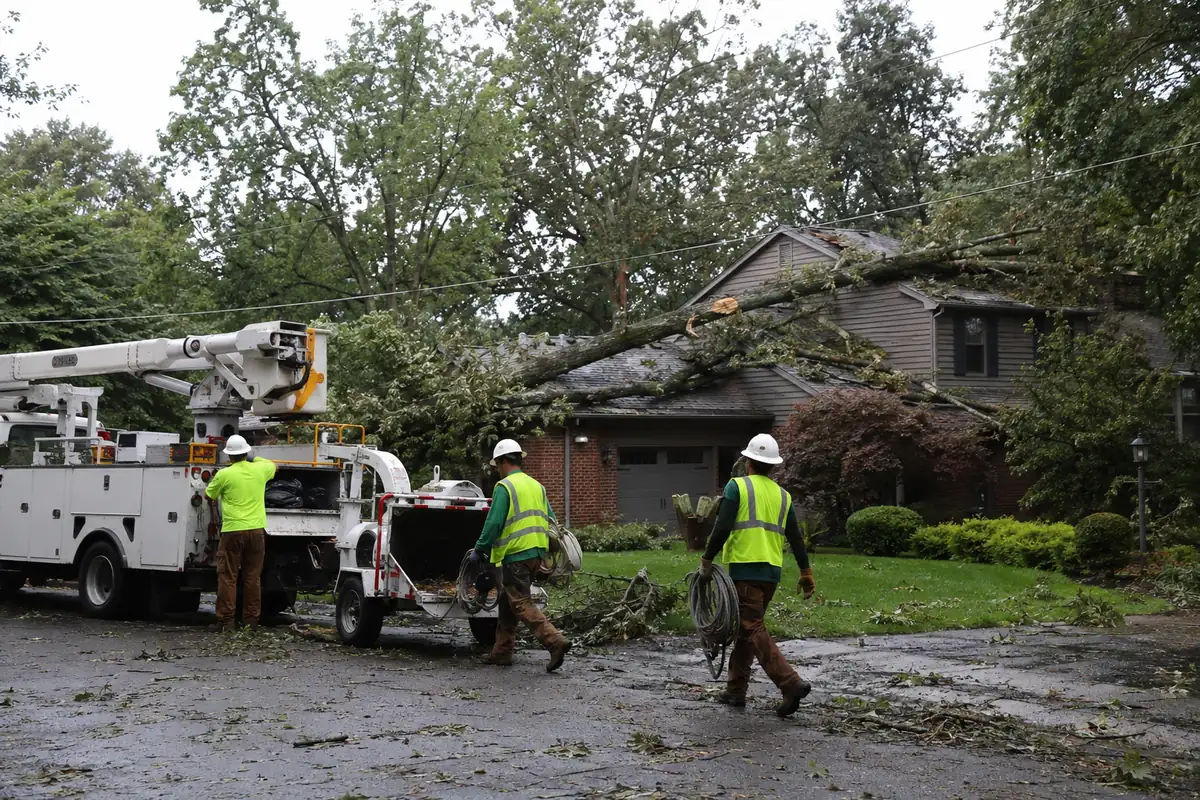
A line of storms blows through on a Tuesday night, and by 6 a.m. your phone has 47 voicemails, 22 texts, and four homeowners in your front yard waving photos of the maple branch on the roof. Meanwhile, three of your crews are already booked in your tree service scheduling app for routine pruning you quoted six weeks ago. This is the moment tree service storm response either makes your year — high-margin emergency work, fast insurance payouts, neighborhoods full of new customers — or breaks it, because canceled maintenance jobs, burned-out crews, and double-booked equipment cost more than the storm windfall earns.
The difference is not luck. It is a dispatch playbook your office, foremen, and homeowners can follow without you personally answering every call. Here is how high-performing tree service businesses are running that playbook in 2026.
Why Storm Response Is the Make-or-Break Workflow for Tree Service Businesses
Storm calls aren’t just more revenue — they are a different kind of revenue with a different operating model. Emergency tree service dispatch typically earns 1.5x to 3x standard rate, with 25%–40% margins when crews are deployed efficiently. Insurance-funded removals invoiced through tree service invoicing software settle in days, not 60–90 days like residential invoicing. A single storm week can equal a slow month on the planned-work calendar.
The trap: every truck and climber you redeploy is a maintenance customer who got pushed. Owners who reschedule planned pruning four or five times — because the next storm hits before they catch up — lose those accounts to whoever calls back consistently. The win condition is capturing storm revenue and protecting your maintenance base, which means treating them as parallel lanes that share equipment and people, not one first-come, first-served queue.
A second factor: tree work is among the most dangerous jobs in the U.S., and storm conditions make it more dangerous. A 2 a.m. dispatch to a leaning oak over a powerline is not the same job as a Tuesday morning crown reduction. Your playbook needs explicit go/no-go criteria, or you will eventually send a tired crew into work they shouldn’t have taken.
Build a Dual-Track Schedule: Maintenance and Emergency Lanes
The single biggest fix most tree service businesses can make is to stop running one schedule and start running two. Use a tree service scheduling system that lets you tag jobs as “planned” or “emergency” and assign different crews, vehicles, and even pricing tables to each lane.
A practical setup:
- Planned lane. Recurring pruning, scheduled removals, stump grinding, arborist consultations. Booked 2–6 weeks out. Fixed crew assignments. Standard pricing.
- Emergency lane. Storm response, hazard trees, insurance removals. Booked 0–48 hours out. Pool of “storm-qualified” crew on rotating on-call. Premium pricing with a documented surge multiplier.
- Swing crew. One or two crews that move between lanes. Usually your best foremen — fast, safety-conscious, and trusted when a job changes shape.
When a storm hits, swing crews shift to emergency for 48–72 hours. Planned-lane crews keep cutting work you already promised. Planned customers don’t get cancelled; emergency customers don’t wait two weeks. This dual-track structure is the prerequisite for everything else here.
The 24-Hour Storm Dispatch Workflow
When the storm has actually hit, the first 24 hours decide your week. Most owners try to run this by phone, in their head — and it falls apart by 10 a.m. A documented workflow keeps dispatch and the field on the same page.
Hour 0–2: Intake triage
Stand up a single intake channel — one phone number, one form on your site, one email — and route everything through it. Use a simple triage script: address, photos, immediate hazard (yes/no), structure or vehicle damage (yes/no), powerline involvement (yes/no), insurance carrier. Capture this once in your tree service crm software and stop calling the homeowner back for the same details. A tree service CRM that lets the intake person attach photos to the customer record is worth its weight in saved phone calls.
Hour 2–6: Dispatch priority queue
Order the queue by hazard, not by call time:
- Active hazard — tree on house, tree on vehicle, tree on powerline (after utility clears the line)
- Blocking hazard — tree across driveway or road
- Standing hazard — leaning or split trees that could fall on a structure
- Cleanup — large limbs and debris with no immediate hazard
Assign emergency-lane crews to category 1 first. Push category 4 to a separate “cleanup crew” that travels with a chipper and a skid steer and runs through neighborhoods systematically. Mixing categories on one truck wastes the climbers on hauling brush.
Hour 6–24: Customer status updates
Every customer who reported a hazard wants to know when you’re coming. Send a status text within 4 hours, even if it says “you’re in category 3, expect a foreman tomorrow.” Silence is what makes them call a competitor. A tree service business with field service software that sends automated arrival windows out-converts one that doesn’t, every time, in storm conditions.
Crew Routing, Equipment, and Communication During Storm Response
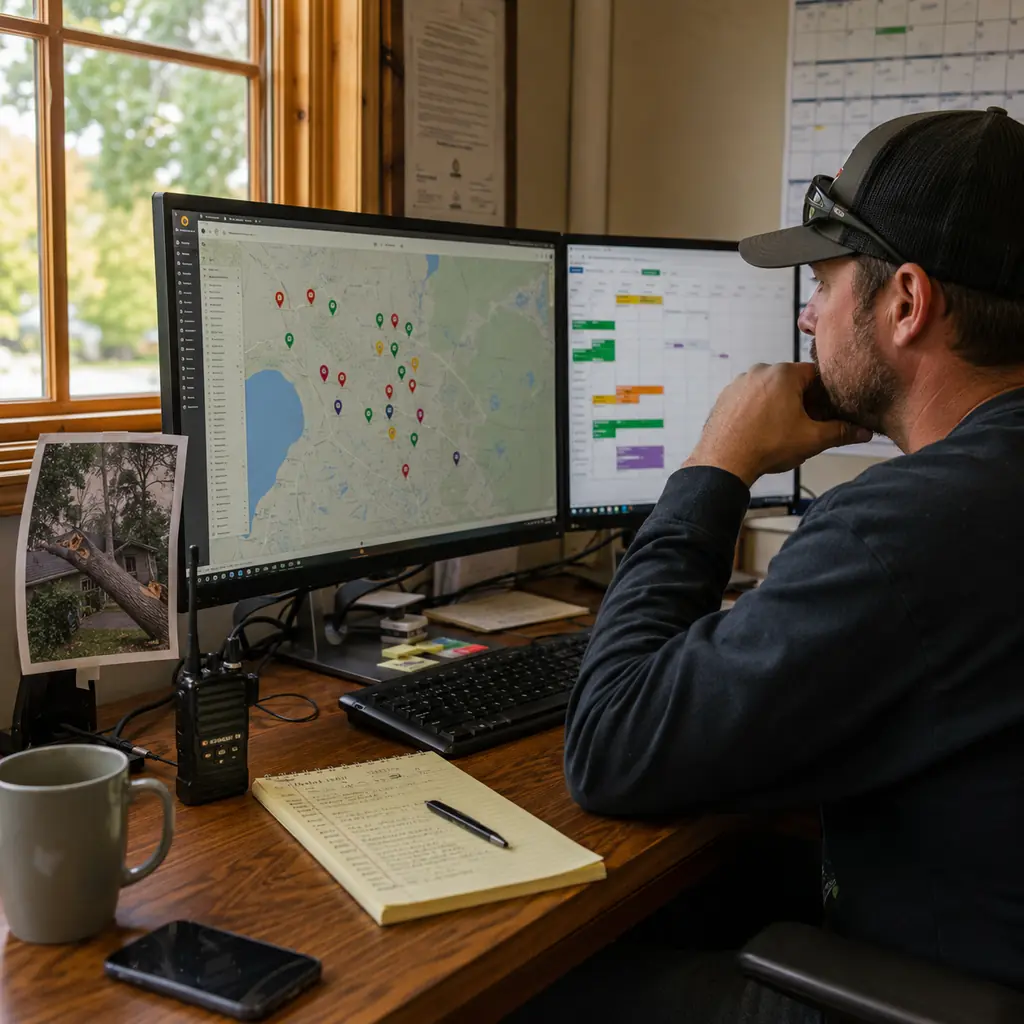
Once the queue is set, the operational question is simple: are your crews moving or sitting? In storm response, crew utilization is the single number that drives margin. A crew with a loaded chip truck and a clear next address bills 9 productive hours a day. A crew waiting on directions, missing gear, or a dispatcher callback bills 5.
Route emergency stops in tight clusters
Tree service routes during storms should look like dense ZIP-code clusters, not the spread-out maintenance routes you run in calm weather. A storm dumps damage in neighborhoods, not evenly across a metro. Route a single emergency crew through 6–10 stops in one subdivision before sending them across town. This is where modern dispatch software earns its cost — it groups jobs geographically and updates the route as new calls land.
Pre-stage equipment
Before the next forecasted storm, pre-load each emergency truck with a 70-foot crane-rated rigging kit, two backup saws, a generator, traffic cones, and a printed property damage release form. The 20 minutes a foreman spends hunting for a missing rigging line on storm morning is 20 minutes you don’t have.
Use one channel for crew comms
Pick one channel — Slack, group SMS, or your FSM’s built-in messaging — and run every storm update through it. Foremen check it; dispatch updates it; the owner reads it. No side calls. The point isn’t the tool; it’s the discipline of a single source of truth.
Ready to level up your business?
Try Bella FSM free and transform the way you work.
Invoicing, Insurance, and Documentation: Capturing Every Dollar
A significant share of storm work is paid by homeowner’s insurance, so the job isn’t done when the chipper stops — it’s done when the carrier cuts the check. Tree service businesses that nail this step turn storm weeks into the most profitable revenue of the year. Those that don’t chase payment for 90 days on work that already strained their crews.
Photo-document everything
Before, during, and after photos on every storm job, geotagged and timestamped. The carrier needs to see the tree on the structure, the cut sections being lowered, and the cleared site. Without those photos, claims get reduced or denied. Your crews should know that a job isn’t closed until the photos are uploaded.
Generate the invoice on-site, not next week
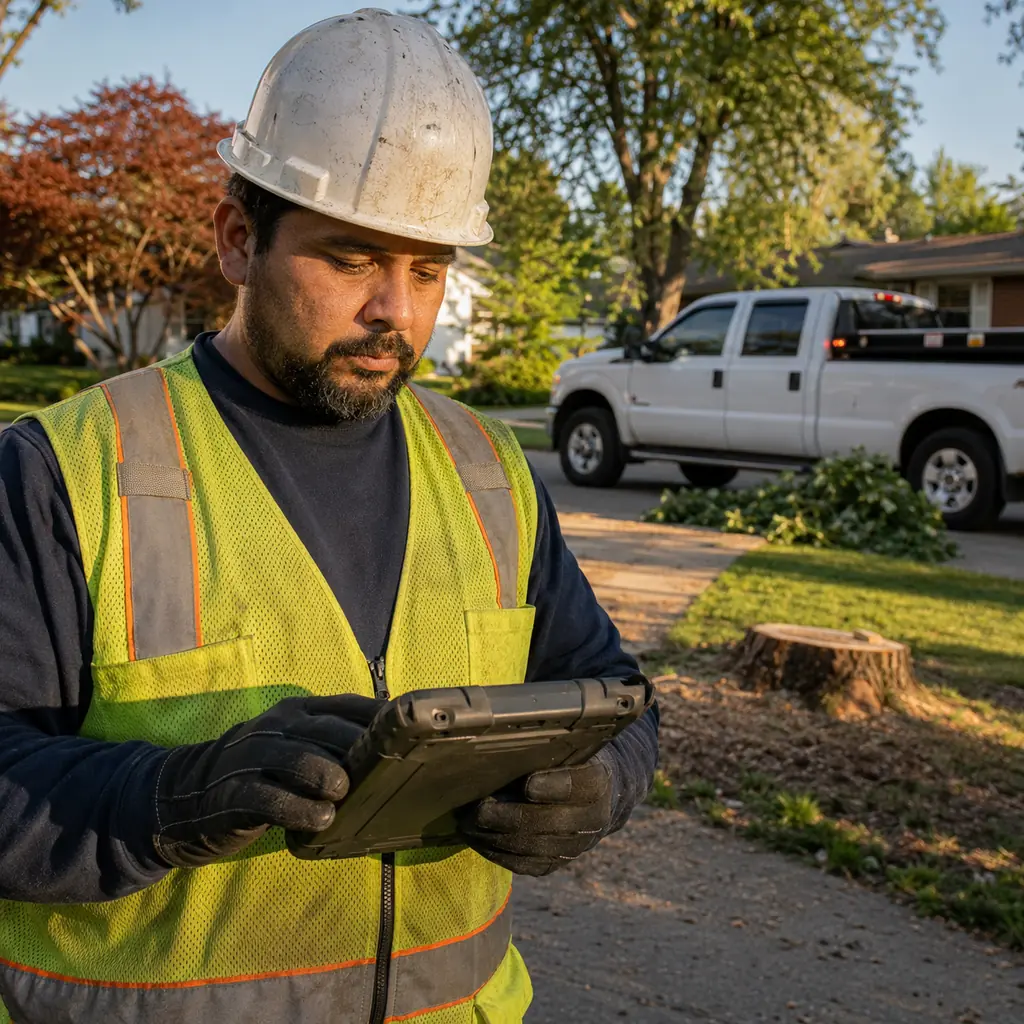
The closer the invoice is to the job, the faster it gets paid. Use a mobile tree service invoicing tool that lets the foreman build the invoice on a tablet, attach the photos, get a signature, and email it to the customer and the insurance adjuster before the truck pulls out of the driveway. Same-day invoicing typically cuts collection time from 30+ days to under 14 in storm work.
Use a deposit and a release
For storm jobs over $2,500, collect a 25%–50% deposit before climbing. For any job that involves dropping wood near structures, get a signed property damage release. Both are standard in the industry and both protect you from the small percentage of customers who try to renegotiate after the work is done.
Common Mistakes That Cost Tree Service Owners Money
Five patterns that show up in nearly every post-storm review:
- Skipping intake triage and dispatching whoever called the loudest. Loud doesn’t equal hazardous. Hazardous equals hazardous. Triage every call.
- Canceling maintenance jobs to chase storm work. The maintenance customer remembers being canceled. The one-time storm customer doesn’t remember you next year. Protect the planned lane.
- Underpricing emergency work. Set your surge rate in writing before the storm hits — 1.75x or 2x — and stick to it. Negotiating each job in the moment leaves money on the table and creates inconsistent quotes within the same crew.
Ready to take your business further?
Try Bella FSM free and transform the way you work.
- Letting crews freelance. A climber who takes a side cash job during a storm week is a workers’ comp claim waiting to happen and a customer record never created. Make the rule explicit and enforce it.
- Not following up after the storm. Every storm customer is a potential maintenance customer. Send a thank-you with a quote for ongoing tree health care within 14 days. Conversion rates of 15%–25% from storm-to-maintenance are realistic.
If you’re newer to running a tree service and your storm playbook is still informal, our tree service business start-up guide covers the pricing, licensing, and crew-structure foundations everything in this article builds on.
Tree Service Storm Response: FAQs
Tree service storm response rewards businesses that have already invested in the workflow — separate maintenance and emergency lanes, a documented dispatch playbook, mobile invoicing tied to insurance documentation, and a CRM that captures every photo and customer note in one place. If your office is still running on a whiteboard and your foreman’s cell phone, see how Bella FSM’s tree service software brings dispatch, scheduling, CRM, and invoicing into a single platform built for trade businesses.
Ready to grow your business?
Try Bella FSM free and transform the way you work.