
Grow Your Business

For an electrical contractor, a permit is not a piece of paper. It is a starting whistle. Until the city stamps it, you cannot pull wire, you cannot pass an inspection, and your electrical contractor invoicing software cannot bill the customer. A backlog of pending permits is a backlog of frozen revenue.
Electrical permit tracking has quietly become one of the most expensive workflow problems in the trade. Multi-jurisdiction project loads, paperwork-heavy submittals, and inspector schedules that change without warning all compound into approval times that stretch from days to weeks. According to NAHB's 2025 Technology Adoption Survey, 34% of residential contractors now run on dedicated permit tracking systems — up from just 11% in 2022 — because the manual chase is no longer sustainable.
This guide lays out a permit tracking workflow that holds up at scale, the metrics that show whether it is working, and the mistakes that quietly kill velocity.
Why Electrical Permit Tracking Has Become a Bottleneck
Permits used to be a side task — pulled by an office admin between phone calls. That works at five jobs a month. It collapses fast at fifty.
Three trends have made the workload heavier:
- Multi-jurisdiction sprawl. Residential electricians chasing EV charger, panel upgrade, and solar interconnect work often submit to a dozen different cities and counties in a quarter. Each one wants a different form, fee schedule, and routing.
- Higher-touch reviews. Service upgrades, smart panels, and generator interconnects pull plan-review attention that simple repair permits used to skip.
- Inspector calendar volatility. Backlogged inspectors reschedule with little notice, and a missed inspection can push a job — and its final invoice — back a full week.
The industry data is hard to argue with. Procore's 2024 productivity report tied automated permit tracking to a 40–60% reduction in approval time. NAHB's contractor survey found that firms without a tracking system reported an average of $9,600 in lost productivity per permit dispute. A single forgotten inspection on a $42,000 service upgrade can convert margin into rework overnight.
The fix is not more headcount. It is a workflow that codifies what your best office coordinator does in her head, so the rest of the team — and your software — can run it without her.
Build the Backbone: A Five-Stage Permit Tracking Workflow
Treat every permit like a mini-project with a defined lifecycle. Five stages move it from estimate to archive.
Stage 1 — Pre-bid jurisdiction check
Before the estimate ever leaves your office, the coordinator (or your software) flags which jurisdiction owns the address, the likely permit type, fees, plan-review SLA, and any pre-application requirements. This goes into the estimate as a line item and a timeline note. Your customer hears about permits before signing — not three weeks later when wire is sitting in the truck.
Stage 2 — Application packet assembly
Each jurisdiction needs a standard packet: scope of work narrative, load calc, single-line diagram, panel schedule, and any product cut sheets. Build a library of templates per jurisdiction so the packet drafts itself once a job kicks off. The estimator's notes flow directly into the application, eliminating the rework that happens when someone has to translate a sales-stage scope into a permit-stage scope.
Stage 3 — Submission and tracking
The permit is filed, the application number is captured against the job record, and a stage-aware reminder fires every two business days until the city issues. This is where a good electrical contractor scheduling software earns its keep — the same record powers the work-in-progress board, so dispatch never schedules a crew before the permit is issued.
Stage 4 — Inspection scheduling
Rough-in and final inspections are calendar events on the job, not Post-It notes on a desk. Tie inspection requests to crew availability so the request you submit aligns with the day you can actually have a journeyman on site. When the inspector reschedules, the crew gets rerouted automatically through your dispatch software instead of standing idle.
Stage 5 — Close-out and archival
Once the final is signed, attach the inspector's sign-off to the job, trigger the invoice, and archive the full permit packet. Most disputes that ate $9,600 in productivity in the NAHB survey started here — at close-out, where the trail goes cold.
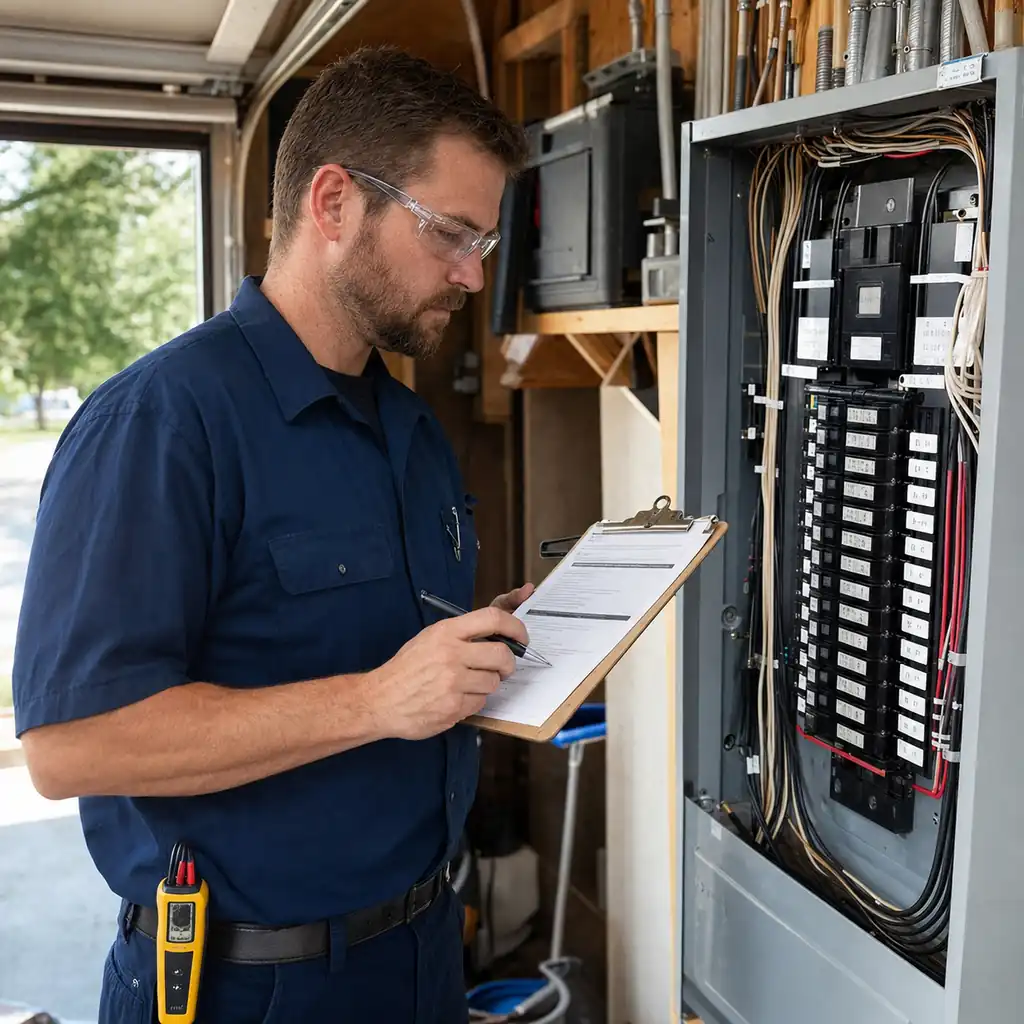
Tools That Make the Workflow Stick
A spreadsheet can survive a handful of permits. The minute you cross twenty open at once, every gap becomes a leak. The tools that hold up:
- A connected job record. The permit does not live in a separate system. It is a tab on the job, alongside the estimate, work order, and customer notes. When the office updates the application status, the field crew sees it in the mobile workforce management app on the way to the site.
- Jurisdiction profiles. A library of cities and counties with their forms, fee schedules, SLA, online portal links, and inspector contact info. Update it as you encounter changes; let your software treat it as a lookup, not tribal knowledge.
- Reminder cadences. Two-business-day pings on stalled applications, 48-hour confirmations before inspections, and 24-hour customer texts so they know to give the crew yard access.
- Work order linkage. Schedule a crew only against jobs whose permit is issued, or whose jurisdiction allows pre-permit prep work. Your work order software should make this filter native.
- Document storage. Cut sheets, single-line diagrams, and load calcs live with the job — not in someone's email — so reassembling a packet for a similar future job takes minutes, not hours.
Each tool removes a human step that used to be the failure point.
Ready to level up your business?
Try Bella FSM free and transform the way you work.
Metrics Every Electrical Contractor Should Watch
If you only watch revenue and AR aging, you will miss the leading indicators of a permit backlog forming. Track these instead:
- Average days to issuance, by jurisdiction. A city creeping from 5 days to 12 is telling you to adjust your sold timelines and customer expectations.
- Open permit count, and aged-over-30-days count. The aged bucket is where dispute-prone permits hide.
- Inspection pass rate, first try. Anything below 85% means rough-in checklists are slipping.
- Permit-to-invoice cycle time. From application submitted to final invoice paid. Cutting this by even five days at scale frees real working capital.
Review weekly with your operations lead. Permits do not fix themselves; they fix when someone owns the number.

Common Mistakes That Sabotage Permit Velocity
Even shops that buy good software still trip on the same recurring mistakes:
- Treating permits as an admin task. When the office coordinator is the only one who knows where a permit stands, you have a single point of failure. Move status into the shared job record.
- Skipping the scope-to-application translation. Estimators write for the customer; cities want load calcs and code references. If the estimate does not capture permit-grade detail, every application becomes a rewrite.
- Booking inspections too aggressively. Lining up a rough-in two days after submission, before the jurisdiction has even cleared plan review, leads to wasted truck rolls.
- Letting close-out slide. A permit that never closes is a future code dispute. Close-out is the cheapest insurance you will buy.
- Ignoring the estimate electrical work feedback loop. When permit timelines blow estimates, your pricing model is wrong — feed real data back into the estimator's defaults.
Ready to take your business further?
Try Bella FSM free and transform the way you work.
Putting the Workflow Into Practice
Roll it out in three sprints, not one big-bang migration. In the first sprint, document your existing process and stand up the jurisdiction library — even if the rest is still paper-based. In the second sprint, move the permit record onto the job inside your electrical contractor CRM so status is visible to estimators, dispatch, and field techs. In the third sprint, wire up the reminder cadences and inspection-to-crew linkage in your electrical contractor scheduling app so the workflow runs itself.
By the end of 90 days, expect your aged permit count to drop, your inspection pass rate to climb, and your permit-to-invoice cycle time to compress. That is revenue, freed.
Frequently Asked Questions
Run Your Permits Like a Workflow, Not a Fire Drill
Permit tracking is one of those electrical contractor problems that hides until you scale. At five jobs a month, you fix it with a Post-It and a coffee. At fifty, you cannot fix it with anything except a workflow that runs without you. Stage it out, instrument it with the right metrics, and let your software shoulder the reminders so your office team can spend time on revenue work instead of paperwork chasing.
Ready to put a real permit tracking workflow behind your jobs? Explore how Bella FSM's electrical contractor software and connected scheduling, invoicing, and dispatch tools keep every permit on a clock.
Ready to grow your business?
Try Bella FSM free and transform the way you work.