
Grow Your Business
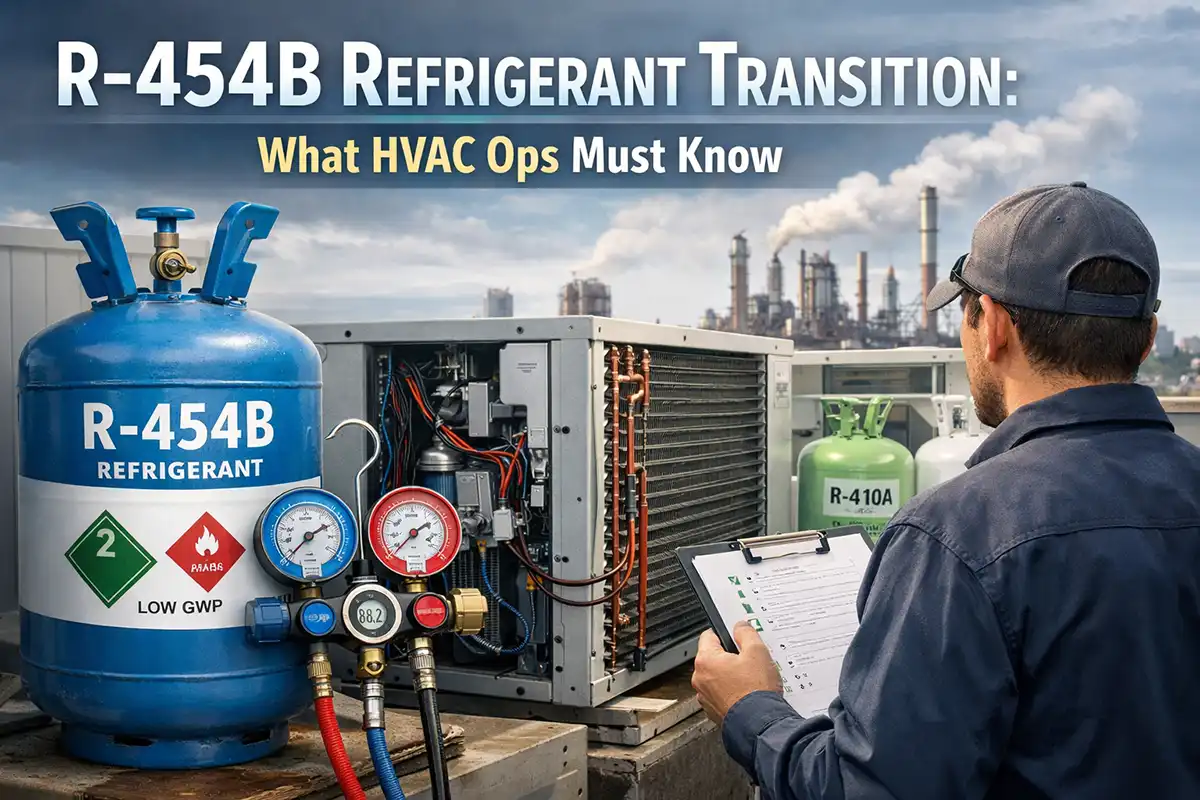
Most coverage of the R-454B refrigerant transition treats it as a technical story — new cylinders, new tools, new pressures. That is only half of it. The real problem for HVAC contractors in 2026 is an operational one. R-454B is forcing contractors to track more data per job, manage tech certifications more carefully in your hvac scheduling software, reprice quotes more often, and keep cleaner audit trails than they ever have before.
Contractors running modern field service management software are absorbing the R-454B transition as a workflow update. Contractors still running on spreadsheets, whiteboards, and paper tickets are absorbing it as a crisis — missed refrigerant costs, technicians dispatched without the right certifications, and no way to prove to the EPA what was installed, where, and by whom.
This guide walks through the operational side of the R-454B transition — what changed, where it hits your business, and how modern HVAC operations teams are managing it without bleeding margin.
A Quick Primer on R-454B and the January 2026 Deadline
R-454B is a low-GWP A2L refrigerant blend (roughly 68.9% R-32 and 31.1% R-1234yf) designed to replace R-410A in residential and light-commercial HVAC systems. As of January 1, 2026, new ducted systems installed in the U.S. must use refrigerants with a GWP below 700, which in practice means R-454B or R-32 for most new equipment.
The regulatory timeline is not the interesting part — every HVAC trade publication has covered it. The interesting part is what it does to how a contracting business actually runs on a Tuesday morning.
Five Operational Challenges the R-454B Transition Creates
Every HVAC contractor we talk to is dealing with some version of the same five operations problems this year:
- Dispatching the wrong tech to an A2L job — a technician without current A2L certification sent to an R-454B install or service call.
- Quoting jobs with stale refrigerant pricing — estimates written against last quarter’s cylinder costs, locked in before the customer signs.
- Losing track of refrigerant type per system installed — especially painful when a warranty call comes in two years later.
- Missing EPA reporting and leak-record requirements — the paperwork expectations for A2L systems are tighter than R-410A ever required.
- Customer communication at scale — explaining to every homeowner why the install looks different, without every tech telling a different story.
Each of these is a software problem before it is a technical problem. Let’s walk through how field service management software solves them.
1. Dispatching Jobs by Tech Certification
In the R-410A era, “Any HVAC tech can take this call” was mostly true. In the R-454B era, it is not. A2L-certified techs have taken specific training on A2L charge limits, leak detection, ventilation mitigation, and A2L-rated tool usage. A non-certified tech showing up to an A2L job is a liability problem, a warranty problem, and potentially a compliance problem all at once.
Modern HVAC operations teams are solving this by tagging every tech in their field service software with their current certifications and expiration dates, then routing jobs to only the techs who are qualified. When a homeowner calls with an R-454B system under warranty, the dispatch board automatically filters out techs whose A2L certification has lapsed.
The certification-aware dispatch workflow is one of the highest-ROI changes an HVAC contractor can make in 2026. If your current dispatching is “whoever is closest,” look at how HVAC software handles technician skill and certification tagging — the dispatch logic alone can eliminate most of the A2L assignment risk.
2. Keeping Quotes Current When Refrigerant Costs Move Weekly
R-454B cylinder pricing moved more than 300% from late 2024 to peak shortage in Q3 2025, and while prices have softened in 2026, spot shortages still cause sudden spikes. Contractors who locked in quotes at last month’s refrigerant cost and honored them without a re-look are the ones losing 4–7 points of margin on every install.
The operational fix is two things:
- A line-item refrigerant cost that pulls from a central, centrally-updated price reference inside your hvac invoicing software — not a hard-coded number buried in every estimate template.
- A quote-aging rule that flags any estimate older than 14 days for a refrigerant-price re-check before it is presented to the customer.
Both are trivial inside a purpose-built FSM platform and nearly impossible inside a spreadsheet. The contractors who are not updating estimating templates centrally are the ones sending out quotes with refrigerant math that is weeks out of date.
For a deeper walkthrough of how to structure HVAC pricing to stay margin-safe during volatile cost periods, see How to Price HVAC Jobs.
3. Tracking Refrigerant Type on Every Work Order
Every install from 2026 forward will have a 15–20 year service life. Two years from now, when a homeowner calls about a system that is short on charge, the tech rolling the truck needs to know in 10 seconds whether they are looking at R-410A, R-454B, or R-32 — and whether their cylinder matches.
An hvac crm software solves this by pinning the refrigerant type (and quantity) to the equipment record at install time. Every future service call against that system loads the refrigerant type on the work order before the tech even leaves the shop. This is not a “nice to have” feature in 2026 — it is the difference between a clean repair call and a tech driving back to the shop to swap out cylinders.
The bonus: refrigerant data tied to equipment records makes annual EPA reporting a query instead of a project. Which leads to the next problem.
4. EPA Reporting and Audit Trails You Can Actually Produce
A2L systems carry tighter paperwork expectations than R-410A ever required. Depending on your state and the size of the systems you work on, contractors may be asked to produce:
- Refrigerant type and pounds charged per installation
- Recovery records for refrigerant removed from existing systems
- Leak inspection and repair records for systems above certain charge thresholds
- Technician certification records tied to specific jobs
- Safety Data Sheets (SDS) in the truck and available on request
Paper-ticket operations can build these audit trails — painfully, after the fact, over two or three weekends. Modern operations build them as a byproduct of the work itself. Every completed work order captures the refrigerant data, every tech’s assignment captures the certification context, every service visit captures the leak-check result, and the annual EPA report is a filter, not a project.
If your current system cannot produce this information in under an hour when asked, that is an operational risk worth fixing before 2027.
5. Customer Communication at Scale
In 2024, homeowners rarely asked about refrigerant. In 2026, they ask about it on almost every install. Some of them have read enough to be dangerous; many just want reassurance. A modern HVAC contractor is having a version of the same conversation dozens of times a week — and a modern operation makes sure every tech tells the same story.
The operational fix looks like:
- A saved customer communication template (in the estimate, in the confirmation email, and in the post-install handout) that explains R-454B in plain language.
- Automated pre-install and post-install SMS that sets expectations before the tech shows up and confirms the system details afterward.
- A knowledge base snippet techs can pull up on their tablet during the install to answer the “is it flammable?” question consistently.
Consistent customer communication is less visible than dispatch or pricing, but it is one of the things that separates a business that scales comfortably through the transition from one that does not.
Where Are You on the A2L Operational Readiness Curve?
A quick gut-check — which column describes your current operation?
| Operational Area | Exposed | A2L-Ready |
|---|---|---|
| Tech dispatch | Nearest tech, manual check | Certification-filtered auto-dispatch |
| Refrigerant pricing | Hard-coded in templates | Centrally updated, flags stale quotes |
| Refrigerant tracking | Handwritten in service notes | Pinned to equipment record |
| EPA reporting | Weekend reconstruction project | Filtered report on demand |
| Customer communication | Every tech tells a different story | Templates + automated touchpoints |
Two columns of “Exposed” is a project plan. Four or five columns of “Exposed” in April 2026 is a margin problem that will get worse every quarter.
What About the Technical Side — Tools, Training, Licenses?
The technical side of the A2L transition matters, but it is largely a checklist. Most contractors have worked through at least part of it by now. For quick reference:
- A2L-rated manifold gauges, recovery machines, vacuum pumps, leak detectors, and dedicated A2L recovery cylinders are the minimum truck-stock change.
- Techs who certified before 2023 should refresh with an A2L update course (distributors and manufacturers offer these, often free).
- Baseline state HVAC licensing did not change — but it is a good time to verify every tech’s license and certification records are current.
For the full core tool kit, see Best HVAC Tools for Techs and Contractors. For state-level licensing requirements, see HVAC License Requirements.
Frequently Asked Questions About the R-454B Transition
The Bottom Line: R-454B Is an Operations Test
The contractors who are going to come out of the R-454B transition stronger are not the ones with the best technical knowledge of A2L refrigerants. They are the ones with the best field service operations.
Three things to do this quarter:
- Audit your dispatch system. Can you filter job assignments by current A2L certification? If not, that is the highest-ROI fix.
- Pull a random estimate from two weeks ago. Does the refrigerant cost in it still reflect current reality? If it does not, fix the pricing workflow before any more quotes go out.
- Try to produce a list of every R-454B install you have done in the last 90 days, the refrigerant quantity charged, and the tech who did the work. If that takes longer than an hour, your system is not ready for 2027 EPA reporting.
Modern hvac business software is built to handle all three of those workflows without extra effort. If your current system is making the R-454B transition harder than it needs to be, that is your answer.
For broader context on where HVAC operations are heading this year, see our HVAC Industry Trends and HVAC Trends Changing 2025–2026 coverage.
Ready to take your business to the next level?
Try Bella FSM free and see how it transforms the way you work.