
Grow Your Business
How to Price Pool Service Jobs in 2026: Chemicals, Routes, and Recurring Profit
If you want to know how to price pool service jobs in 2026 without leaking margin, the short answer is: stop using one number. Chlorine prices are volatile, tariffs are squeezing imported equipment, and customers compare rates on Google before picking up the phone. If you are pricing weekly maintenance with the same flat rate you used in 2023, you are losing money on every other stop. The operators winning right now are not the cheapest — they price every job around three numbers (drive time, chemical cost, recurring lifetime value) and let software handle the math. This guide walks through how to price pool service jobs so your route is profitable on the first stop and the fiftieth.
Why 2026 Is the Year to Rethink Your Pricing
Three forces are colliding at once for pool service owners:
- Chemical volatility. Trichlor tabs, liquid chlorine, and stabilizer have all swung double-digit percentages in 12 months, and most distributors no longer guarantee 90-day pricing.
- Tariffs on equipment. Roughly 47% of pool pros expect modest cost increases on imported pumps, filters, and salt cells in 2026, and another 18% expect significant increases.
- Smarter customers. Homeowners use AI search results to compare local quotes in seconds. A vague flat rate looks suspicious next to a competitor who itemizes water testing, chemicals, and labor.
Flat-rate weekly maintenance was built for a world where chlorine cost a predictable buck a pound. That world is gone. The 2026 pricing models that protect gross margin share three traits: they separate labor from chemicals, they include a price-adjustment clause, and they reward routes — not one-off stops. Our guide to growing a pool service business pairs naturally with what is below.
How to Price Pool Service Jobs: The Three Numbers That Drive Profit
Every pool service stop has three line items hiding under the price tag. Get them right and your route prints money; get them wrong and you donate labor every week.
1. True hourly cost (not your hourly rate)
Your hourly rate is what you charge. Your hourly cost is what each tech actually costs you with payroll taxes, workers' comp, vehicle, fuel, insurance, and overhead loaded in. For a typical solo or 2-truck pool operation in 2026, that lands between $48 and $72 per billable hour. Use a labor rate calculator to nail your number — pricing without it is guessing.
2. Cost-per-stop chemicals
A 14,000-gallon residential pool burns roughly $9–$14 in chlorine, stabilizer, and balance chemicals per weekly visit, depending on region and water source. That cost has to be built into the fee with an inflation clause, or billed pass-through. Pretending it averages out is how owners discover in October that they lost 8 cents on every chlorine dollar from May to September.
3. Drive minutes per stop
The killer metric most owners ignore. A 35-minute pool clean with 22 minutes of drive time is a 57-minute job, and your hourly cost has to be amortized across all 57 minutes. Tight routes turn marginal stops profitable; sprawling routes sink even premium-priced contracts.
Pricing Model 1: Flat Weekly Maintenance + Chemical Pass-Through
This is the single biggest pricing shift happening in pool service right now. Instead of one all-in number, you split the weekly invoice in two:
- Maintenance line — covers labor, equipment wear, dispatch overhead, and a fixed margin. Quote a fixed per-visit price ($85–$160 for a residential 14k-gallon pool, depending on market).
- Chemicals line — billed at actual cost plus a 25%–40% markup, itemized on every invoice with a water-test reading attached.
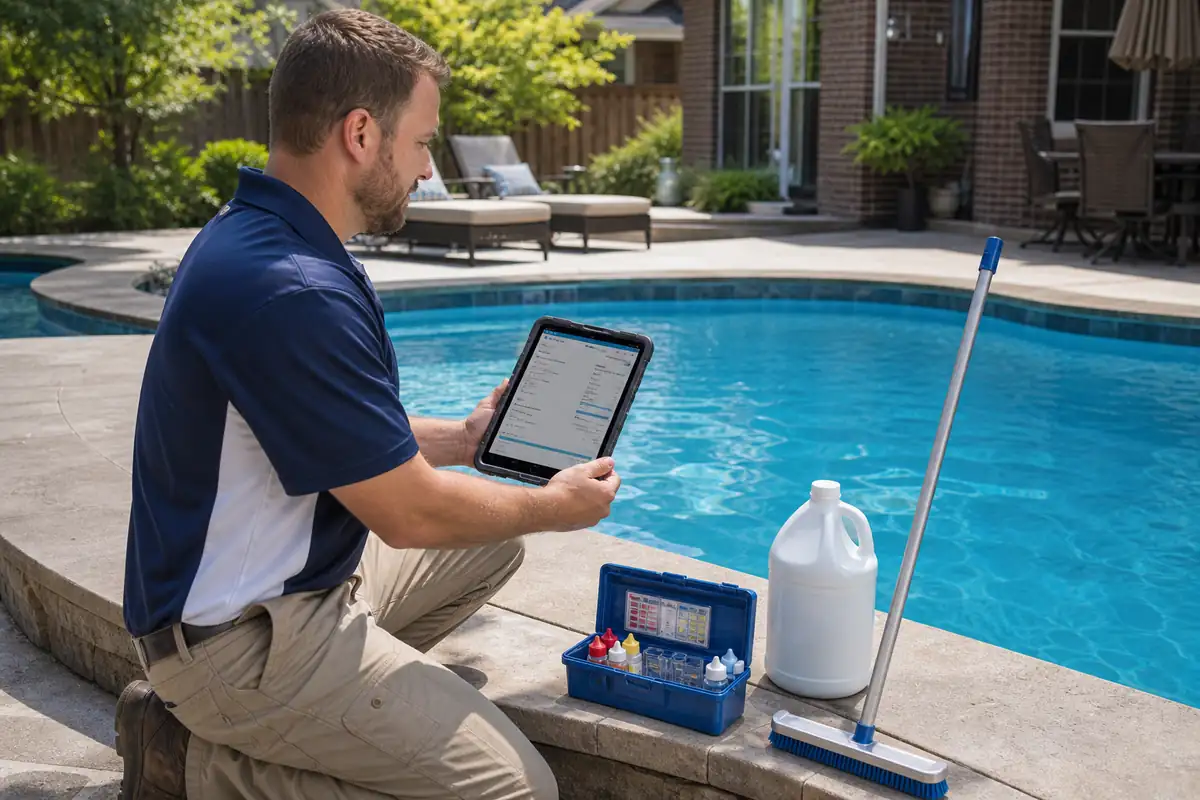
Your labor margin is protected when chlorine spikes. Customers see exactly what they are paying for, which kills the "why is this $200 a month?" call. When chemicals dip, you can adjust the line without renegotiating the contract. Field service software with chemical tracking — like the kind built into pool service management software — automates this so techs log readings on a tablet and the numbers flow straight to the invoice.
This model works best for residential routes with mid-to-high chemical loads, customers who care about transparency, and operators who already run a digital dosing log. Skip it if you serve a price-sensitive market where the appearance of a fixed bill matters more than the math, or if you do not yet have software to itemize chemicals automatically — without automation, the bookkeeping will eat the margin gain.

Pricing Model 2: Tiered Service Plans (Recurring Revenue Bedrock)
Tiered plans are how pool operators in mature markets graduate from feast-or-famine to predictable monthly recurring revenue. Build three tiers around the same weekly visit and let customers self-select.
- Essential — water testing, surface skim, basic chemical balance, equipment glance. $89–$120/visit.
- Performance — Essential + brush, vacuum, filter inspection, monthly equipment report, priority scheduling. $135–$175/visit.
- Concierge — Performance + monthly filter cleaning, equipment warranty management, quarterly water replacement assessment, 24-hour callback guarantee. $195–$285/visit.
Three rules make tiers work. Every tier needs at least one feature the tier below does not — that is what justifies the upsell. The middle tier should be where 50%–60% of customers land; price Essential intentionally light so Performance is the obvious upgrade. And build a quarterly "tier review" into your workflow — customers drift up over time when they trust your team.
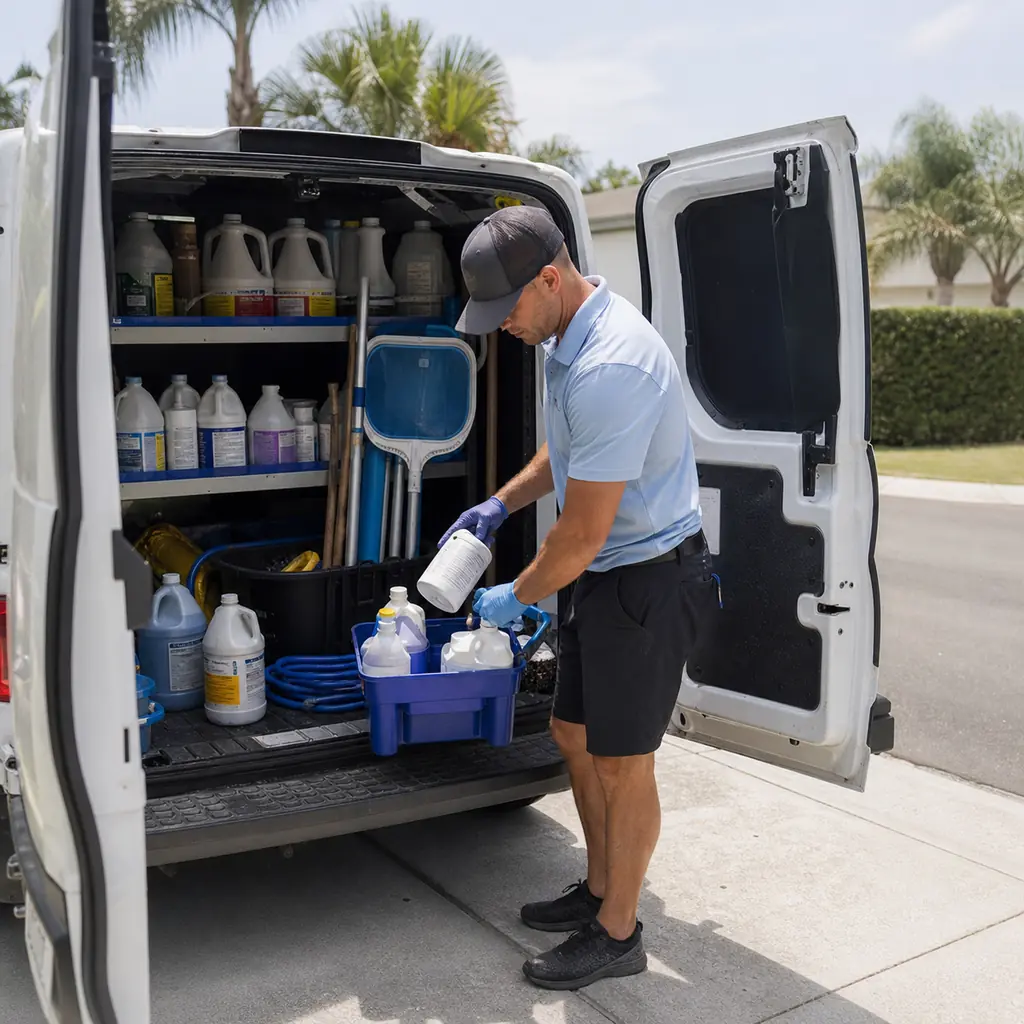
For sample weekly schedules, equipment kits, and what to load on each truck, see best pool service tools.
Ready to level up your business?
Try Bella FSM free and transform the way you work.
Pricing Model 3: Per-Pool-Stop Route Math
Route-heavy operators with 200+ stops a week price per minute on route, then back into a stop price that hits target margin. The math:
- Loaded labor cost per minute (loaded hourly cost ÷ 60)
- Plus chemical cost per stop
- Plus fuel and vehicle wear per minute × drive minutes from the last stop
- Multiply by your target margin multiplier (2.0× for 50% gross margin, 1.67× for 40%)
- Round to the nearest $5
Worked example — 14k-gallon residential pool, 35-min service, 18-min drive:
- Labor: 53 min × $0.95/min loaded = $50.35
- Chemicals: $11
- Vehicle/fuel: 18 drive min × $0.55/min = $9.90
- Subtotal cost: $71.25
- Target margin 2.0× → $145 (rounded)
Stops with longer drive times automatically price higher; tight clusters price lower and stay competitive. Route optimization inside service scheduling software shrinks those drive minutes — every minute you cut is pure profit on the next stop.
How to Roll Out a Price Change Without Losing Customers
The biggest pricing leak in pool service is not the rate — it is the inability to update the rate without losing accounts. The operators who raise prices smoothly all do four things in order:
- Anchor to an external cost. "Chemical costs rose 14% in 2025" lands. "We need more revenue" loses the customer.
- Give 30 days written notice. Email plus a printed copy in the equipment shed, with old rate, new rate, and percentage change spelled out.
- Pre-empt the cancel threat. Train techs on one response: "I understand. We also offer a no-chemical-surcharge plan if you prepay 6 months — want the details?"
- Never raise in October. Seasonal accounts on the fence about closing will leave. Increases land best in February (before open) or July (mid-season, when value is visible).
Systematized, you lose 2%–4% of accounts on a 7%–10% increase. Freelanced, you lose 12%–18%.
Common Pricing Mistakes That Quietly Sink Margins
The unforced errors I see most in 2026 audits:
- One flat rate for every pool size. A 30k-gallon pool burns 2.1× the chemicals of a 14k pool. Charging the same is a charity.
- Free water tests at point of sale. A water test is your most billable diagnostic — bundle it into a tier, do not give it away.
- Travel time inside the labor minute. Drive time is a separate cost line. Lump it in and you cap your service area without realizing it.
- No mid-season price-adjust clause. Sign every annual contract with a "chemicals subject to indexing every 90 days" clause — standard in commercial, increasingly normal in residential.
- Quoting without a site visit on first-time conversions. A $135 quote on a 30k pool with sand filter and algae is a future loss leader. Charge a $45 site-survey fee, credited to the first month if they sign.
If you are early in your pool career, this pairs with the basics in our pool cleaning business startup guide — licensing, insurance, and your first 30 customers.
Ready to take your business further?
Try Bella FSM free and transform the way you work.
What Software Actually Has to Do for Your Pricing to Work
Pricing strategy without the right tooling is a spreadsheet exercise. The operators who hold their margins all run software that handles five things:
- Per-customer chemical reading + dosing history attached to the invoice.
- Tiered service plan templates that auto-bill weekly or monthly.
- Route optimization that recalculates drive minutes after every stop.
- Mobile invoicing with on-iPad signature capture before the tech leaves.
- Two-way QuickBooks integration so your bookkeeper sees revenue by tier, not as a wall of line items.
Without those five capabilities you are paying a tech to do bookkeeping — the most expensive bookkeeping in the world.
Frequently Asked Questions
The Bottom Line
If you take one thing from this guide on how to price pool service jobs, make it this: stop using a single number. The pool operators making real money in 2026 are not the ones doing the most stops — they are the ones whose price per stop reflects what each pool actually costs to service, with software handling the line-item math. Whether you adopt flat-plus-pass-through, tiered plans, or per-stop route math, the principle holds: separate labor from chemicals, protect margin with indexing clauses, and let route density do the heavy lifting.
Bella FSM's pool service business software is built around exactly this workflow — chemical tracking, tiered plans, route optimization, and QuickBooks-clean invoicing in one place. If you are still pricing on a spreadsheet, see how the platform handles a real route — it pays for itself in the first season.
Ready to grow your business?
Try Bella FSM free and transform the way you work.