
Grow Your Business
Appliance Repair Parts Inventory: How to Stock Service Vans to Cut Second Visits
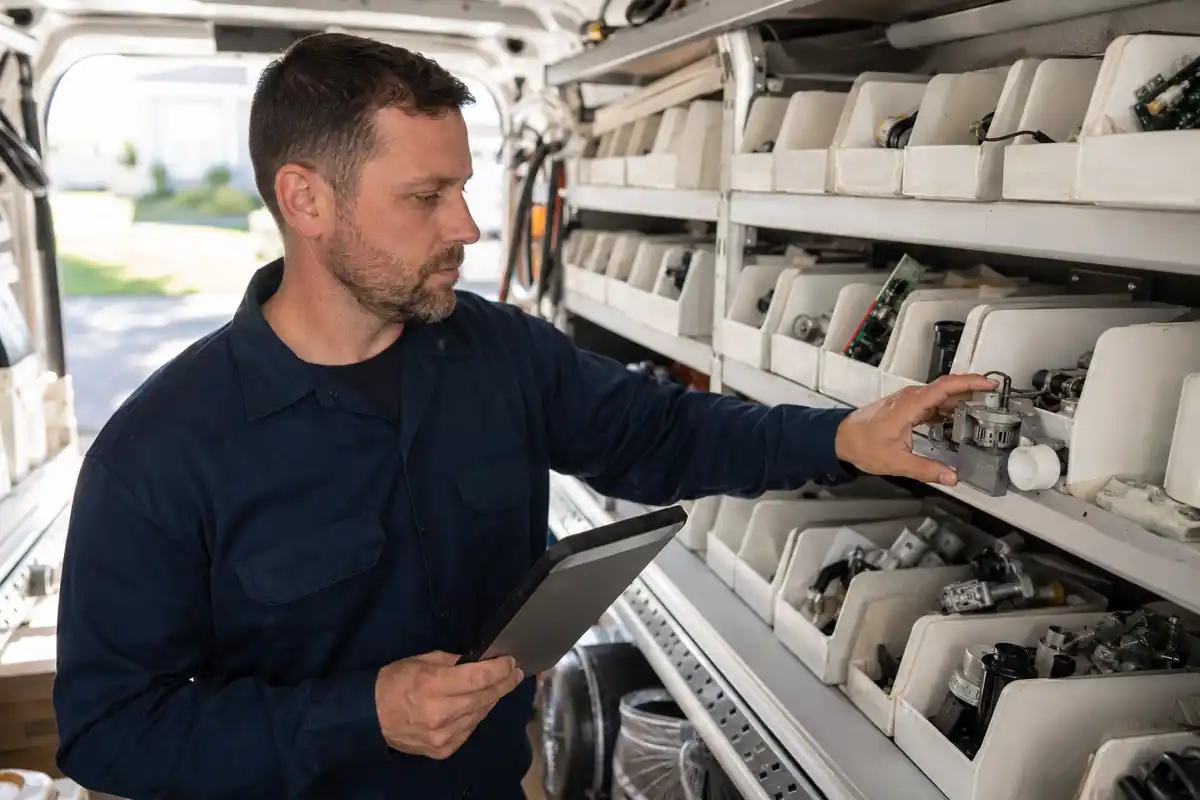
Every appliance repair owner I talk to has a number burned into their head: the second visit. A tech rolls out, confirms the failure, then realizes the part isn't on the truck. The call closes incomplete. The customer waits two more days. The tech burns another bay slot, another billable hour, another rolled mile and the margin on that job quietly drains away. Most shops don't track second-visit cost in their financials, but it shows up everywhere overtime, bad reviews, cancellation rates.
A well-built appliance repair parts inventory is the single biggest lever you have against all of it. This guide walks through how the strongest shops stock service vans, forecast demand, and use software to stop returning visits from eating their margin.
The True Cost of a Second Visit in Appliance Repair
A second visit isn't just one extra trip it's a compounding problem. Industry benchmarks put the loaded cost of an unplanned return call between $85 and $140 once you add technician wages, vehicle mileage, dispatcher time, and the billable call you didn't run in that slot. For a shop running 25 calls a day at a 68% first-time fix rate, that's eight return visits every day. Conservatively, that's $700 in daily margin walking out the back door call it $200,000 a year.
The damage doesn't stop at the P&L. Customers who experience a return visit are roughly three times more likely to leave a negative review or refuse to refer you. First-time fix rate is one of the strongest leading indicators of customer lifetime value in field service, yet most appliance repair operators still treat it as a soft metric.
Your parts inventory is where that fix rate lives or dies. If the tech doesn't have the right control board, motor coupler, or thermistor on the van, no amount of training or dispatch wizardry will save the call. Smarter stocking is where you start.
What "Appliance Repair Parts Inventory" Really Means in the Field
Most owners think of inventory as the shelf in the back of the shop. That's wrong. In appliance repair, your real inventory is the rolling parts kit on every service van, plus the central warehouse, plus the parts you can pull from your distributor within four hours. All three layers matter, but each solves a different problem.
The van stock is your first-visit fix layer. It should hold roughly 80% of the parts a tech needs for the calls on today's schedule plus the most common failure parts for the appliance categories you service most. The shop stock is your backup layer for second-day completions and pre-staged jobs. The distributor relationship is your safety net for the long tail the rare control board for a 2003 high-end wall oven that no shop keeps on the truck.
The operators that win on first-time fix rate think of these three layers as a single system. They size the van based on real call data, not on what a previous tech "always carried." They re-stock every morning from a kitting list tied to the day's dispatched jobs. And they track parts usage like a P&L line because that's exactly what it is. Bella FSM's inventory management software is built to manage all three layers as a single inventory, with the van as its own tracked location.
A Practical Van Stocking System for Appliance Technicians
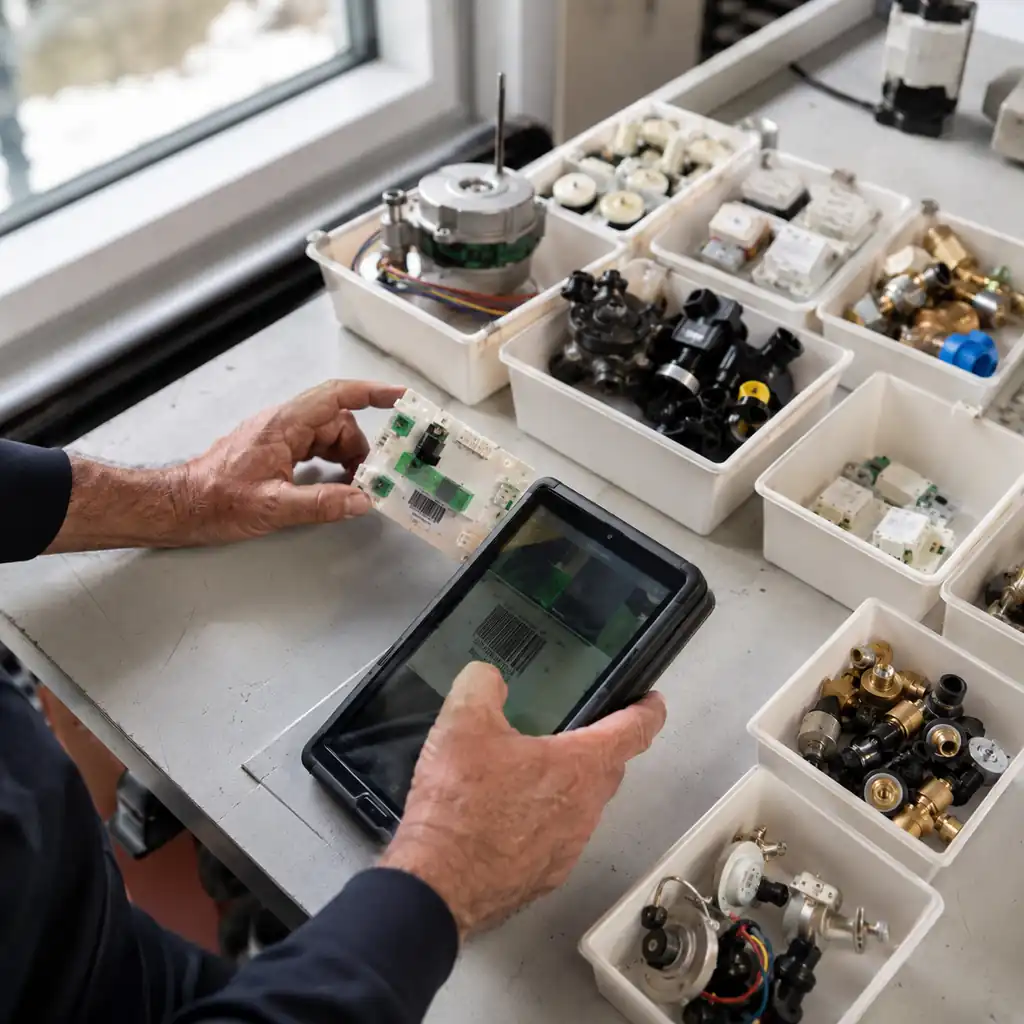
Here's the system the strongest appliance repair shops use. It isn't glamorous, but very few small shops run it consistently.
Step 1: Pull 12 months of work order history
Every modern appliance repair CRM software can export the parts consumed per call. Get a flat file with three columns: appliance category, part number, count used.
Step 2: Sort by frequency and category
Group by appliance type refrigeration, laundry, cooking, dishwashers, microwaves. Inside each group, list parts from most-consumed to least. You'll find a brutal Pareto: roughly 20 part numbers cover 70-80% of all repairs in each category.
Step 3: Set par levels per van
A par level is the minimum count of each part the truck should never drop below. Use this rule of thumb: for the top 20 parts in each category, par = (average daily usage 3 days). For category-adjacent parts (used 1-2 times a month), par = 1 or 2. Anything used less than monthly stays in the shop, not on the truck.
Step 4: Build a daily kitting list
Each morning, before the tech leaves, run a query against today's dispatched calls. Pull the work order notes for any "appliance + symptom" pair and pre-stage likely parts on top of the standard van stock. If three of today's calls are Whirlpool front-load washers with no-spin symptoms, the door latches go on the van whether or not par requires it.
Step 5: Reconcile at end of day
The tech reports parts used per call directly in your work order software. The system decrements van inventory and flags re-order triggers automatically. No clipboards.
Shops that run this system disciplined typically see first-time fix rates climb from the mid-60s to the mid-80s within 90 days.
Ready to level up your business?
Try Bella FSM free and transform the way you work.
Software That Keeps Your Parts Inventory Honest
The biggest hidden cost in appliance repair isn't the part itself - it's the manual reconciliation that FSM software for small business is designed to eliminate. When techs scribble parts on paper and a part-time office manager keys it into the accounting system three days later, two things happen: stockouts hit the truck without warning, and "ghost inventory" shows on the books that the tech actually used weeks ago.
A field service platform built for appliance repair eliminates both. The tech logs the part used inside the mobile work order. The system decrements both the van and the shop balances. Low-stock thresholds fire a re-order notification or push a PO directly to your distributor's portal. Cycle counts move from a quarterly fire drill to a five-minute weekly scan.
The appliance repair software we build at Bella FSM treats every van as its own warehouse location, so par levels, replenishment, and reporting are van-specific. When a tech transfers a part from one truck to another mid-day, that movement gets recorded no shrinkage assumed, no spreadsheet reconciliations on Friday night. For shops still chasing parts manually, our guide on receiving multiple inventory parts walks through how to log distributor shipments into a multi-location inventory in one pass.
The other quiet payoff: when appliance repair scheduling software is integrated with inventory, the dispatcher can't book a call against a van that doesn't carry the parts the symptom code requires. The schedule becomes inventory-aware. That alone kills a meaningful slice of second visits before they ever leave the office.
Forecasting Parts: From Reactive to Predictive Stocking
The shops that have moved past "we just reorder when the bin's empty" are doing two things differently.
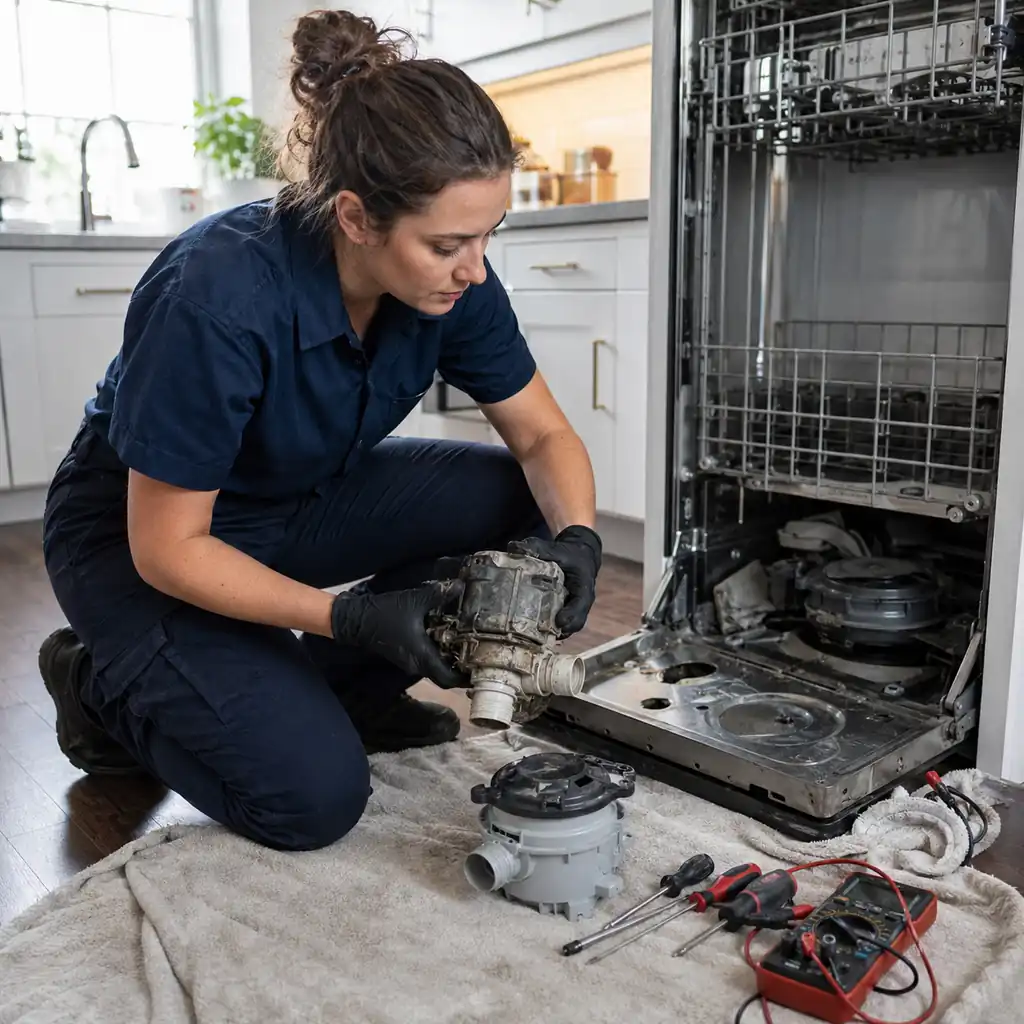
They forecast by season. Compressor failures spike in July and August. Dryer thermal fuses spike in November when laundry volumes rise. Dishwasher motor pumps trail off in winter; refrigerator ice maker valves climb in summer. Pull last year's monthly usage and stock 30-60 days ahead of the curve.
They forecast by install base. If your service area has 8,000 active service agreements on Maytag washers from the 2020-2022 model years, you can predict within a few hundred units how many bearing kits you'll consume next year. That's not magic. It's parts lifecycle data your distributor or OEM rep can share for free.
Combine the two and you stop reacting. You order for the August spike, you keep your truck stock churning, and you free up cash that would otherwise sit in slow-moving SKUs. Compare that to the typical small shop sitting on 60-90 days of dead stock ordered "just in case" two years ago.
A modern dispatch software platform tied to your inventory data is the cleanest way to expose this. Reports showing par-vs-on-hand by season, van, and SKU give you a forecast you can plan against not a hunch.
Ready to take your business further?
Start using Bella FSM free and work smarter.
Common Appliance Repair Parts Inventory Mistakes
Three mistakes show up in nearly every shop I audit.
- Treating the van as a black box. Owners know what's in the shop. Nobody knows what's on truck #3. Parts shrink, techs "borrow" from each other, and dispatch can't trust the system. Fix: every van is a tracked location with weekly cycle counts. No exceptions.
- Stocking what the tech "likes" instead of what the data says. Veterans carry their pet parts. Newer techs copy them. The van starts to look more like a personal toolkit than an inventory system. Fix: stock from your top-20 list per category, not from tribal knowledge. Our appliance repair tools guide is a useful cross-check.
- Ignoring the in-warranty channel. Many manufacturers reimburse parts and labor on warranty calls, but only if part numbers and serial data are submitted cleanly. Shops that don't track this leave 6-10% of revenue on the table every year. Fix: capture model and serial in the work order, automate the warranty claim packet, and don't let "we'll do it later" become "we'll do it never."
Frequently Asked Questions
Make Inventory the Foundation of Your Service Business
A well-built appliance repair parts inventory isn't a back-office concern, it's the operational backbone of every billable call your team runs. Stock by data, not by gut. Track every van as its own warehouse. Re-stock each morning from a kitting list tied to today's dispatched calls. Forecast for season and install base, not just for last week's usage. Let software do the math while your technicians do the work.
Owners who tighten parts inventory typically see first-time fix rates climb by 15 points or more inside a quarter, with second-visit costs dropping by half or better. That's real margin, not a theoretical exercise. If you'd like to see how Bella FSM ties inventory, dispatch, and work orders together for shops like yours, our appliance repair business software is built for exactly this problem.
Ready to grow your business?
Try Bella FSM free and simplify your work.