
Grow Your Business
AI Hype vs Real-World Results: What the AGI Timeline Debate Means for Service Businesses
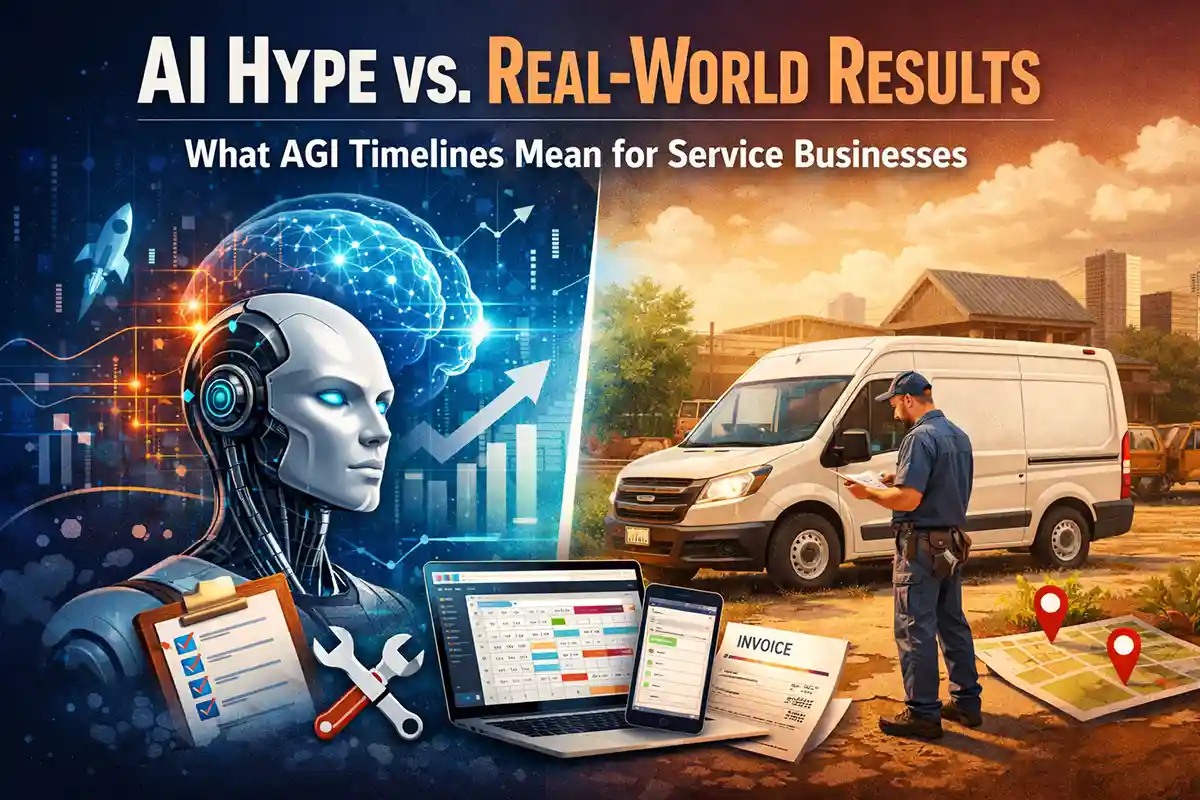
Artificial intelligence is dominating headlines, with frequent claims that artificial general intelligence (AGI), or even superintelligence, could arrive within 12–18 months.
For AI researchers and technologists, that debate centers on scaling laws, reasoning benchmarks, and scientific breakthroughs.
But for service businesses, HVAC contractors, electricians, plumbers, landscapers, cleaning companies, and other field operators, the more practical question is much simpler:
What can AI reliably do today to improve operations?
A recent discussion that generated more than 700 comments examined whether we should already be seeing major standalone scientific breakthroughs if AGI is truly close. The debate revealed something important: the difference between speculative AI timelines and applied AI tools.
That distinction matters far more to small business owners than futuristic predictions.
Here’s what the conversation revealed, and what it actually means for service businesses.
-
-
Knowledge vs. Reasoning: The Core Disagreement
One of the most recurring arguments was that today’s AI systems demonstrate extraordinary knowledge, but not necessarily independent reasoning.
Large language models can:
- Draft documents
- Analyze patterns
- Summarize complex information
- Generate structured outputs
But critics argue that these systems are fundamentally advanced pattern engines trained on vast datasets, not autonomous thinkers capable of generating entirely new scientific frameworks.
For service businesses, this distinction is important.
You don’t need an autonomous scientist to:
- Generate estimates faster
- Automate appointment reminders
- Organize job histories
- Reduce administrative overhead
You need reliable systems that reduce friction in your day-to-day workflow.
And that capability already exists.
-
-
-
The “Breakthrough” Benchmark
A popular thought experiment in the discussion proposed a simple test:
If AGI is truly imminent, shouldn’t we already see AI independently deriving major scientific breakthroughs, not just assisting researchers?
Whether that’s a fair benchmark is debatable.
But it reveals something important: many people equate “general intelligence” with dramatic, paradigm-shifting discoveries.
For small business operators, that’s not the bar.
The meaningful breakthroughs aren’t new physics equations.
They’re operational improvements like:
- Fewer missed appointments
- Clearer scheduling visibility
- Faster dispatch coordination
- Automated follow-up messaging
- Real-time job status tracking
Those gains compound quickly in the field.
-
-
-
Incentives and AI Hype
Another strong theme was skepticism around aggressive AGI timelines.
Some argued that bold predictions often align with:
- Investment cycles
- Competitive positioning
- Talent recruitment
- Media attention
Regardless of where someone stands on timelines, the takeaway for service businesses is simple:
Hype cycles move faster than operational reality.
AI headlines change weekly.
Your schedule, invoices, crews, and customer communication do not.
Sustainable improvement comes from tools that make daily operations more predictable and efficient, not from speculative milestones.
-
-
The Definition Problem
One of the most revealing aspects of the debate was that people weren’t always arguing about the same thing.
For some, AGI means:
- Economic automation across cognitive labor.
For others, it means:
- Autonomous scientific discovery.
For others still, it means:
- Human-level reasoning across all domains.
These are radically different thresholds.
When definitions shift, timelines appear contradictory, even when observers are looking at the same systems.
For service businesses, clarity matters more than definitions.
The practical question isn’t:
“When will AGI arrive?”
It’s:
“What tasks can be automated or streamlined right now?”
What Applied AI Already Does for Service Businesses
While futurists debate superintelligence, applied AI is already improving real workflows.
In streamlined field service operations, AI-driven and automation-driven tools can:
- Automatically schedule and reschedule jobs
- Optimize technician dispatch
- Generate invoices quickly and accurately
- Send automated reminders to reduce no-shows
- Track job progress across crews
- Surface customer history instantly
These aren’t theoretical capabilities.
They’re operational improvements that save time, reduce errors, and increase revenue predictability.
For contractors and service operators, that’s what matters.
AI for Field Service Management: Execution Over Speculation
Whether AGI arrives in two years or twenty, the businesses that win won’t be the ones predicting the future.
They’ll be the ones deploying practical tools that:
- Reduce administrative burden
- Improve scheduling clarity
- Keep crews aligned
- Eliminate double entry
- Increase customer responsiveness
In other words:
Applied AI > speculative AI.
That principle applies especially in industries like HVAC, plumbing, electrical, landscaping, and other field service sectors where operational efficiency directly impacts profitability.
The Practical Takeaway for Service Operators
The AGI debate reveals something deeper than optimism or skepticism.
Most disagreements are about:
- Definitions
- Standards of evidence
- Incentives
- Expectations of breakthroughs
Meanwhile, the practical advantages of automation and intelligent software are already here.
You don’t need superintelligence to:
- Stay organized in the field
- Keep jobs on schedule
- Improve dispatch coordination
- Send invoices faster
- Maintain clean customer records
You need reliable home service software built around real operational workflows.
How Bella FSM Fits Into This Conversation
Bella FSM is designed for service businesses that want:
- Clear scheduling
- Organized job management
- Efficient dispatching
- Streamlined invoicing
- Better visibility across teams
While headlines focus on AGI timelines, our focus remains on helping service operators save time, reduce chaos, and stay organized in the field.
The future of AI will continue to evolve.
But operational clarity is valuable today.
If you're evaluating tools to improve your scheduling, dispatch, and field workflow, you can explore how Bella FSM supports service businesses without adding unnecessary complexity.