
Grow Your Business
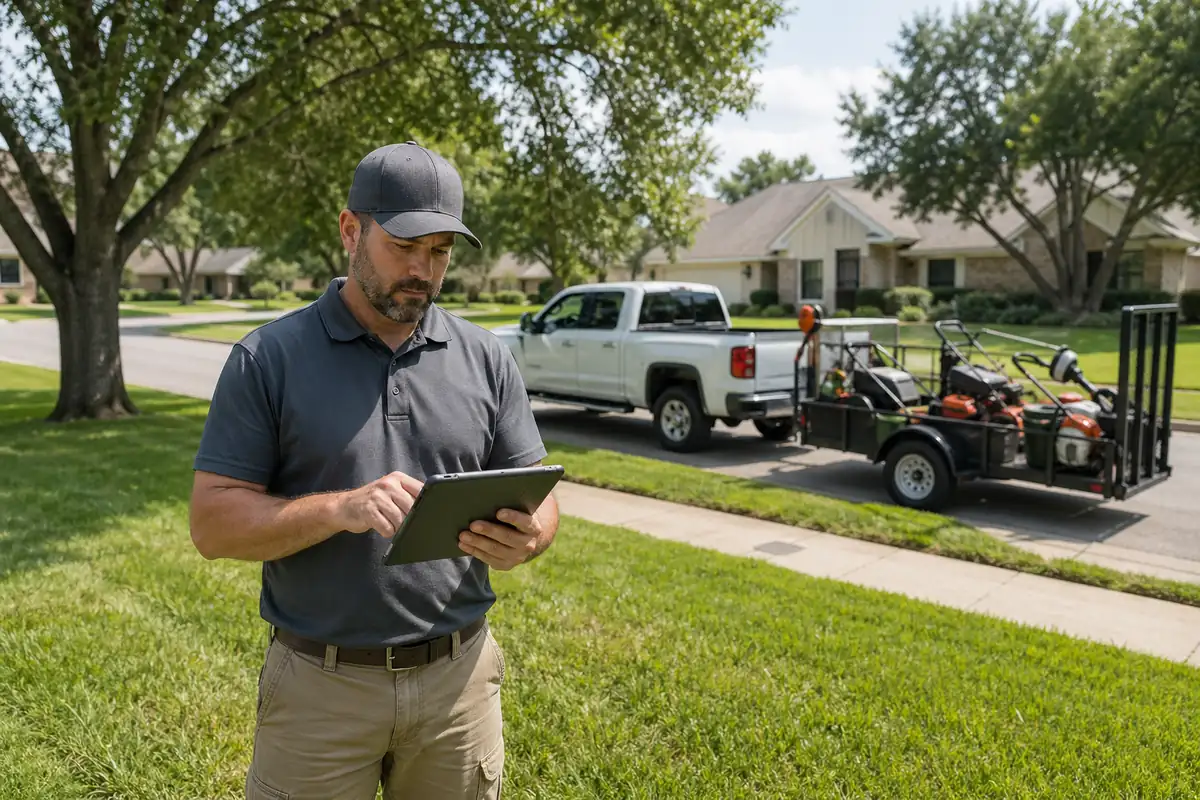
Most lawn care companies don't lose money on the lawns they cut — they lose it on the streets between them. A typical residential mowing crew can spend 90 minutes to two hours a day in transit, and if you run three crews, that's the equivalent of one full crew you're paying to drive nowhere. Lawn care route optimization is the discipline of shrinking that wasted time so the same crew, same hours, and same payroll cover more billable stops. With labor tight and fuel expensive, owners who get serious about routes typically add one to three stops per crew per day without hiring anyone. This guide shows how to do that, what tools help, and what to watch for as you change how the day gets built.
Why Route Optimization Matters More for Lawn Care Than Most Trades
Lawn care is structurally different from HVAC or plumbing. A plumber runs four to six longer jobs a day; a mowing crew can hit 14 to 25 stops by 4 p.m. The shorter the job, the more of the day gets eaten by drive time, parking, and re-loading. A 12-minute drive between stops looks small until you stack it 18 times.
Lawn care also runs on tight cycles most residential customers are on a 7, 10, or 14-day rotation, so the same homes flow through the same neighborhoods on the same weekday, week after week. If those routes weren't designed with geography in mind, every week you re-pay the same inefficiency. That is why lawn care routing software pays back faster here than in industries with longer, more variable jobs.
The True Cost of Inefficient Lawn Care Routes
Run the math on your own operation. Pull a recent week and calculate three numbers:
- Drive time per crew per day. GPS data, route history in your scheduling tool, or even a manual tally from the crew leader works for a starting point.
- Average billable revenue per crew per day.
- Total fuel cost per crew per week.
We typically see lawn care operators sitting at 18-25% of paid hours in drive time. Knock that to 12-15% and the same five-person crew picks up 8-12 hours of billable work a week. At a $55 residential ticket and 22 minutes per stop, that's $1,200-$1,800 of additional weekly revenue per crew with no new hires the difference between scraping by and funding a second truck.
Inefficient routes also drive second-order costs: more equipment wear, more late-arrival complaints, and higher technician turnover because crews resent unpredictable end times. Operators that have moved to a structured service agreement program for recurring lawn customers also rely on stable routes guaranteed visit windows are a lot easier to deliver when the route plan respects them.
Building a Smarter Route: 7 Practical Steps
You don't need a logistics PhD. You need a deliberate weekly process. Here's what works for lawn care companies in the $500K$5M range.
1. Cluster Your Customer Base by Geography First
Before you touch a calendar, plot every active customer on a map. Most operators discover their book is more concentrated than they thought and that a few outliers are silently destroying margins. Flag any home more than 15 minutes from the nearest cluster. Either re-route that customer to a different visit day, raise their price to cover the drive, or graciously refer them out.
2. Assign Each Geographic Cluster to a Specific Day of the Week
Mondays might be the north-county cluster, Tuesdays the central-city cluster, Wednesdays the lakefront cluster. This is the foundation of a tight route. Once you commit, communicate the visit-day expectation to customers and document it in your scheduling system. Bella FSM's service scheduling software lets you anchor recurring jobs to a day and a sequence so they re-appear automatically without manual re-planning.
3. Sequence Stops Within Each Day to Minimize Backtracking
Within a daily cluster, the order matters. Avoid the classic mistake of running customers in the order they signed up. Instead, drop them into a logical loop typically starting with the stop closest to the shop or the crew leader's home, then a one-direction sweep, ending with the stop closest to the dump or the route home.

4. Build a Realistic Day, Not an Aspirational One
Most owners pack a day to 9.5 hours of "ideal" work and then wonder why crews finish at 6:30 p.m. complaining. Pad each daily route with 30-45 minutes for fueling, equipment issues, customer flag-downs, and a single missed stop you'll need to recover. A daily plan a crew can actually finish builds trust in the system.
5. Use Live Dispatch for Same-Week Adjustments
Customers add stops, weather pushes work, equipment breaks. The goal is not a static plan but a living one. A purpose-built dispatch software tool lets office staff move jobs between crews and re-sequence in seconds rather than re-keying everything in a spreadsheet.
6. Push the Day to the Crew via Mobile
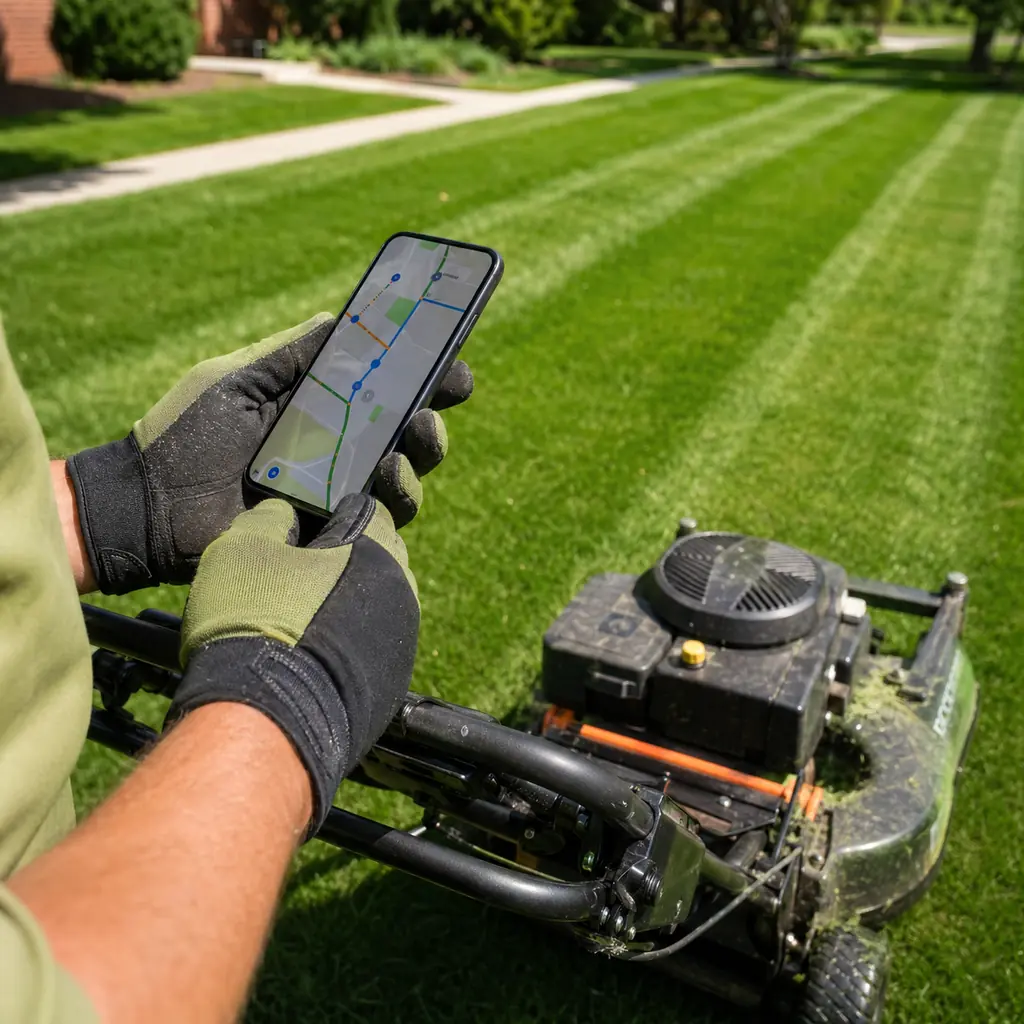
Crews shouldn't be trying to figure out the day from a printed Excel sheet. Each technician should see today's stops, navigation, customer notes, and any photos from the previous visit on a phone or tablet. We dig into the mechanics in our mobile workforce management overview the short version is that the moment crews stop driving by paper, route adherence improves measurably.
7. Close the Loop with Daily Time and Drive Data
At day's end, compare planned drive time to actual drive time. A 10-15% gap is normal. A 30%+ gap means the plan is broken either the cluster is wrong or the sequence is wrong. Adjust before next week's cycle, not next quarter.
Ready to level up your business?
Try Bella FSM free and transform the way you work.
Choosing Lawn Care Routing Software That Actually Helps
There are three tiers of tooling lawn care owners use, and they behave very differently.
Generic mapping apps (Google Maps and the like) are fine for an owner running one truck. They break down the moment you have a recurring customer base, multiple crews, or any back-office dispatch.
Standalone routing tools plot a great loop but they don't know about your work orders, your billing, or your customer history. You end up double-entering data and the route optimizer becomes a parallel system rather than the system.
Integrated FSM platforms plan the route, generate the work orders, capture the technician's time and notes, and feed everything into invoicing. For most lawn care operators in the $500K+ range, this is the right tier. Our lawn care software hub goes deep on which features matter for the trade, but the short list to ask any vendor about is:
- Recurring job templates that re-spawn weekly with the right sequence intact
- Drag-and-drop dispatch board for same-day moves
- Mobile app that shows the day's optimized order, with one-tap navigation
- GPS visibility on crew location and arrival/departure stamps
- One-click conversion of completed jobs into invoices, ideally syncing to QuickBooks via a QuickBooks integration
If a vendor demos great mapping but can't show you the path from "stop completed" to "money in the bank," you're buying half a tool.
Common Route Optimization Mistakes (And How to Avoid Them)
A few traps come up over and over with operators who try to optimize routes for the first time.
- Re-routing customers without telling them. Surprise day changes drive cancellations. Send an email or text 14 days before any visit-day change.
- Optimizing only for distance, not for windows. A commercial property that requires service before 8 a.m. will blow up an otherwise tight route. Build hard time windows into the route engine, not into a sticky note.
- Letting the most experienced crew leader override the plan. That person's mental map is worth listening to in week one but the system needs to win by week four, or you have no system.
- Treating one bad week as proof the tool doesn't work. Weather, breakdowns, and seasonal surges create noise. Look at four-week rolling averages.
- Forgetting to re-price drive-heavy customers. If a stop genuinely sits an extra 25 minutes from the cluster, its price should reflect that. Use a current lawn care pricing chart to make sure you're not subsidizing the customer with your fuel budget.
Metrics to Track Once Optimization Is Live
Owners often "feel" routes have improved without measuring. Pin these five numbers to a wall and review them weekly.
- Drive-time percentage of paid hours target under 15%.
- Stops completed per crew per day target a 10-20% increase within 60 days.
- Average revenue per crew-hour should rise as drive shrinks.
- On-time arrival rate target 90%+ within the promised window.
- Crew end-of-day variance if Friday lasts 11 hours but Monday wraps at 2 p.m., the route plan is unbalanced.
Ready to take your business further?
Try Bella FSM free and transform the way you work.
These five metrics tell you in plain numbers whether the system is working. If you also use work order software to capture job-level time, you can drill into which routes, which crews, and which neighborhoods are dragging the averages. Pair that with a clean lawn care invoice template downstream and you have a closed-loop view from route plan to paid invoice.
Frequently Asked Questions
A Smarter Day Starts with a Smarter Route
Lawn care route optimization isn't a software project. It's an operating discipline that happens to need software. The owners who pull it off treat the route as the central artifact of the company — the thing every customer, crew, and invoice flows through. Get the cluster right, sequence the day right, and put the plan in the crew's hand on a phone, and you'll find capacity you didn't know you had.
If you're ready to stop running routes out of spreadsheets, take a look at how Bella FSM's lawn care business software brings recurring scheduling, dispatch, mobile crew tools, and invoicing into one system. The crews you already have can do more — once the day is built around them instead of against them.