
Grow Your Business
Cleaning Business Quality Control: How to Stop Recleans and Keep Clients

Your best commercial account just emailed a photo of a dusty baseboard in a suite your crew signed off on last night. Now you are booking a free reclean, eating two hours of labor, and quietly hoping the contract does not churn at renewal. This is the tax that weak cleaning business quality control puts on residential and commercial operators every single week. A reclean is not just an awkward apology. It erases the margin on a job you already staffed and paid for. The fix is not hovering over every tech or working longer hours. It is a repeatable inspection system that travels with your team. Pair that process with the right cleaning business software and consistency stops being a guessing game. This guide shows you how to build a quality program that holds up across dozens of recurring accounts.
Why Cleaning Business Quality Control Breaks Down on Recurring Accounts
Industry data heading into 2026 suggests up to 30% of commercial cleaning visits carry some form of quality issue. The problem is rarely that crews stop caring. It is that most operators run quality control on memory and good intentions instead of a structured system. When you clean the same 40 accounts every week, the work blurs together. A skipped restroom touchpoint or a missed conference room looks identical to a perfect one until the client notices.
Three forces make this worse for cleaning businesses specifically:
- High turnover. Cleaning has some of the highest staff churn in the trades. Every new hire resets the quality baseline, and tribal knowledge about a picky client walks out the door with the person who left.
- Distributed crews. Your teams work alone or in pairs across town. You cannot physically inspect every site, so most jobs close with zero verification.
- Paper or no checklists. Clipboards get left in the van, photos live on personal phones, and nobody can prove what was actually done when a dispute lands.
Strong cleaning business quality control replaces all of that with one consistent process every tech follows, every visit, on every account — the kind of consistency that small business field service software is built to enforce.
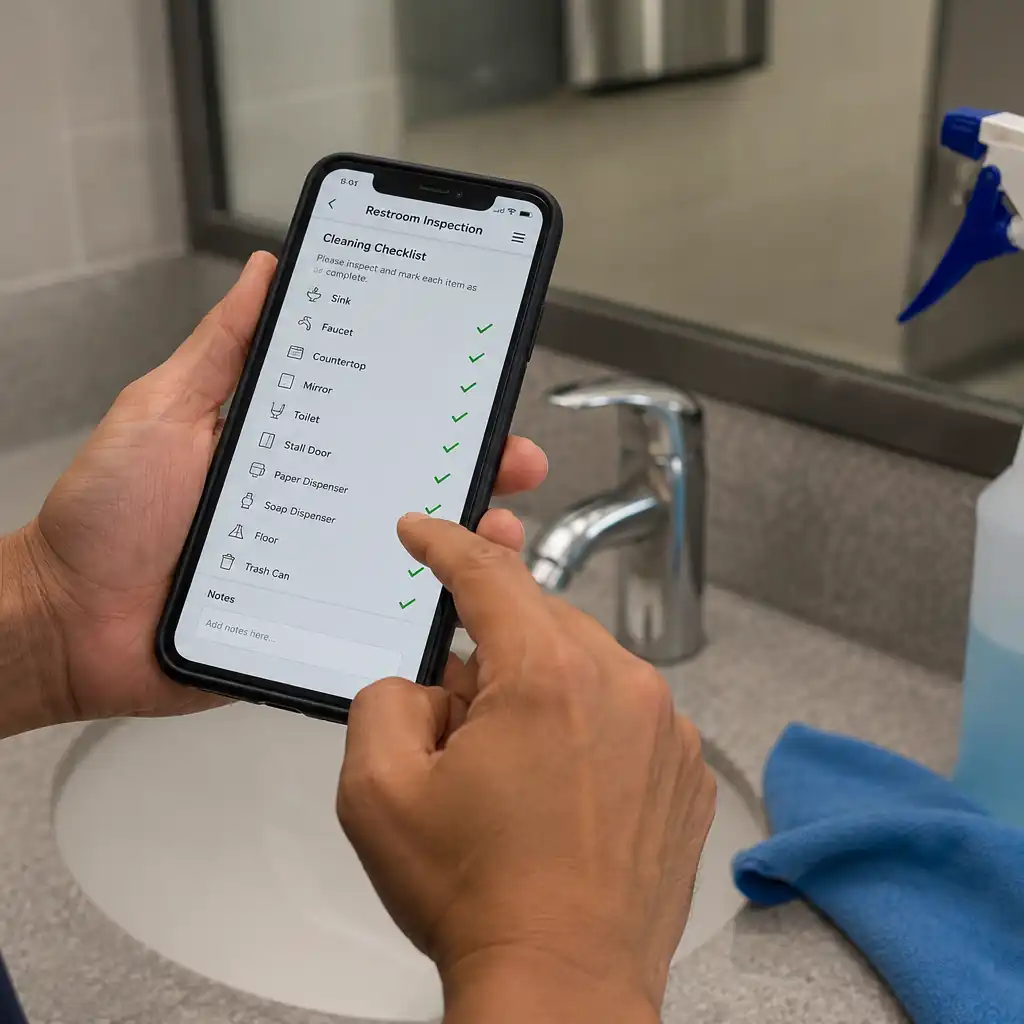
Build a Digital Inspection Checklist Your Crews Actually Use
A checklist only works if it is specific, scored, and impossible to skip — and a digital checklist inside your cleaning software cannot get left in the van. Vague items like "clean the kitchen" invite shortcuts. Break each space into zones and tie each zone to a clear pass or fail standard.
Make every line item measurable
Replace "bathroom looks good" with named touchpoints: toilet base and hinges, faucet handles, mirror streak check, floor corners, and trash liner replaced. A tech can argue about "good." They cannot argue about whether the trash liner was replaced. Aim for 8 to 15 checkpoints per room type so the list is thorough without becoming busywork the crew rushes through.
Score it so quality becomes a number
Assign points to each zone and weight the ones that drive complaints, like restrooms and entryways. A weighted score turns a fuzzy feeling into a metric you can track per crew, per account, and per week. When a site drops from a 96 to an 82, you see it on a dashboard before the client sends an angry email. Digital checklists also timestamp completion, so you know the closing tasks were not all tapped at once from the parking lot.
Because cleaning revenue is recurring, the same checklist runs week after week. That repetition is your advantage. Standardize it once inside your mobile workforce management app and every tech, new or veteran, cleans to the same standard from day one. This also makes onboarding faster, which matters when you are hiring reliable cleaning employees in a tight labor market.
Ready to level up your business?
Try Bella FSM free and transform the way you work.
Photo Verification: The Accountability Layer That Stops Disputes
A checked box says a tech tapped a screen. A timestamped, GPS-tagged photo proves the work happened. Photo verification is the single highest-impact upgrade most cleaning operators can make, and 2026 forecasts expect roughly 80% of large contract cleaning firms to rely on digital platforms for exactly this kind of quality audit.
Here is how to roll it out without slowing crews down:
- Require before-and-after photos on high-risk zones only. Restrooms, kitchens, glass entrances, and any area that generated a past complaint. Do not demand a photo of every square foot or techs will revolt.
- Tag each photo to the checklist item. The image attaches to "restroom floor" so there is no ambiguity about what it shows.
- Store everything against the account, not a personal phone. When a client claims the lobby was skipped, you pull up a timestamped photo from last night in seconds.
That evidence does two things. It ends he-said-she-said disputes that cost you free recleans, and it changes crew behavior the moment people know the work is documented. Accountability rises without a single uncomfortable conversation. The photos also become a quiet sales asset. A monthly visual report showing consistent, documented work is a powerful reason for a client to renew.

Turn Inspection Data Into Fewer Recleans and Higher Retention
Collecting scores and photos is step one. The money is in what you do with the data. Because acquiring a new cleaning client costs five to eight times more than keeping an existing one, every prevented churn is pure profit. Quality data is your earliest churn warning system.
Route failures to instant corrective action
When a zone fails inspection, the system should automatically create a follow-up task so it gets fixed before the client walks the space. A failed checkpoint that triggers a same-day correction never becomes a complaint. Tie this into how you are already scheduling recurring cleaning visits so the fix lands on the next route without manual juggling.
Watch trends, not just single visits
One bad night is noise. A crew whose score slides three weeks in a row is a pattern. Trends typically surface within 30 days of tracking, which gives you time to retrain, reassign, or have a direct conversation before you lose the account. Track pass rate, reclean rate, and complaints per 100 visits. Those three numbers tell you more about the health of your book than revenue alone.
This same data strengthens your pitch for new contracts. Walking into a bid with documented quality scores and a corrective-action process separates you from competitors who can only promise they care. It is one of the most underused levers to grow your cleaning business profitably rather than just chasing more low-margin one-time jobs.
Ready to take your business further?
Start using Bella FSM free and work smarter.
Quality Control Mistakes That Quietly Cost You Contracts
Even operators who adopt a system undercut it with avoidable errors. Watch for these:
- Letting the cleaner inspect their own work. Self-scoring inflates results. Where you can, separate who cleans from who verifies, even if verification is a rotating lead or a manager spot-check on a sample of sites.
- One generic checklist for every account. A medical office, a gym, and a law firm have different priorities. Build templates by facility type rather than forcing one list onto every job. Reviewing the types of cleaning services you offer helps you map the right checklist to each.
- Measuring without acting. Scores that nobody reviews are just data exhaust. Block 15 minutes weekly to scan the dashboard and act on outliers.
- Punishing instead of coaching. If techs feel inspections are a trap, they will game them. Frame quality data as the path to better routes and fewer callbacks, not a disciplinary tool.
Avoid these and your inspection system becomes a growth engine instead of a filing cabinet nobody opens.
Frequently Asked Questions
Ready to grow your business?
Try Bella FSM free and simplify your work.