
Grow Your Business
After Hours Plumbing Calls: How to Triage, Staff, and Price Night Work
July 27, 2026
Updated on July 27, 2026

It is 11:40 on a Tuesday night and the phone rings. A homeowner has water coming through a kitchen ceiling. Your on-call plumber is asleep, your dispatcher went home at five, and nobody has written down what happens next. Most shops handle that moment on instinct, which is why after hours plumbing calls are at once the most profitable and the most poorly run part of a residential plumbing business. Roughly two thirds of plumbing emergencies land outside business hours, and an estimated 65% of those calls go unanswered and straight to a competitor. The fix is not a bigger phone bill. It is a written coverage system backed by plumbing software that holds the schedule, the history, and the paperwork in one place.
What After Hours Plumbing Calls Actually Cost You
Owners treat night work as pure upside because the ticket is bigger. The ticket is bigger. The cost structure is also different, and most shops never separate the two figures.
Run the math on one overnight call. A tech earning $38 an hour at time and a half for a three hour call is roughly $171 in wages plus burden. Add fuel, parts off the truck, and the productivity lost when that tech starts at 10:00 instead of 7:30. Against a $650 emergency ticket you are still ahead, but margin is closer to 35% than the 55% you clear on a scheduled water heater swap.
The bigger cost is invisible on the P&L. Replacing a service plumber runs 20% of annual salary at the conservative end, and $55,000 to $110,000 once you count recruiting, ride-alongs, and schedule chaos. On-call burnout is a top reason good techs leave residential for commercial, and that bill arrives eighteen months later. The broader trends in the plumbing industry make the same point: labor scarcity, not demand, is the constraint on growth right now.
Takeaway: run night coverage as its own profit center with its own margin target, not as overflow from the day board.
Build an On-Call Rotation Your Crew Will Keep
A rotation fails for predictable reasons. It is verbal, it is unfair, and the person carrying the phone does not know what they are paid to carry it. Write it down and publish it at least six weeks out. Six weeks is the threshold where techs stop resenting the schedule, because they can plan a kid's birthday around it.
- Pay for the phone, not just the truck roll. A flat weekly stipend of $150 to $300 for carrying the phone, plus the hourly rate when a call rolls. The stipend acknowledges the restriction; the hourly acknowledges the work.
- Know your FLSA exposure. Federal guidance draws the paid-or-unpaid line at how restricted the employee really is. A tech required to stay within 20 minutes of the shop is engaged to wait, and that time is generally compensable. Get this wrong and a wage claim erases a year of night profit.
- Cap the rotation. One week on, three weeks off is sustainable for a five-tech shop. One week on, one week off is a resignation letter with a delayed timestamp.
- Build the failover first. Two missed alerts should escalate to a second name without anyone in the office waking up.
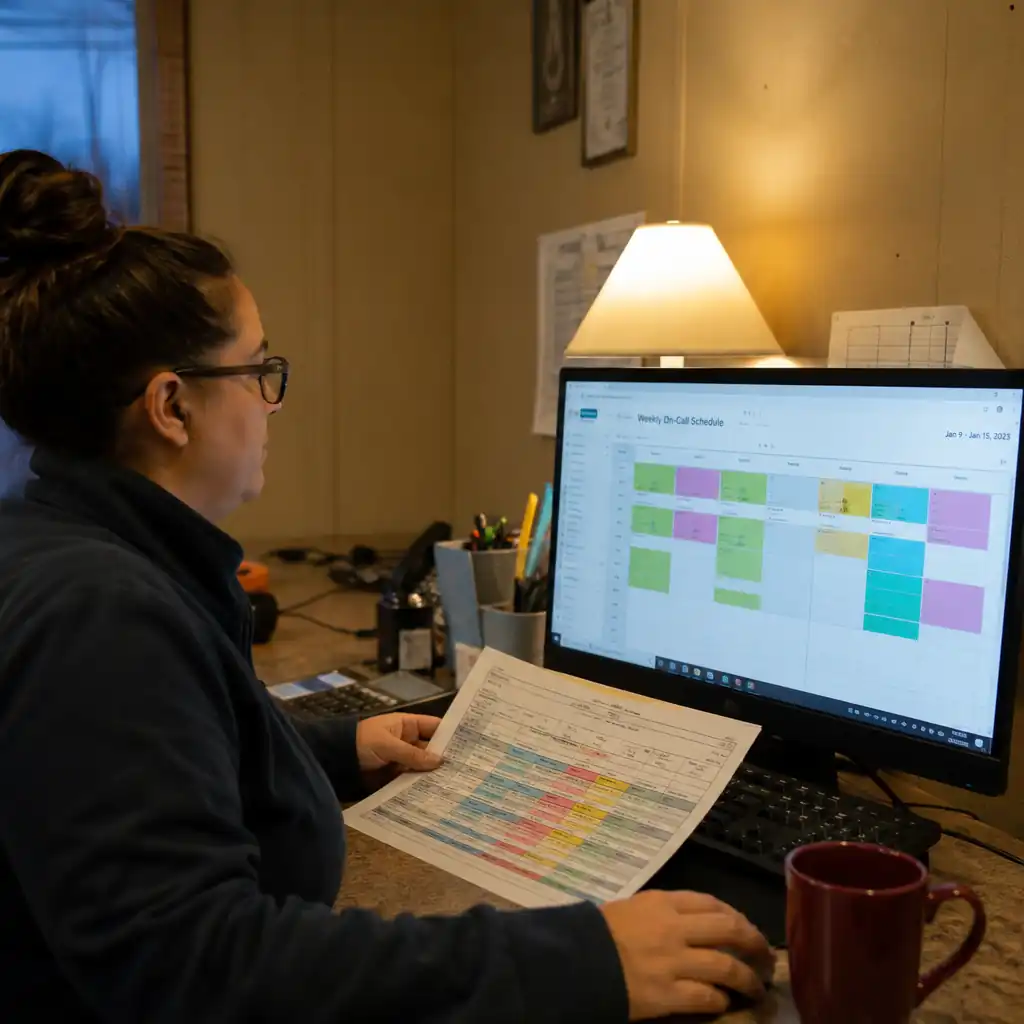
Separate availability schedules per technician are the mechanical piece that makes this work. Day hours and on-call hours are two different calendars for the same person, and plumbing scheduling software should let you maintain both without one overwriting the other.
Call history matters just as much at midnight. A plumber who pulls up plumbing CRM software on the drive over knows whether this address has called three times this quarter about the same stack. That changes the diagnosis and the conversation at the door.
Takeaway: publish six weeks out, pay a stipend for the restriction, and cap consecutive weeks.
Triage Every Call Into Three Tiers Before You Dispatch
The highest-leverage change most shops can make is to stop treating "after hours" and "emergency" as the same word. A running toilet at 1:00 in the morning is not worth $400 in overtime and a groggy tech tomorrow. Give whoever answers the phone a written tier script with clear thresholds:
| Tier | What qualifies | Response |
|---|---|---|
| Tier 1 | Uncontrolled water, sewage backup into living space, no water to the house, gas odor | Dispatch now, no exceptions |
| Tier 2 | Single fixture failure, slow leak the customer has contained, water heater out with another bathroom working | First slot at 7:00, confirm by text tonight |
| Tier 3 | Dripping faucet, running toilet, low pressure at one fixture, quote requests | Book into the next regular opening |
Two questions do most of the sorting: "Is water moving that you cannot stop?" and "Have you found the shutoff?" Walking a homeowner to the main shutoff converts many Tier 1 calls into Tier 2 calls, and customers remember the plumber who saved them a 2:00 a.m. bill. Log the call in your plumbing business software so the morning crew arrives already knowing what the house did overnight.
Takeaway: a two-question triage script moves 30% to 40% of night calls to the morning without losing the job.
Ready to level up your business?
Try Bella FSM free and transform the way you work.
Price Night Work So It Pays for Itself
Emergency pricing in 2026 sits in consistent bands. Standard residential rates run $80 to $130 per hour. After-hours weeknights generally price at 1.5x, weekends at 2x, and holidays at 2x to 3x, which puts evening calls at $120 to $300 per hour, weekends at $150 to $350, and holidays at $200 to $450. Most shops also carry a separate emergency trip fee of $150 to $300, charged regardless of what the tech finds. Three rules separate the shops that profit from night work from the shops that merely survive it:
- Quote the trip fee on the phone. A cancellation at midnight is cheaper than an argument at the door.
- Never discount the multiplier to win a call. Do it once at day rate and you have told your team night work is normal work.
- Collect before the truck leaves. Night receivables age worse than any other line, because there is no relationship to lean on.
That last point is where the money quietly leaks. A signed invoice and a card on file at the curb, while the ceiling is still wet and the customer is grateful, is the whole ballgame. Mobile plumbing invoicing software that closes the job on the tailgate turns a 45-day receivable into a same-night deposit.
None of this rescues loose day-rate pricing. If your standard bids are soft, fixing them does more for annual margin than any night multiplier, and our guide on how to bid plumbing jobs is where to start.
Takeaway: publish your multipliers, quote the trip fee at intake, and take payment on site.
Dispatch the Right Plumber, Not the Nearest Phone
Consider a shop with four service plumbers: two on sewer and drain, one gas and water heater specialist, one newer tech strong on fixtures. If the rotation is a simple round robin, roughly one night in four the person carrying the phone cannot solve the call. That is a wasted truck roll at 2x labor plus a second dispatch in the morning.
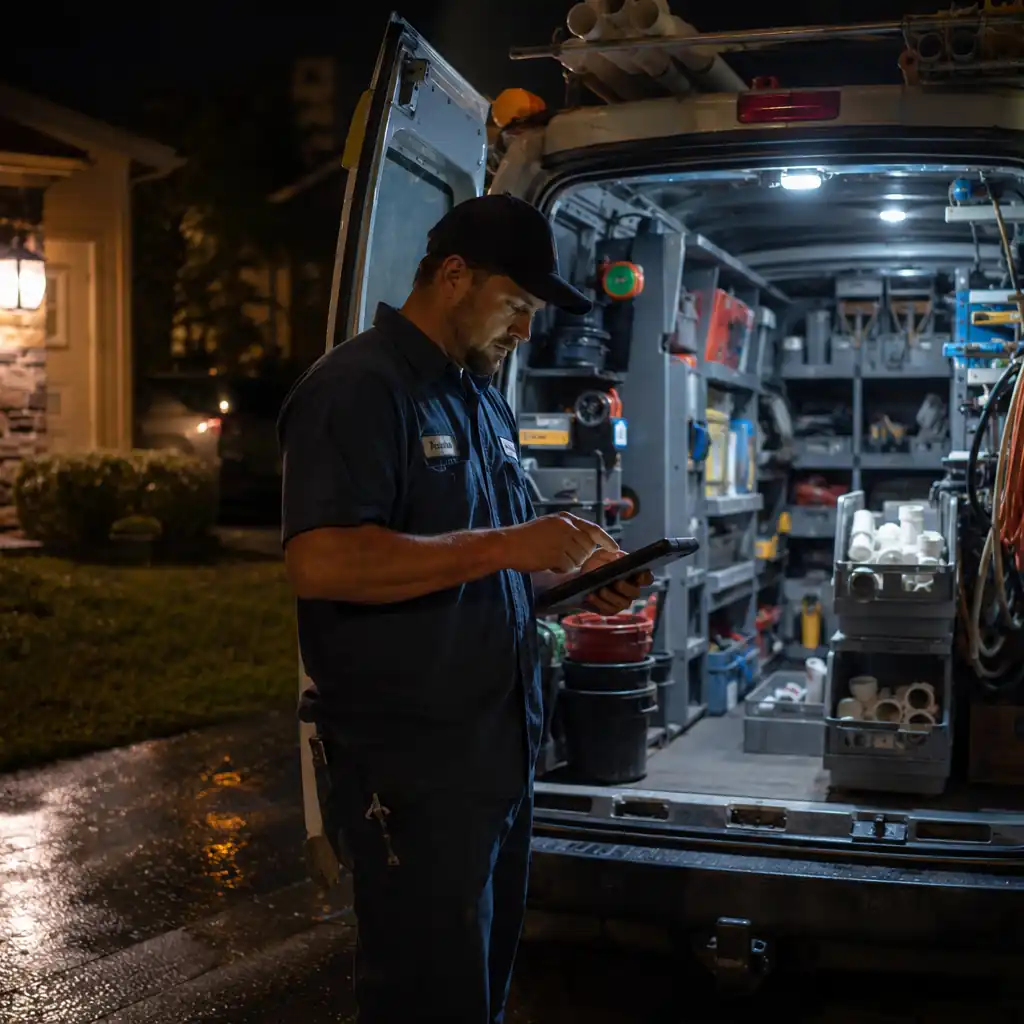
Match the rotation to skill, not just to fairness. Keep a documented list of who can pull a permit, who is licensed for gas, and who has the camera, then let the system route on it. Good dispatch software holds skill tags, license expirations, and current location against the open call, so a Tier 1 gas call alerts the gas-qualified tech first and the round-robin second.
Location behaves differently at night because drive times collapse without traffic. A tech 22 minutes out at 6:00 p.m. may be 11 minutes out at midnight, so route on night drive time, not daytime zones. The same plumbing dispatch software that runs your morning board should send the overnight alert, because a second system is a second place for the job to get lost.
Takeaway: tag techs by license and capability so night escalation routes on skill first, proximity second.
Ready to take your business further?
Start using Bella FSM free and work smarter.
Close the Loop Before Monday
The most common failure in an otherwise functional night program is that the job never fully lands in the system. The tech fixed it at 1:00 a.m., went back to bed, and the work order sits in a truck for three days. Parts never get pulled from inventory, the invoice goes out late, and nobody follows up on the $2,400 repipe he spotted under the sink.
Build a fixed morning handoff. By 9:00 the next business day, every overnight call should have a closed work order with photos, a sent invoice, truck stock replenished, and any follow-up work quoted. Fifteen minutes of dispatcher time recovers more revenue than most marketing spend.
Night jobs are also the best source of maintenance-plan conversions in a plumbing business. A customer who just watched water come through a ceiling will never be more receptive to an annual inspection, and that window closes in about 72 hours. Log the conversation in your plumbing customer management software with a dated follow-up task before the tech goes home.
Send the estimate from the same plumbing billing software the tech used on site. When the written number matches what the homeowner heard at midnight, close rates hold. When it does not, the call reads as a bait and switch.
Takeaway: a 9:00 a.m. handoff recovers billing, inventory, and the follow-up quote while the customer still cares.
Frequently Asked Questions
Turn Night Coverage Into a Real Line of Business
After hours plumbing calls reward the shops that treat them as a system and punish the ones that treat them as an interruption. The pieces are not complicated: a published six-week rotation with stipend pay, a three-tier triage script at intake, multipliers you hold to, skill-based dispatch, and a 9:00 a.m. handoff that closes every job. Put those five in place and night work stops costing you technicians and starts funding your next truck.
Bella FSM gives plumbing contractors one place to run the rotation, dispatch the call, invoice on site, and log the follow-up, so nothing that happens at midnight gets reconstructed on Monday. Start a free trial and see what your night work is really worth.
Ready to grow your business?
Try Bella FSM free and simplify your work.