
Grow Your Business
Monday morning, three removal bids sit on your desk, and the first homeowner already has a competing quote for half your number. According to Fixr's tree removal cost guide (updated January 2025), homeowners expect to pay a national average of $435 per tree. Yet Tofu's analysis of more than 13,700 removal jobs invoiced by 253 tree service businesses from 2024 to 2026 puts the median removal line item at about $1,125. Knowing how to price tree removal jobs means knowing which side of that gap your costs put you on. This guide builds the number from a loaded crew hour, a risk adjustment, separate stump and debris lines, and a final market check. Set it up once in your tree service software and every estimate starts from the same math.
What does a tree removal crew really cost per hour?
A three-person removal crew with a bucket truck and chipper costs about $200 per hour to put on a job before overhead and profit, and roughly $300 per hour once both are added. Labor starts with wages. The Bureau of Labor Statistics reports a median wage of $24.50 per hour for tree trimmers and pruners in its May 2025 Occupational Employment and Wage Statistics, with the top 10% earning $38.61 or more. That top figure is a fair stand-in for an experienced climber. Employers then owe 7.65% in Social Security and Medicare taxes on those wages, per the IRS employment tax rules. Workers' compensation for tree work (class code 0106 in most states) is expensive, so get the actual rate from your carrier rather than guessing. Equipment comes last, and it is the line owners most often forget to charge for every hour it runs.
Building the loaded crew-hour rate
Wages come from BLS; swap in your own figures for the rest.
| Cost line | Basis | Per crew hour |
|---|---|---|
| Climber wage | BLS 90th percentile | $38.61 |
| Two ground workers | BLS median, $24.50 each | $49.00 |
| Employer payroll taxes | 7.65% of wages | $6.70 |
| Workers' comp (illustrative) | $12 per $100 of payroll | $10.51 |
| Equipment (illustrative) | Truck, chipper, pickup at $760 per day | $95.00 |
| Direct crew cost | Sum of lines above | $199.82 |
| Overhead | 25% of direct cost | $49.96 |
| Profit | 20% of cost plus overhead | $49.96 |
| Billable crew-hour rate | Total | $299.74 |
Source: wages from BLS OEWS May 2025 (SOC 37-3013); payroll tax rate from IRS Topic 751 (2026); other inputs are illustrative, with overhead and profit matching the defaults in Tofu's 2026 tree pricing calculator.
Where the hours actually go
The rate only works if your hour estimates are honest, so compare them against clock-in data after each job. When your tree service invoicing software pulls labor hours from the work order, that check takes a minute.
Work out your own billable crew-hour rate before you write another bid.
Ready to level up your business?
Try Bella FSM free and transform the way you work.
Pricing tree removal by height, diameter and risk
Height is the usual starting point for tree removal pricing, but on its own it predicts hours poorly. Fixr's January 2025 cost guide lists homeowner prices of $150 to $400 for trees up to 30 feet, $450 to $700 for 30 to 60 feet, $900 to $1,200 for 60 to 100 feet, and $1,300 to $2,000 above 100 feet. It also quotes per-foot pricing at $2 to $5 per foot of height or diameter. Run those bands through the $299.74 crew-hour rate and the problem shows. The top of the 60 to 100 foot band buys four crew-hours. A clean drop in an open backyard fits inside that, but a 75-foot oak over a garage with every limb roped down does not. Experienced estimators treat height as a floor. Height tells you how much wood is up there; the target zone, access and hazards tell you how long it takes to bring it down.
| Tree height | Homeowner price | Crew-hours at $299.74 |
|---|---|---|
| Up to 30 ft | $150 to $400 | 0.5 to 1.3 |
| 30 to 60 ft | $450 to $700 | 1.5 to 2.3 |
| 60 to 100 ft | $900 to $1,200 | 3.0 to 4.0 |
| Over 100 ft | $1,300 to $2,000 | 4.3 to 6.7 |
Source: price bands from Fixr tree removal cost guide (January 2025); crew-hour conversion is a Bella FSM calculation using the illustrative $299.74 rate.
Target zone and access
The target zone is everything a falling piece could damage: roofs, fences, pools. Each item means more rigging. If the bucket truck cannot reach the tree, a climber does all the work, and a narrow gate slows every load of brush.
Hazard, crane and utility work
Dead or storm-damaged trees deserve a risk premium, not just extra hours. Fixr lists crane-assisted removals at $1,500 to $2,500 and emergency removals at two to three times the normal cost. Work near energized lines belongs to qualified line-clearance crews. See our guide to tree service storm response for storm triage.
Use the height bands as a sanity check, then price the hours the site adds.
How many crew hours does a tree removal take?
Most residential removals take between two and eight crew-hours, and the reliable way to estimate them is to break the job into phases and price each one. Start with travel and setup: cones, the drop zone and the chipper hookup. Then estimate climbing and rigging, which is where target-zone risk shows up. Next come lowering and bucking the wood, chipping and loading brush, and finally cleanup and raking. Estimating by phase prevents the most common error, which is quoting the cutting time and forgetting the hour of raking at the end. After 20 or 30 jobs, your actual phase times become your own benchmark and replace any guess, including the ones in this guide. When a phase keeps running long, the data shows whether pricing or crew training is the problem.
Worked example: a 60-foot oak over a garage
A 60-foot red oak leans toward a detached garage. The bucket truck reaches two-thirds of the canopy; the climber rigs the rest.
| Job phase | Crew hours | Cost at $299.74 |
|---|---|---|
| Travel and site setup | 1.0 | $299.74 |
| Climbing and rigging over the garage | 2.5 | $749.35 |
| Lowering and bucking the trunk | 1.5 | $449.61 |
| Chipping and loading brush | 1.0 | $299.74 |
| Cleanup and raking | 0.5 | $149.87 |
| Total | 6.5 | $1,948.31 |
Source: illustrative Bella FSM worked example using the crew-hour rate calculated above.
Add $150 for disposal and the quote lands near $2,100: almost five times Fixr's $435 homeowner average, and just under the $2,360 median Tofu's invoice data shows for a full removal including stump and cleanup.
Scheduling decides whether the estimate holds
A 6.5-hour job stays a 6.5-hour job only if the crew arrives with the right equipment. Booking bucket truck and crane days in tree service scheduling software keeps two crews from claiming the same machine, and grouping removals by neighborhood trims travel time.
Estimate every removal by phase, and check the actual phase times once the job closes.
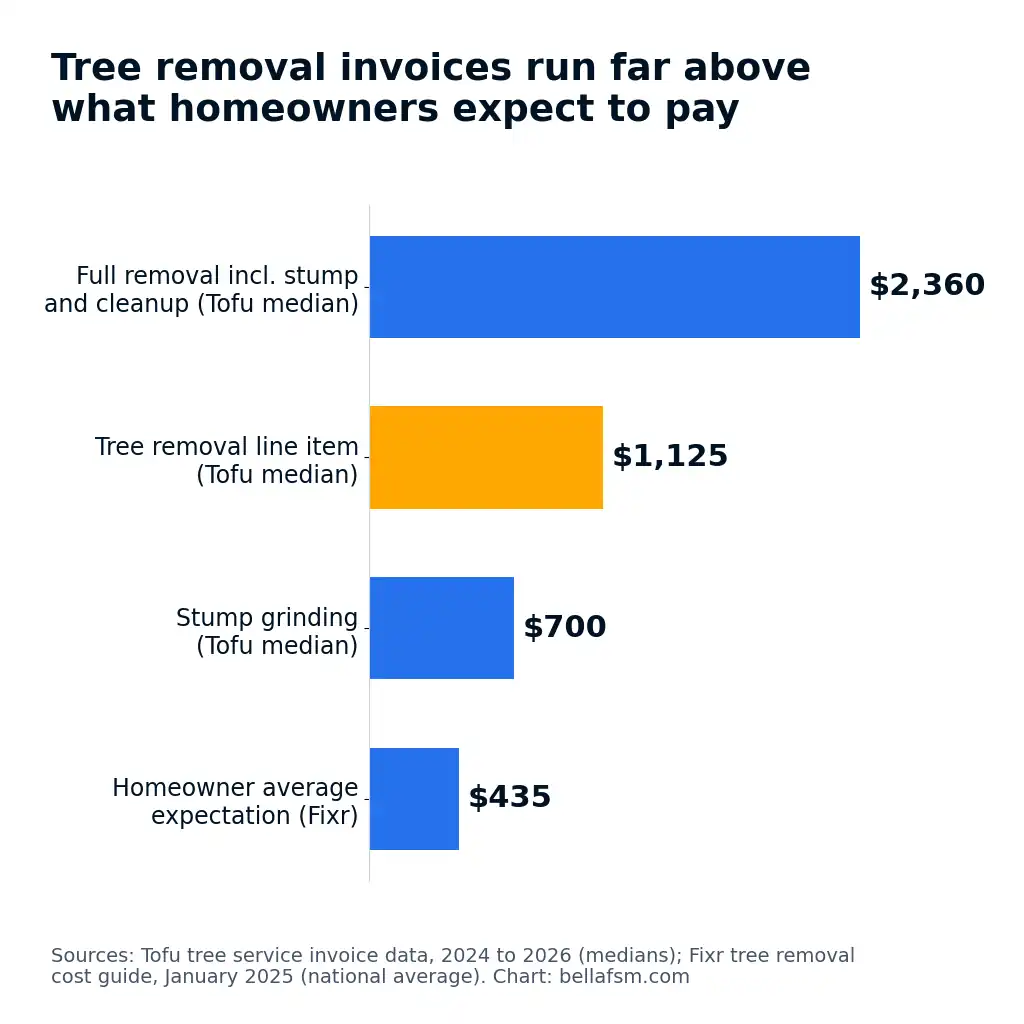
Tree removal price benchmarks: Tofu invoice medians, 2024 to 2026, compared with the Fixr homeowner average, January 2025. Sources: Tofu, Fixr. Chart may be embedded with attribution to Bella FSM and a link to this page.
Stump grinding, hauling and disposal as line items
Stump grinding, debris hauling and wood disposal should be separate line items on a tree removal quote, because each carries its own equipment, time and cost. Tofu's invoice data from 51 businesses and more than 6,000 jobs puts the median stump grinding charge at about $700, with the middle half of jobs between $300 and $1,700. Fixr's homeowner guide lists stump grinding at $100 to $500 per stump and debris removal at $150 to $300. The spread between those sources is the difference between one small stump and a crew-sized grinding job with root chasing and backfill. Splitting these items out lets customers drop an item without asking for a discount on the whole job, and gives your crew a clear scope, so nobody grinds a stump that was never sold. Customers also see exactly what they are paying for. One bundled number is how crews end up working the last two hours for free.
Converting an approved quote into a job in work order management software carries the stump count, haul-away and wood-retention notes to the foreman's phone.
A declined stump is also a future sale. Noting it in tree service crm software sets a reminder to offer the grind again next spring, when the stump starts sprouting.
Quote the stump, the haul and the wood as their own lines.
Ready to take your business further?
Start using Bella FSM free and work smarter.
Common tree removal pricing mistakes
Five mistakes come up again and again:
- Pricing from competitor quotes, when their number says nothing about your costs.
- Leaving estimate visits and weather days out of overhead, so they come out of profit instead.
- Saying "we'll grind it while we're here," which turns a $700 service into a giveaway.
- Charging the same for dead and live wood, even though brittle deadwood makes rigging riskier.
- Never asking why a bid was lost, so you never learn whether price was the problem.
If you are setting rates for the first time, our guide on how to start a tree service business covers the insurance, equipment and licensing costs that feed the overhead line.
Fix the rate first. The price follows from it.
Checking your price against market data
Once a bid is built from costs, compare it with the market. The Tofu figures in the chart are invoice medians, not recommendations. BLS reports a mean wage of $26.91 for tree trimmers, above the $24.50 median, so experienced climbers push your labor line up.
Your arborist software can run the yearly review: estimated against actual hours, quoted against invoiced amounts, and close rate by job type.
Market data checks your math. It should never be where the math starts.
Frequently Asked Questions
How to price tree removal jobs from your own numbers
Knowing how to price tree removal jobs means you start from a loaded crew-hour rate, estimate hours by phase, quote stumps and debris separately, and check the market last. Bella FSM keeps estimates, work orders and invoices in one place, and its tree service dispatch software puts the crew you priced on the job you sold. Start a free trial with your next removal bid.
Ready to grow your business?
Try Bella FSM free and simplify your work.