Grow Your Business
Backflow Testing Program: How Plumbers Turn Annual Tests Into Recurring Revenue
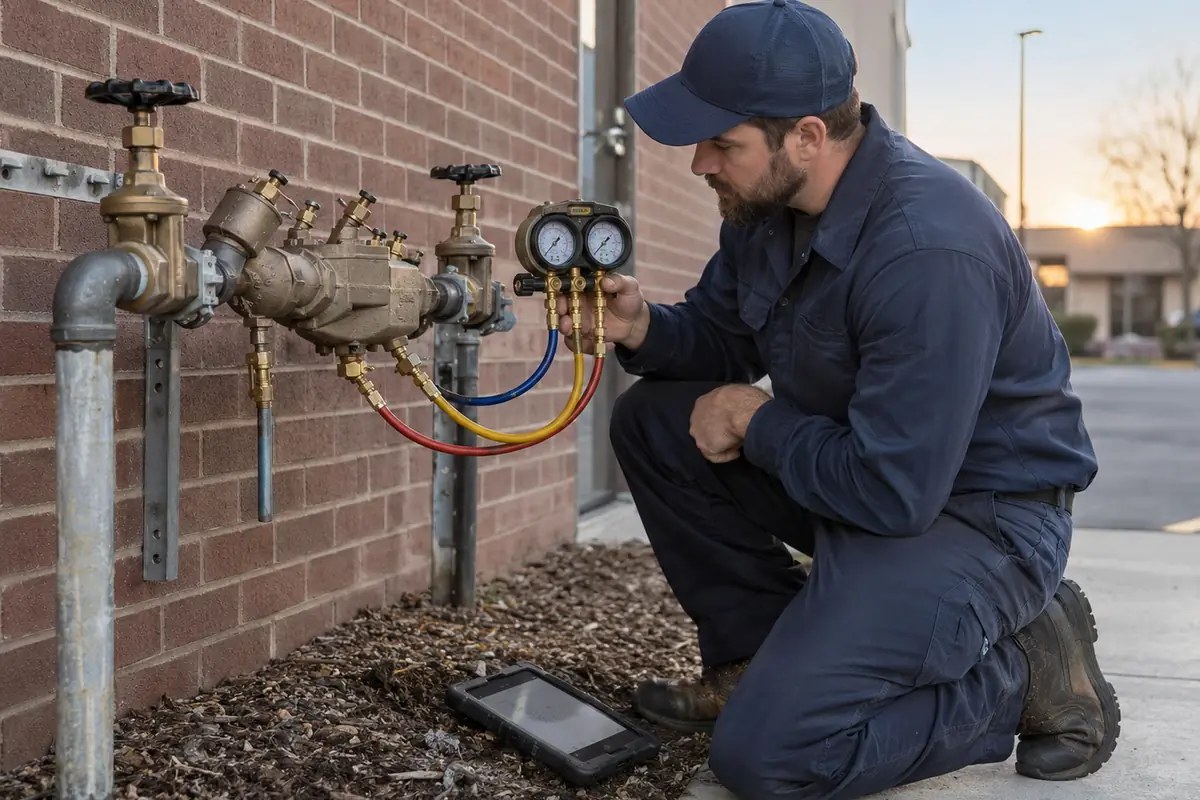
A backflow test takes about twenty minutes and pays roughly $165. According to HomeGuide's 2026 backflow testing cost guide, the national average is $165 per device, with most jobs landing between $30 and $300. On its own that is a small ticket. A backflow testing program is what turns it into something worth building a route around, because every testable assembly you certify this spring comes due again next spring, and the spring after that. Most shops treat backflow as work that arrives when a customer calls. The shops making money on it treat it as a renewal list they own. If you already run plumbing software for dispatch and customer history, you have most of the machinery already. What is usually missing is the discipline to work the list.
What does a backflow testing program actually include?
A backflow testing program is a standing service line where your shop tracks every testable assembly it is responsible for, tests each one on its required schedule, and files the report with the water purveyor before the deadline passes. It has four moving parts: a device inventory tied to a property, a certified tester with a calibrated gauge, a scheduling rule that fires from the device's last test date, and a reporting step that closes the loop with the utility. The IAPMO Backflow Prevention Institute wrote in February 2026 that all three model plumbing codes and many state regulations require testable assemblies to be tested at installation, after repair or relocation, and at least annually, with more frequent testing on fire protection and high-hazard systems. Installing the device does not make a customer compliant. Testing it and filing the paperwork does, and that gap is the service you are actually selling.
The device inventory is the piece most shops get wrong, because a customer record is not a device record. One commercial property can carry a reduced pressure assembly on the domestic line, a double check on the fire line, and a pressure vacuum breaker on irrigation, each with its own serial number and test history. Plumbing CRM software that stores those as separate assets under one account lets you renew a device instead of guessing at a customer.
Who owns the deadline
In most jurisdictions the property owner carries the obligation and the purveyor mails the notice. In practice the customer reads it, sets it aside, and calls whoever reaches them first. Decide now that the reminder is yours to send.

How much should you charge for a backflow test?
Price the test against the visit, not against the twenty minutes of gauge time. HomeGuide's 2026 cost guide puts the national average at $165 per device and the common range at $30 to $300, with outliers from $25 to $350 and plumber labor running $75 to $150 per hour. The spread is that wide because a $30 test is a second device on a property where the truck is already parked, and a $300 test is a single commercial assembly across town with a utility filing fee attached. Build your sheet the same way: a first-device price that covers drive time, paperwork, and the filing fee, then a materially lower each-additional-device price on the same address or the same block. That structure is what makes a dense route profitable, and it is also what wins multi-building property management accounts, because the buyer can see the volume logic instead of guessing at it.
| Line item | 2026 figure |
|---|---|
| National average test, per device | $165 |
| Common range, per device | $30 to $300 |
| Reported low and high | $25 and $350 |
| Residential test time | 20 to 30 minutes |
| Plumber hourly labor | $75 to $150 |
| Replacement assembly, installed | $200 to $1,000 |
Source: HomeGuide, "How Much Does Backflow Testing Cost?" 2026 cost guide.
Residential and irrigation assemblies
These are volume work. Irrigation preventers cluster in subdivisions built in the same few years, so one neighborhood can hold dozens of devices due in the same month. Price them tight and schedule them together. The margin comes from density.
Commercial and fire line accounts
Commercial buildings are the opposite: fewer addresses, more devices per address, and a facilities contact who cares more about a clean compliance record than the invoice. They also carry the repair work: a failed assembly that needs replacing runs $200 to $1,000 installed per HomeGuide's 2026 figures. Our guide on how to bid plumbing jobs covers the overhead math underneath any service price.
Ready to level up your business?
Try Bella FSM free and transform the way you work.
The route math behind an annual backflow program
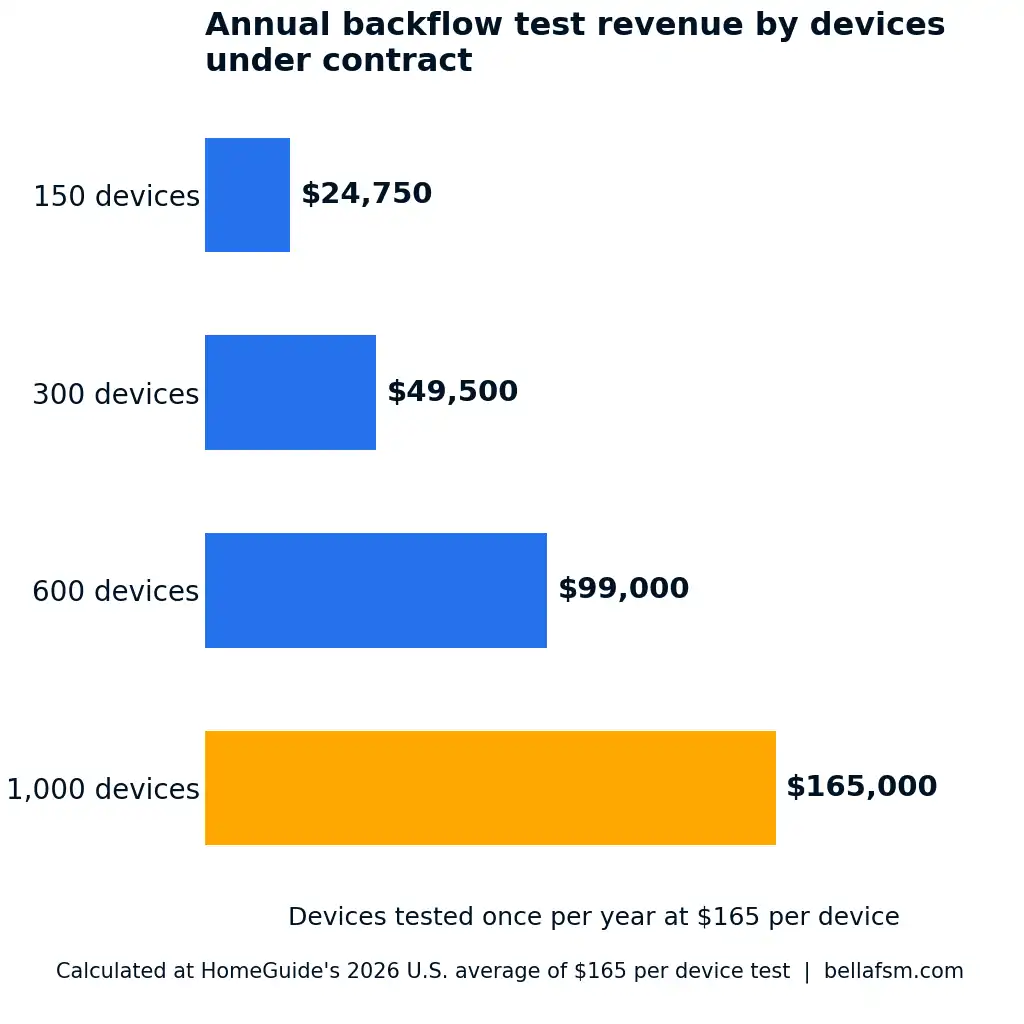
Run the arithmetic on devices under contract rather than on jobs booked and a small ticket starts to behave like an annuity. The table below multiplies device count by HomeGuide's $165 national average. The tech-day column is an illustrative planning figure rather than a published benchmark: it assumes twelve tests per technician day, which fits HomeGuide's 20 to 30 minute test window plus travel and filing on a dense route.
| Devices under contract | Annual test revenue at $165 | Tech-days per year at 12 tests/day |
|---|---|---|
| 150 | $24,750 | 12.5 |
| 300 | $49,500 | 25 |
| 600 | $99,000 | 50 |
| 1,000 | $165,000 | 83 |
Source: device counts multiplied by HomeGuide's 2026 national average of $165 per device test. Tech-days are an illustrative planning assumption, not a published figure.
Six hundred devices works out to fifty tech-days, or one technician on backflow roughly one week in ten for $99,000, and that counts none of the repair work the visits turn up. The pull-through is usually worth more than the tests. Shops that use plumbing business management software to keep device history on the asset can see that an assembly failed twice in four years. Shops that track invoices only start every visit from scratch.
Chart may be embedded with attribution to Bella FSM and a link to this page.
How do you stop annual backflow tests from slipping?
Slippage is the failure mode that kills these programs, and it is almost never a technician problem. A test that was due in April and gets done in August still counts as one test that year, so revenue looks fine on the P&L while the customer has spent four months out of compliance and fielding calls from competitors. The fix is structural. Your renewal date has to live on the device record and trigger on its own, at a fixed offset from the last passing test, without anyone remembering to look. Sixty days out, the customer gets a notice. Thirty days out, the job is on the board. Ten days out, it is assigned. Plumbing scheduling software that generates recurring work orders from a device's test anniversary removes the human step entirely, which matters because the human step is the one that fails every busy season.
Trigger from the device, not the customer
A customer with three assemblies has three separate clocks. Tie the reminder to the serial number and that resolves itself. Tie it to the account and you will test one device, close the ticket, and lose the others for a year.
Batch by water purveyor, not by zip code
Every utility has its own form, portal, and filing window. Grouping a day's tests by purveyor means one set of paperwork rules and one submission session instead of six. Technicians hate filing, and batching stops it becoming a pile on someone's desk.
Certification and the 2026 compliance shift
Backflow testing is gated work. A tester needs a current certification, a calibrated gauge, and in many jurisdictions a separate registration with each water purveyor served. Those requirements are tightening. California's State Water Resources Control Board states that from July 1, 2026 through June 30, 2027, backflow assembly testers and cross-connection control specialists working for compliance with the Cross-Connection Control Policy Handbook must be certified by a certifying organization recognized in California, and that effective July 1, 2027 only organizations accredited by ANSI to ISO/IEC 17024 can be used. California is not every state, but California water rules tend to travel, and the same ANSI standard is the reference point elsewhere. If your testers hold a certification from an organization that has not applied for recognition, you want to know that this year rather than during the week a purveyor rejects a filed report and the customer asks why.
Certification also changes what a technician is worth on the truck. The training covers cross-connection theory and assembly repair, and a technician who understands why an assembly failed sells the replacement more credibly than one who only knows that it did. Capture the result, the gauge readings, and the photos on the visit record. Work order management software that files the report against the device makes a five-year failure history searchable.
Ready to take your business further?
Start using Bella FSM free and work smarter.
Mistakes that stall a backflow program
- Quoting one flat price with no each-additional-device rate, which leaves money on dense residential routes and prices you out of multi-building accounts.
- Letting the utility own the reminder, so the purveyor's notice sends your customer shopping.
- Treating a failed test as a bad outcome rather than a repair lead you were paid to find.
- Filing reports late, which in some jurisdictions voids the test and costs you a free retest.
- Leaving the retest price undecided until a device fails, instead of putting it on the estimate up front.
- Sending the invoice on a separate cycle from the certificate. Customers pay fastest while the compliance relief is still fresh, and plumbing invoicing software that bills straight off the completed work order closes that gap.
Frequently Asked Questions
Turn the list into a route
A backflow testing program is one of the few plumbing service lines where the work arrives on a schedule you control. The devices are already in the ground and the interval is already written into code, so the open question is whose renewal list they sit on. Start by inventorying every testable assembly your crews have touched in the last three years, then put a test anniversary on each device record. Shops that have already sorted out after hours plumbing calls usually take to this quickly, because it runs on the same recurring structure.
From there it is a matter of letting the calendar do the asking. Point scheduling software for plumbers at the test anniversary, let it raise the sixty-day notice on its own, and the renewal list works itself. Bella FSM keeps that structure on the board, from the device record through the invoice.
Ready to grow your business?
Try Bella FSM free and simplify your work.