
Grow Your Business
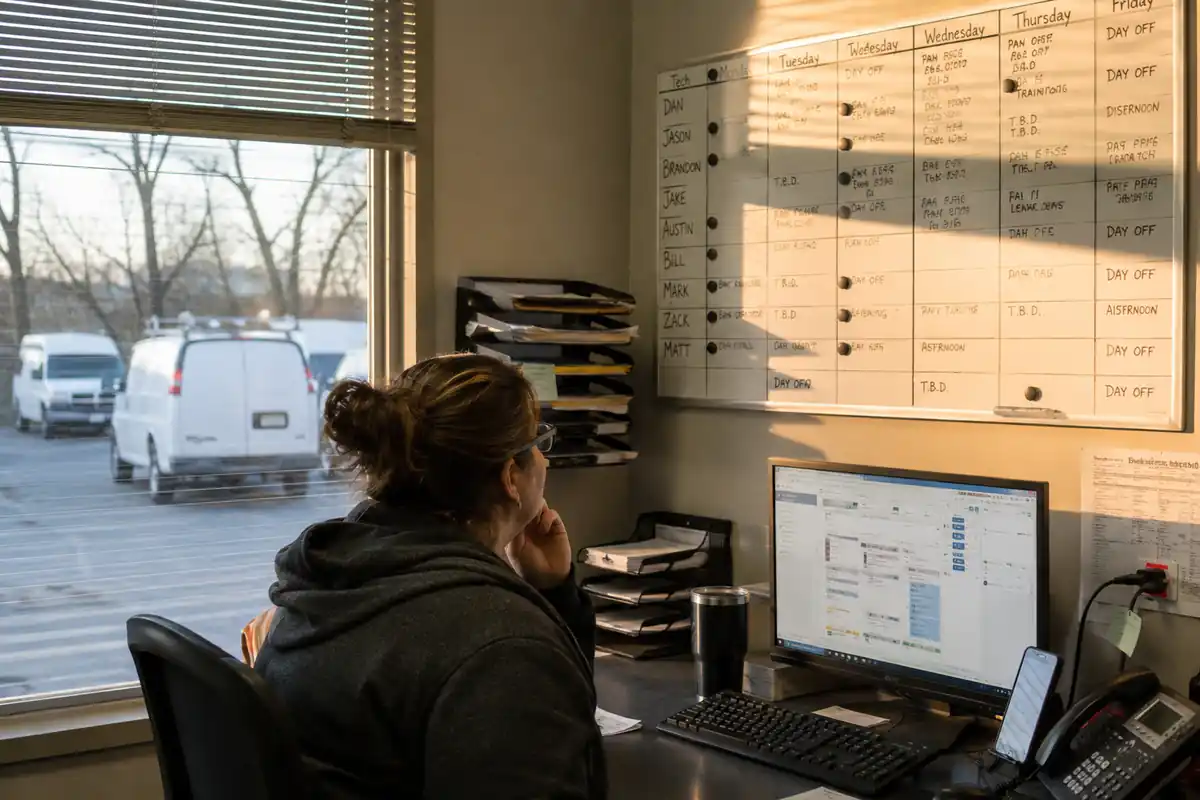
It is 3:40 on a Thursday and the phone rings with a no-heat call twenty-two minutes past your closest truck. Every technician is already at forty hours. You take the call, because you always take the call, and Friday's payroll absorbs another $210 nobody budgeted. Three afternoons a week of that becomes a five-figure line item. Most owners try to reduce technician overtime by telling the crew to move faster. That rarely works, because overtime is not a speed problem. It is a scheduling, routing, and information problem, and the fix lives in how you build the day rather than how hard you push at the end of it. Good dispatch software makes those tradeoffs visible before you commit a truck.
What an Hour of Overtime Actually Costs You
The 1.5x multiplier is the number every owner knows, and it is the smaller half of the story. Overtime wages carry payroll burden on top of the inflated rate. Employer payroll taxes run roughly 8% to 13% of gross wages, and workers' compensation adds more by trade: plumbers 5% to 9% of payroll, electricians 6% to 10%, HVAC technicians 8% to 12%. Here is what a $35 per hour technician really costs past 40 hours:
| Line item | Straight time | Overtime |
|---|---|---|
| Base wage | $35.00 | $52.50 |
| Payroll taxes (approx. 10%) | $3.50 | $5.25 |
| Workers' comp (approx. 8%) | $2.80 | $4.20 |
| Loaded cost per hour | $41.30 | $61.95 |
Two overtime hours a day, three days a week, across 48 weeks is 288 hours, or roughly $17,800 a year for one technician. A six-truck shop running half that pace spends over $53,000 a year on unplanned hours. Most owners never see the figure because time entries live in payroll and job costs live elsewhere. When hours flow from the same job record that produces the bill, field service invoicing software shows overtime attached to specific jobs instead of buried in a payroll total.
Takeaway: calculate your loaded overtime rate and write it on the dispatch board. Decisions change when the dispatcher sees $62 instead of $35.
Five Things That Actually Create Overtime
Overtime is a symptom. Before changing policy, spend two weeks coding every overtime hour to a cause. In most shops the same five reasons account for nearly all of it.
1. Optimistic job durations. A shop that books four-hour installs into four-hour slots has zero recovery room. Jobs run long for ordinary reasons: a seized access panel, a talkative customer, a supply house out of stock. If your average job overruns by 20%, an eight-hour day becomes a 9.6-hour day. Booking against historical actual durations is the highest-leverage change most shops can make, and it is where service scheduling software earns its keep.
2. Missing site information. The technician arrives, finds equipment nobody documented, and burns 45 minutes on the phone. A field service crm for small business holding equipment models, gate codes and prior repair notes removes most of that waste from the second visit onward.
3. Mid-day parts runs. A round trip to the supply house costs 50 to 90 minutes with counter time. Two in a week wipes out an afternoon.
4. The late-day emergency. The 3:30 call is real revenue and you should usually take it. The question is which truck takes it, and shops rarely decide deliberately.
5. After-hours paperwork. A technician writing up five jobs at the kitchen table at 7pm generates compensable time whether or not it was recorded. That is a payroll cost and a compliance exposure at once.
Takeaway: cause-code two weeks of overtime. Two of these five usually produce most of the hours, so you have two problems to solve.

Travel Time Is Where Unplanned Overtime Hides
This is where owners create overtime accidentally. Under the Fair Labor Standards Act and the Portal-to-Portal Act, ordinary home-to-work travel is not compensable, even when the worksite changes daily and even in a company truck. The drive from home to the first job, and from the last job home, is normally commuting.
The exception catches people. If you require a stop at the shop first to pick up parts or attend a huddle, the workday starts at the shop. Everything after that, including the drive to the first customer, is paid time. Travel between job sites is always compensable.
Do the arithmetic on a mandatory 7:00am shop stop. If it adds 35 minutes of paid time per technician per day across six technicians, that is 17.5 hours a week, and for a crew already near 40, most of it lands at the overtime rate. The fix is not to cancel a huddle that earns its keep. It is to decide whether the shop stop is truly required, then route accordingly. Good technician dispatch software surfaces that tradeoff, because a routing decision made at 6:45am sets the payroll number for the whole day.
Capturing the time honestly matters as much as reducing it. A mobile field service app that timestamps arrival and departure at each stop gives you a defensible record and shows how much of the week is windshield time.
Takeaway: audit your shop-stop policy against how technicians actually start their day. If it says optional but works out mandatory, you pay either way.
Ready to level up your business?
Try Bella FSM free and transform the way you work.
Dispatch Controls That Reduce Technician Overtime Before It Starts
Once you know the causes, the controls are straightforward. None require capping the schedule or turning work away.
- Show the loaded overtime rate at assignment. Choosing between a technician at 38 hours and one at 41 is a $20 per hour decision.
- Set a daily overtime cap. Two hours is the common threshold. It keeps flexibility for emergencies while stopping the drift into ten-hour days.
- Rotate the late slot. Overtime concentrates on the two or three technicians who never say no. Put the after-hours rotation on a calendar, not on reflex.
- Hold a recovery block. Leave the last 60 to 90 minutes unbooked. It absorbs overruns and gives you somewhere to put the 3:30 call without paying a premium.
- Stage parts the night before. Pulling tomorrow's parts at 4pm turns a 60-minute mid-day supply run into a five-minute morning pickup.
- Match skill to job, not proximity. The closest technician on a job outside their skill band trades 15 minutes of driving for two hours of struggle.
These controls work best when the tool enforces them rather than a person remembering at 3:30 on a Thursday. Modern job scheduling software can flag an assignment that pushes someone past a threshold before the job is offered, turning overtime into a conscious decision instead of an accident.
Review the result alongside the field service metrics you already watch, so overtime is never managed in isolation from utilization.
Takeaway: pick two controls, not six. The recovery block and the visible overtime rate work fastest.
When Overtime Is Actually the Cheaper Option
Here is what almost nobody says out loud: some overtime is the most profitable capacity you can buy. A seventh technician is not a $60,000 decision. It is closer to $95,000 or $115,000 once you add burden, a truck payment, commercial auto insurance, fuel, tools, and 60 to 90 days of ramp.
At roughly $62 per loaded overtime hour, that hire equals 1,500 to 1,850 overtime hours a year. If your team runs 900 overtime hours annually and those hours are billable at full rate, overtime is the cheaper capacity by a wide margin. Selling an hour at $165 that costs $62 beats carrying a truck you cannot keep busy in February.
Three conditions flip that math:
- The hours are not billable. Overtime spent on paperwork, parts runs, or callbacks is pure cost. Track it separately or the calculation is fiction. Our guide to billable hours shows how to draw that line.
- Callbacks are climbing. A tired technician at hour eleven makes mistakes, and a callback costs a full truck roll plus the goodwill.
- Your best people are leaving. Replacing an experienced technician runs past $20,000 once you count recruiting, ramp, and lost revenue. Chronic overtime on the same two people is a resignation with a delay timer.
Whichever way the math falls, price the work correctly. When a job carries premium labor, that has to reach the invoice, and field service billing software pulling actual logged hours rather than estimates keeps the margin from evaporating between the truck and the ledger.
Takeaway: run the break-even before you post the job listing. Many shops hire a truck to fix what better dispatch would fix for free.
Ready to take your business further?
Start using Bella FSM free and work smarter.
Track It Monthly or It Comes Back
Overtime does not stay fixed. It creeps back every busy season. Four numbers keep it honest:
- Overtime as a share of total labor hours. Under 5% is healthy for most residential shops. Above 10% signals a structural capacity problem.
- Overtime concentration. What share sits with your top two technicians? Above roughly 35% is a retention risk, not a scheduling win.
- Billable share of overtime. If under 70% of overtime hours attach to a billable job, the problem is administrative, not demand.
- Margin on overtime versus straight-time jobs. If overtime jobs run five or more points lower, your pricing ignores your true labor cost.
Concentration data is usually the most useful of the four, because it reveals whether one customer or property type quietly generates your overtime. Job history stored against the customer record in a field service crm makes that pattern obvious within a quarter, and sometimes the answer is repricing the account rather than rescheduling the crew.
Takeaway: put these four numbers on one page and review them alongside revenue. Overtime measured monthly cannot compound.
Frequently Asked Questions
Start With the Number, Then Fix the Day
You do not reduce technician overtime by asking people to hurry. You reduce it by knowing what an overtime hour truly costs, cause-coding where the hours come from, tightening the two dispatch decisions that create most of them, then deciding on purpose which overtime you want to buy. Some of it earns its keep. The rest is a schedule built on hope.
Bella FSM gives small and mid-sized service businesses one place to schedule, dispatch, capture technician time, and invoice from the same job record, so overtime stops hiding between systems. Start a free trial and see where your hours are going.
Ready to grow your business?
Try Bella FSM free and simplify your work.