
Grow Your Business
2026 State of Small Field Service Businesses: Statistics, Trends & Benchmarks
2026 Field Service Report
What 2026 Looks Like for Small Field Service Businesses
Small field service businesses are still in demand, but 2026 is shaping up to be a year where profit depends less on “staying busy” and more on controlling the everyday leaks: labor, fuel, missed calls, slow estimates, late invoices, and wasted drive time.
Running a small field service business has never been simple. Whether you run an HVAC company, plumbing business, electrical service company, pest control company, cleaning company, lawn care business, or general contracting company, the work happens in the real world. Trucks break down. Customers reschedule. Technicians get delayed. Parts are missing. Invoices sit unpaid.
The good news is that demand for skilled service businesses remains strong. People still need repairs, maintenance, installations, inspections, and emergency service. The hard part is turning that demand into profitable, predictable work.
This report breaks down the biggest trends affecting small field service businesses in 2026, using practical statistics from non-competitor sources including NFIB, the U.S. Bureau of Labor Statistics, Associated Builders and Contractors, QuickBooks research, and U.S. Energy Information Administration data.
Main takeaway: The businesses winning in 2026 are not necessarily the ones with the most trucks. They are the ones that schedule tighter, respond faster, invoice sooner, and waste less technician time.
Key Findings for 2026
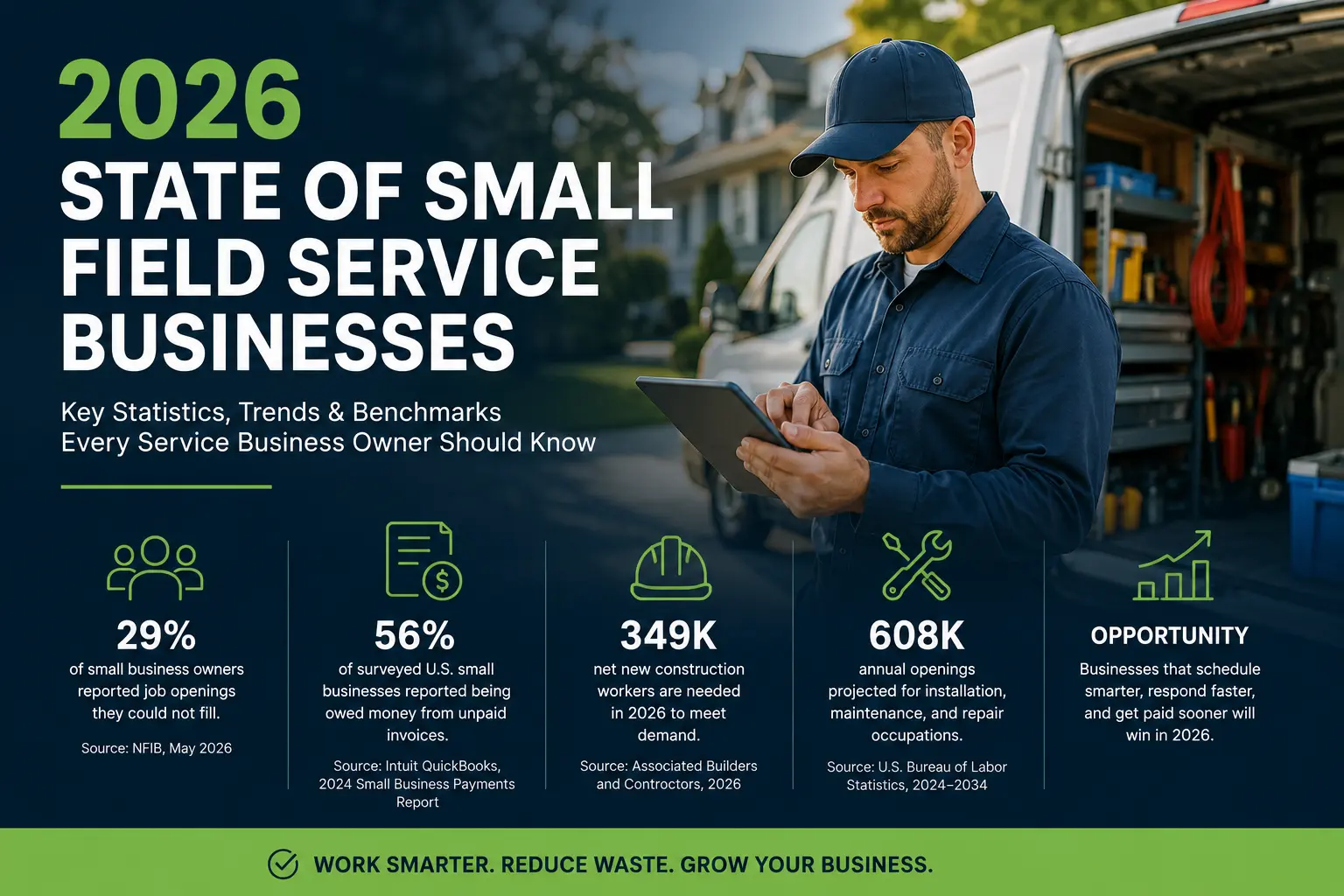
29%
of small business owners reported job openings they could not fill in May 2026.
56%
of surveyed U.S. small businesses reported being owed money from unpaid invoices.
349k
net new construction workers are needed in 2026 to meet demand, according to ABC.
608k
annual openings are projected for installation, maintenance, and repair occupations.
1. Small Business Owners Are Fighting Pressure From Every Direction
Small service businesses are getting squeezed from multiple sides. Labor is harder to find. Labor costs are rising. Customers expect faster communication. Fuel and materials remain unpredictable. Cash flow gets tighter when customers pay late.
NFIB’s May 2026 small business survey shows how many pressure points are hitting owners at once. Seventy percent of small business owners reported supply chain disruptions affected their business to some extent. A net 36% reported raising average selling prices, while 34% planned to increase prices. At the same time, 29% reported job openings they could not fill.
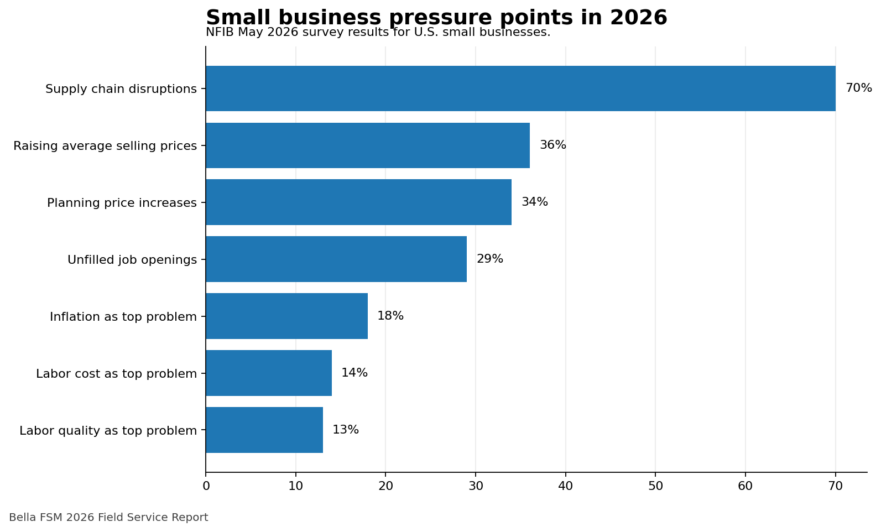
For field service owners, those numbers are not abstract. They show up as real daily problems: expensive overtime, schedule gaps, delayed jobs, higher parts prices, and uncomfortable pricing conversations with customers.
2. Labor Is Still the Biggest Constraint
For most field service businesses, labor is the largest expense and the biggest growth constraint. You can have a full phone, a strong reputation, and plenty of demand, but if you cannot find qualified technicians, you cannot complete more profitable work.
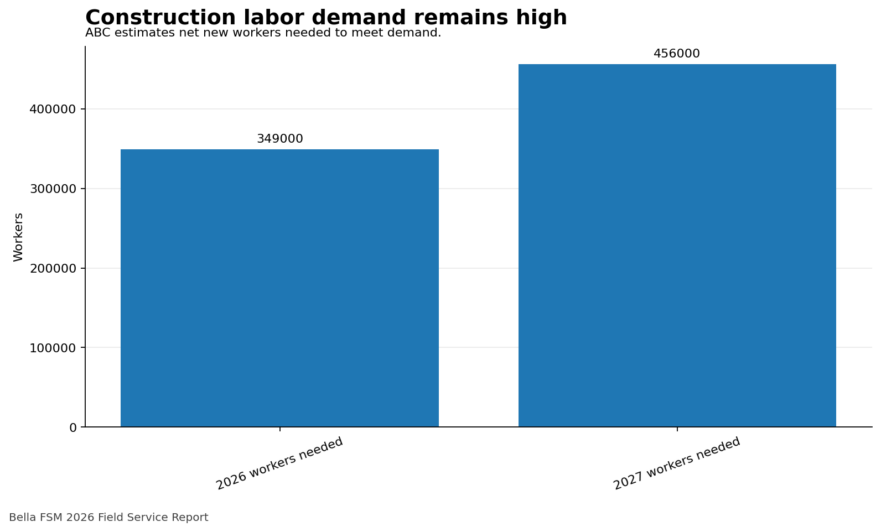
Associated Builders and Contractors estimates that the construction industry needs to attract 349,000 net new workers in 2026 to meet demand. In 2027, that number rises to 456,000 workers. While not every field service business is a construction company, the same skilled labor pressure affects contractors, specialty trades, maintenance teams, and service companies competing for similar workers.
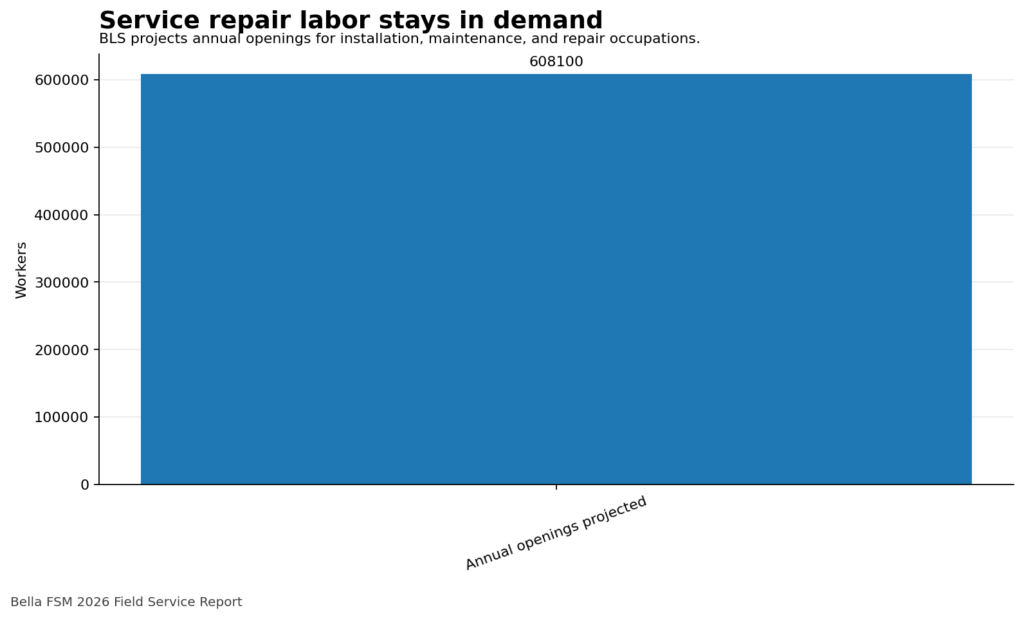
The U.S. Bureau of Labor Statistics also projects about 608,100 openings per year for installation, maintenance, and repair occupations from 2024 to 2034. That means demand for service-related labor is not going away.
The practical takeaway is simple: if labor is hard to find, every existing technician hour becomes more valuable. A business that wastes technician time through poor scheduling, extra driving, missing job details, or delayed paperwork is effectively giving away capacity it cannot easily replace.
3. Fuel Costs Make Bad Scheduling More Expensive
Fuel is one of the most visible costs in a field service business. Every route, callback, missed appointment, and inefficient dispatch decision affects the fuel bill.
According to the U.S. Energy Information Administration series published through FRED, the weekly U.S. regular gasoline price was $3.914 per gallon on June 22, 2026. Prices moved down from late May highs, but they remained high enough to matter for any business running multiple trucks.
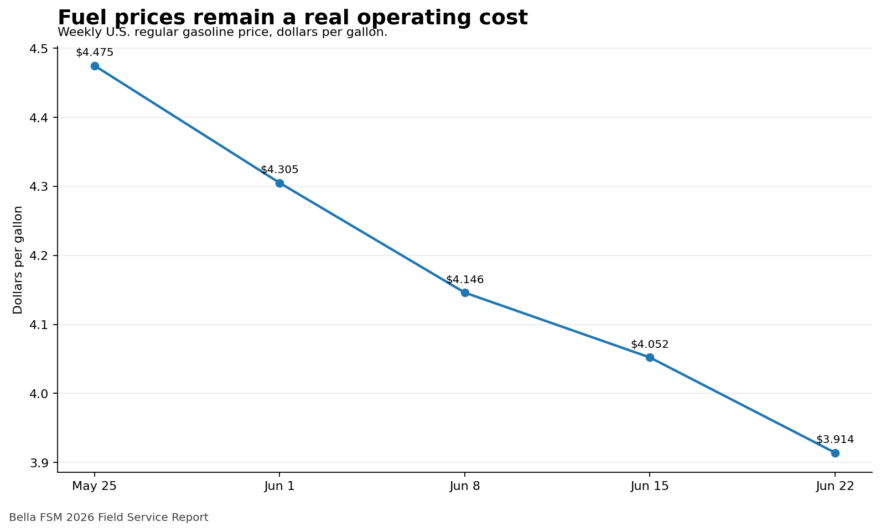
For a service company, fuel cost is only part of the damage. Drive time also reduces billable capacity. Better field service scheduling software helps reduce unnecessary trips, route confusion, and schedule gaps. If a technician loses just one unnecessary hour per day to poor routing, that can add up to 260 hours per year. At a $150 billable rate, that is $39,000 in potential annual revenue tied up in unproductive time for one technician.
4. Revenue Leaks Usually Look Small at First
Most owners do not lose profit from one dramatic mistake. Profit usually leaks out in small ways: missed calls, slow follow-up, inefficient routes, unbilled work, late invoices, rework, and unclear estimates.
The chart below is an illustrative example of why margins can feel tight even when the schedule looks full. If labor, materials, overhead, insurance, vehicles, and admin costs keep rising, the true profit left at the end can be much smaller than the top-line revenue suggests.
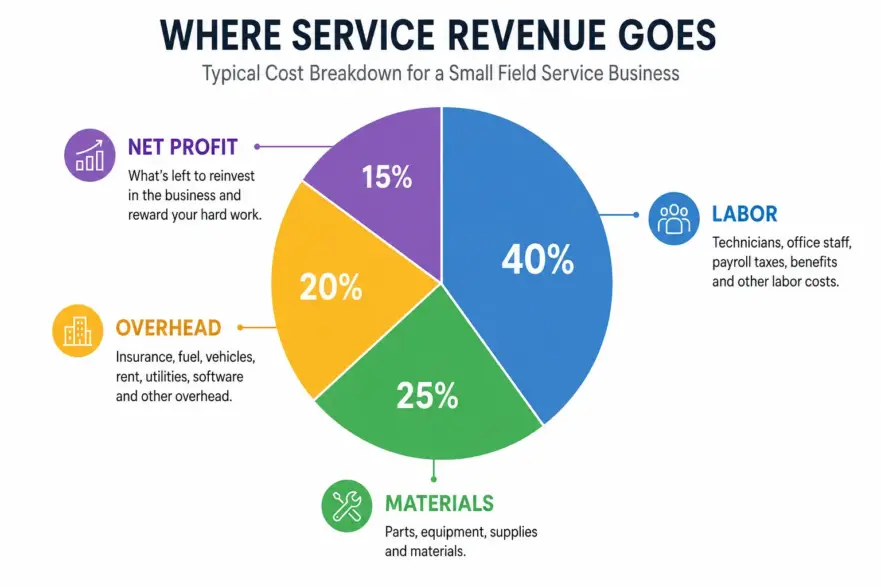
This is why operational discipline matters. A company does not need to double revenue to improve profitability. Even small improvements in dispatching, scheduling, and job follow-up can make the work already on the calendar more profitable. Sometimes the fastest improvement comes from reducing waste in the work already being sold.
5. Late Payments Are a Bigger Problem Than Many Owners Admit
Cash flow is one of the most common pain points for small service businesses. A business can be profitable on paper and still feel broke if invoices are not collected quickly.
QuickBooks 2025 U.S. Small Business Late Payments Report found that 56% of surveyed small businesses reported being owed money from unpaid invoices, averaging $17,500 per business. The same report found that 47% had a portion of invoices overdue by more than 30 days, with nearly 1 in 10 invoices falling into that bucket on average.
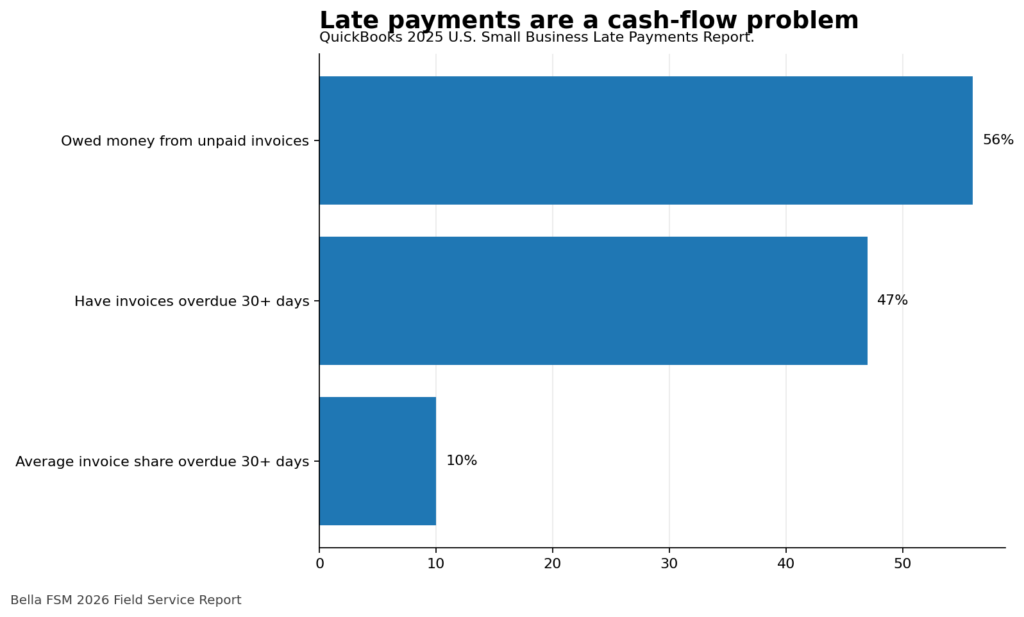
For field service businesses, late payments often start with slow invoicing. If paperwork waits in a truck, if the office has to manually rebuild job details, or if invoices are sent days after work is complete, the payment clock starts late.
Smart operators tighten this workflow. They capture job details in the field, create invoices quickly with field service invoicing software, send them immediately, and make payment easy.
6. Customers Expect Faster Communication
Customers do not compare your business only to other contractors. They compare the experience to every modern service they use.
That means they expect clear communication, including:
- Fast call-backs
- Appointment reminders
- Technician arrival windows
- Digital estimates
- Digital invoices
- Simple payment options
For many small service businesses, this is where sales are won or lost. A missed call may become a lost job. A slow estimate may give a competitor time to win the customer. A confusing invoice may delay payment.
7. The Most Useful 2026 Benchmarks for Owners
Instead of tracking dozens of complicated metrics, small service businesses should focus on a few numbers that directly affect profit and cash flow.
Scheduling Benchmarks
- Jobs completed per technician per day
- Average drive time between jobs
- Schedule gaps and unassigned work
- Callbacks or return visits
Sales Benchmarks
- Estimate approval rate
- Average estimate value
- Time from estimate sent to follow-up
- Time from approval to scheduled work
Cash Flow Benchmarks
- Average invoice value
- Days from job completion to invoice sent
- Invoices overdue by 30+ days
- Days to payment
These metrics are useful because they connect directly to owner pain. They answer practical questions: Are we using technician time well? Are we following up fast enough? Are we invoicing quickly? Are customers paying on time?
8. What Smart Owners Are Fixing in 2026
The best small field service businesses are not trying to solve everything at once. They are fixing the bottlenecks that create the most drag.
They tighten scheduling
They reduce unnecessary drive time, avoid schedule gaps, and assign the right technician to the right job with better field service scheduling and dispatch visibility.
They speed up estimates
They make estimates clear, professional, and easy to approve. A simple contractor estimate template can help standardize pricing, scope, and customer approval details.
They invoice faster
They do not let completed jobs sit unbilled for days. Faster field service invoicing helps start the payment clock sooner.
They track overdue invoices
They know who owes money and follow up before receivables become a cash-flow problem.
They reduce owner dependency
They build repeatable systems so the business does not rely on the owner remembering every detail. A centralized field service CRM keeps customer, job, estimate, and invoice history easier to find.
Final Takeaways
The 2026 field service market still offers plenty of opportunity for small businesses. Demand is not the problem. Execution is the problem.
The companies that win will be the ones that control the basics better:
- Answer faster
- Schedule smarter
- Reduce wasted drive time
- Send better estimates
- Invoice from the field immediately
- Collect faster
Technical skill gets the job done. Operational discipline turns that work into predictable profit.
Bottom line: In 2026, small field service businesses do not just need more work. They need better systems for managing the work they already have.
Sources
- NFIB, Small Businesses Report Reduced Optimism, June 2026
- Associated Builders and Contractors, Construction Industry Must Attract 349,000 Workers in 2026
- U.S. Bureau of Labor Statistics, Installation, Maintenance, and Repair Occupations
- FRED / U.S. Energy Information Administration, U.S. Regular All Formulations Gas Price
- QuickBooks, 2025 U.S. Small Business Late Payments Report