
Grow Your Business
The first heat pump quote you send this month will land differently than the ones you sent in December. The federal tax credit that helped close those sales is gone, and homeowners know it. Some will delay. Some will ask why your number did not drop by two thousand dollars overnight. The shops that keep selling heat pump retrofits in 2026 are not the ones with the lowest bid; they are the ones that can walk a customer through what incentives still exist, quote fast, and run the job cleanly. That takes a repeatable process, and for most small contractors it starts with getting quotes, rebates, and installs out of spreadsheets and into HVAC software that tracks every open opportunity until it closes.
The 2026 retrofit market: what changed on January 1
The Section 25C tax credit, which covered 30 percent of a qualifying heat pump installation up to $2,000, expired for installs completed after December 31, 2025, according to Rewiring America's 25C guide. That is a real loss at the kitchen table, but it is not the end of the retrofit market. Demand for heat pumps was building long before the credit existed. Per RMI's heat pump market tracker, heat pumps have outsold gas furnaces in the United States every year since 2021. Contractors who treat January 2026 as the end of heat pump sales are reading the moment wrong. The buyer pool changed; it did not disappear. Homeowners with failing equipment still need replacements this year, and a large group of them still qualifies for point-of-sale rebates that never touched the tax code. Your job is to know exactly which incentives survived and to build your sales conversation around them.
That last point matters because the surviving programs are rebates, not credits. They come off the invoice at the point of sale instead of showing up at tax time, which changes how you quote and how you get paid.
What does a heat pump retrofit cost in 2026?
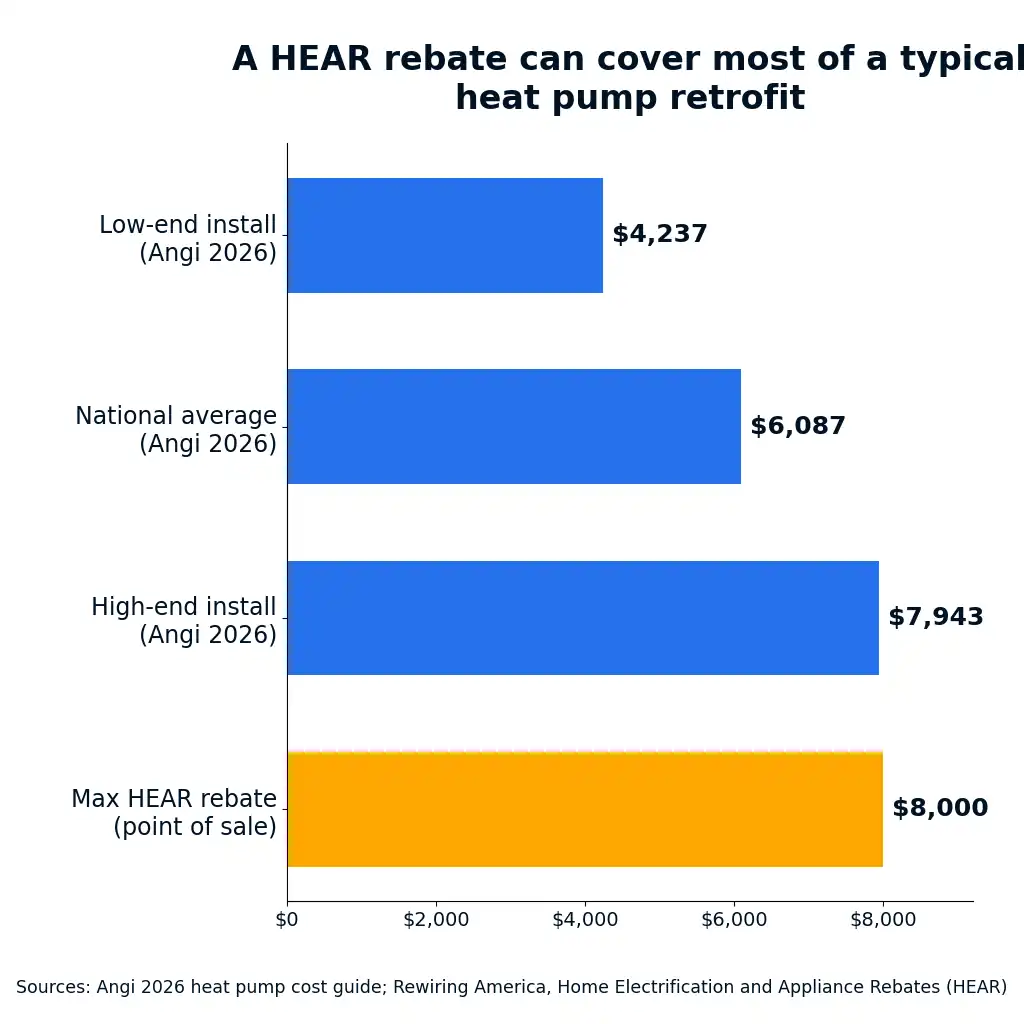
A typical air-source heat pump retrofit runs $4,237 to $7,943 installed, with a national average of $6,087, according to Angi's 2026 heat pump cost guide. Cold climate equipment, ductwork corrections, and electrical work push jobs above that range, while a straightforward changeout on existing ducts with adequate panel capacity lands near the bottom of it. The number that changes the conversation is the rebate: the federal Home Electrification and Appliance Rebates program, known as HEAR, still offers up to $8,000 off a qualified heat pump at the point of sale, per Rewiring America's HEAR guide. Households under 80 percent of area median income can have up to 100 percent of project cost covered, and households between 80 and 150 percent can have half covered. For an income-qualified customer, a rebate that size can cover most of an average install, which makes the 25C loss beside the point.
The catch is that HEAR runs through state energy offices, so availability and paperwork vary by state, and funds move in waves. Quote against the program your state actually has open, not the national headline number.
Expect more quotes to stall in 2026 than last year. A stalled quote is not a dead quote. Log every open estimate with the equipment quoted, the rebate discussed, and a follow-up date in your HVAC CRM software so the customer who says "let me think about it" in March hears from you again before their system dies in July.

How should you sell heat pump retrofits without the federal tax credit?
Lead with the incentives that still exist, then sell the operating cost story. The conversation that worked in 2025 ("the government pays you back $2,000 at tax time") is dead, and pretending otherwise will cost you trust. What works now is specific: this is your utility rebate, this is your state HEAR rebate if you qualify, this is what the equipment costs after both, and this is what your winter bills look like against a 15-year-old furnace and AC pair.
Rebate paperwork is now a sales skill. The shop that files utility and state rebate applications for the customer, and tracks them to payment, wins the job over the shop that hands over a brochure. If your office is still chasing rebate status by memory, the workflow in our guide to HVAC rebate paperwork covers how to document, submit, and track every application without losing billable hours to it.
Two more moves close hesitant buyers. First, offer a dual fuel option: a heat pump paired with the existing furnace as backup. It is a smaller ticket than a full electrification job, but it gets the customer onto heat pump economics and positions you for the full changeout later. Second, put monthly financing on every retrofit quote. A $6,000 job reads differently at roughly $115 a month, and shops that run every proposal through the same quoting process inside their HVAC business software can present cash, financed, and dual fuel numbers side by side instead of promising to email them later.
Ready to level up your business?
Try Bella FSM free and transform the way you work.
How do you schedule multi-day retrofits without wrecking service capacity?
A retrofit changeout is a one-to-three-day job that has to coexist with the emergency calls that pay this week's payroll. The failure mode is familiar: an install crew gets pulled off a changeout for a no-heat call, the retrofit slides a day, the homeowner is furious, and the crew burns an hour remobilizing. The fix is structural, not motivational. Dedicate install capacity in blocks, keep service techs on service, and put a hard rule on who is allowed to be pulled. Then make the schedule visible to everyone. When dispatchers can see install blocks and service demand on one board inside HVAC scheduling software, they stop robbing the install crew to patch the service board, because the cost of the move is visible before they make it. Shops that protect install blocks this way complete changeouts on the day they promised, and on-time completion is the single cheapest source of five-star reviews a retrofit business has.
Seasonality matters more without the credit. The tax deadline no longer creates a December rush, so push retrofit installs into shoulder season deliberately: quote in spring, install in April, May, September, and October when service demand is soft and crews would otherwise sit.
Sizing and scoping: where retrofit jobs go wrong
Most heat pump callbacks trace to the scope, not the equipment. Three checks catch the expensive surprises before the contract is signed.
Run a real load calculation
Rule-of-thumb sizing that worked for oversized furnaces will produce a heat pump that short-cycles in summer and underheats in January. Run a Manual J on every retrofit; our HVAC load calculator walks through the inputs if your team needs a refresher. Size to the calculation, then talk the customer through why the smaller unit is the right one.
Inspect the ductwork before you quote
Heat pumps move more air at lower temperatures than furnaces. Undersized returns and leaky trunks that a furnace muscled through will make a heat pump feel weak. Walk the duct system during the estimate, price corrections into the quote, and photograph what you find so the price holds up when the customer compares bids.
Check the electrical panel early
A full electrification retrofit can need a 240-volt circuit and sometimes a panel upgrade. Finding that out on install day turns a two-day job into a two-week one. Put the panel check on the estimate visit, and write multi-day changeouts up in work order management software so the electrical subcontract, equipment delivery, and crew assignments live on one job record instead of three text threads.
Ready to take your business further?
Start using Bella FSM free and work smarter.
Turn every retrofit into recurring revenue
A heat pump runs year-round, which makes twice-a-year maintenance an easy, honest sell at the moment of install. Attach a maintenance agreement to every retrofit closing, priced into the monthly payment where you can. The agreement is worth more than its sticker: it locks in the future repair relationship, feeds shoulder-season work to your service techs, and turns a one-time install customer into a decade of revenue. Progress billing matters on the bigger jobs too. Collect a deposit at signing and bill the balance at commissioning through HVAC invoicing software so a multi-day changeout does not float on your cash for a month.
A retrofit sold without an agreement attached is a discount you gave away. Make the agreement the default line item and let customers opt out, not in.
Frequently Asked Questions
Win the retrofit year the credit could not give you
The contractors who grow in 2026 will be the ones who stopped waiting for Washington to sell for them. Heat pump retrofits still carry strong demand, live rebate money, and better margins than box-swap furnace work, but only for shops that quote fast, scope honestly, protect their install schedule, and attach an agreement to every close. Bella FSM was built for exactly that kind of operation. Start a free trial and see how it feels to run retrofit season from one system instead of five spreadsheets.
Ready to grow your business?
Try Bella FSM free and simplify your work.