
Grow Your Business
Airbnb Turnover Cleaning: How Cleaning Companies Win Short-Term Rental Work
It's 10:40 on a Saturday. A host texts that her 11 a.m. checkout just became a 4 p.m. check-in, the unit sleeps six, and your only free cleaner is across town. That is Airbnb turnover cleaning, and it pays well: hosts pay $75 to $250 per turnover, with a national average around $150, according to HomeGuide's 2026 Airbnb cleaning cost guide. The same guide puts short-term rental work 20% to 40% above a comparable residential clean. The catch is that the work runs on someone else's calendar. If you already run your crews on cleaning business software, you have most of what the work needs. This guide covers the per-listing math, same-day timing, linens, and the contract terms that keep a short-term rental account profitable.
What makes Airbnb turnover cleaning different from a standard house clean?
Airbnb turnover cleaning resets a short-term rental to a hotel standard between one guest's checkout and the next guest's check-in, usually inside a fixed window of a few hours. A weekly house clean keeps a lived-in home tidy for the owner. A turnover prepares a property for a stranger who will judge it in a public review. So the scope is wider. Your cleaner strips and remakes every bed, swaps towels, washes dishes, restocks toilet paper, soap and coffee, stages the space, and reports anything broken. HomeGuide's 2026 guide lists restocking, staging and linen laundering as the tasks that push turnover pricing 20% to 40% above residential work. The client is different too. You are often working for a property manager with ten or twenty doors, not a homeowner, and a single missed turnover can cost that manager a booking and a five-star rating. Price the reliability, not just the square footage.
New to pricing? Start with our guide on how much to charge for house cleaning, then add the turnover premium.
Keep each host's quirks, like lockbox codes and the linen closet location, in one place. A field service crm for small business stores those notes on the customer record, so a substitute cleaner walks in knowing what the regular knows.
Takeaway: quote turnovers as their own service line with their own checklist and price. Never quote one as "a regular clean, but faster."

The revenue math on one short-term rental account
One short-term rental listing can be worth more than $10,000 a year to a cleaning company, because turnovers repeat every time the guest changes. AirDNA's midyear outlook, published July 8, 2026, forecasts average U.S. short-term rental occupancy of 57.4% for 2026, with demand projected to grow 2.7% (AirDNA via PR Newswire). At that occupancy a listing is booked about 210 nights a year. Divide by the average stay length and you get the number of turnovers you will run. The table below uses a three-night stay as an illustration; swap in the host's real booking data before you quote. Multiply by HomeGuide's $150 national average and you land near $10,500 a year from a single door. A property manager with ten doors hands you a route worth six figures, which is why these accounts are worth chasing and why losing one hurts.
Turnover pricing by property size
Bedroom count drives the price more than anything else.
| Property type | Low per clean | High per clean |
|---|---|---|
| Studio / 1 bedroom | $50 | $100 |
| 2 bedrooms | $100 | $150 |
| 3 bedrooms | $135 | $200 |
| 4 bedrooms | $175 | $275 |
| 5+ bedrooms / large home | $250 | $400 |
Source: HomeGuide, "How Much Does Airbnb Cleaning Cost? (2026)," April 2026. The 5+ bedroom high end is listed as $400 or more.
Ready to level up your business?
Try Bella FSM free and transform the way you work.
Annual revenue per listing: a worked example
The formula is simple: 365 days × occupancy ÷ average stay = turnovers per year. Turnovers × price per clean = annual revenue.
| Step | Value |
|---|---|
| Forecast 2026 occupancy (AirDNA) | 57.4% |
| Booked nights per year (365 × 57.4%) | 210 |
| Average stay (illustrative) | 3 nights |
| Turnovers per year (210 ÷ 3) | 70 |
| Price per turnover (HomeGuide national average) | $150 |
| Turnover revenue per listing per year | $10,500 |
Source: Bella FSM calculation using AirDNA's July 2026 midyear outlook (occupancy) and HomeGuide's 2026 Airbnb cleaning cost guide (price). Stay length is an illustrative assumption.
Labor is the other half. HomeGuide puts a standard two-bedroom turnover at 1.5 to 3 hours, and the Bureau of Labor Statistics reports a median wage of $17.07 an hour for maids and housekeeping cleaners (BLS OEWS, May 2025). A 2.5-hour turnover works out to about $43 in base wages before taxes, drive time and supplies. Load each account's turnovers into service scheduling software to see the cleaner-hours a new portfolio will eat before you sign.
Property managers usually want one statement per property per month, not seventy emails. Field service invoicing software that batches jobs by property does that for you.
Takeaway: before you quote a portfolio, ask for last year's booking count per door. It tells you your revenue and your labor load in one number.
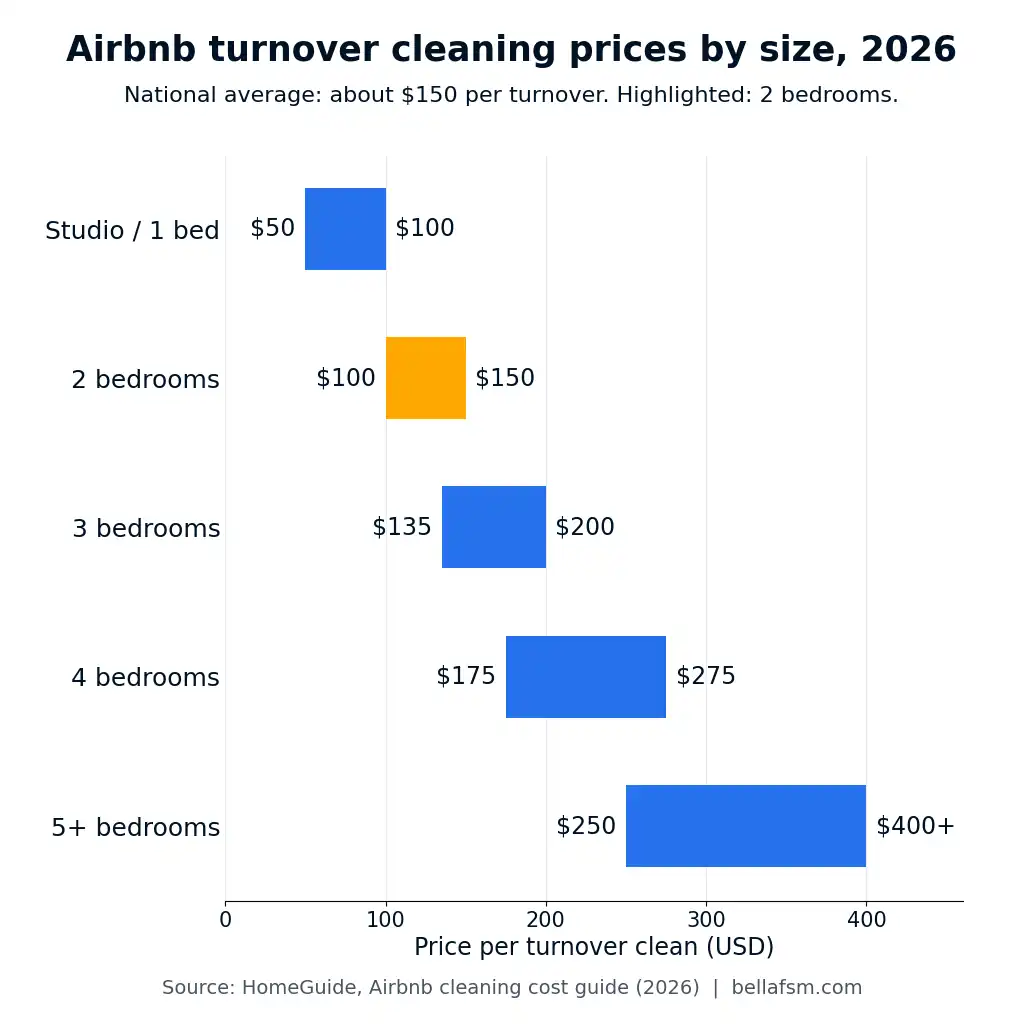
Airbnb turnover cleaning prices by property size, 2026. Chart may be embedded with attribution to Bella FSM and a link to this page.
How do you schedule same-day turnovers without missing a check-in?
You schedule same-day turnovers by working backward from each property's check-in time, not forward from your crew's start time, and by holding one cleaner in reserve for the jobs that run long. Most listings run a short gap between checkout and the next arrival, and the cleaning has to fit inside it. Guests check out late. Hot tubs need draining. A party leaves the kitchen wrecked. HomeGuide notes that a messy checkout can stretch a two-bedroom turnover to 4 or 5 hours, and that many cleaners add a $20 to $50 rush fee for same-day windows. Plan for that variance. Stack your day so the tightest windows get your fastest cleaners first, then fill the rest of the route with properties that have no arrival that day. When a host adds a last-minute booking, you want to see open capacity right away rather than calling around.
Build the day around the check-in clock
- Sort the day's jobs by next check-in time, earliest first.
- Give each job a hard "done by" time 30 minutes before arrival, so there is room for a photo check.
- Group properties by neighborhood only after the check-in order is set.
- Mark vacant-night properties as flexible and use them to fill gaps.
Keep a floater on the board
On busy Saturdays, leave one cleaner unassigned until noon to cover the late checkout or the sick call. It looks like wasted payroll until it saves a manager's five-star rating. Good maid service software shows the whole board, so you can send the floater before the host calls you.
When a host sends a new reservation, put the turnover on the calendar that day. Job scheduling software keeps a 20-door portfolio out of a group text.
Takeaway: the check-in time is the deadline. Build every route around it.
Ready to take your business further?
Start using Bella FSM free and work smarter.
Linens, restocking and damage reports
Linens are where turnover crews lose the most time, and damage reports are where they lose the most trust. A cleaner who washes and dries sheets on site waits on the dryer, and HomeGuide prices on-site linen handling at an added $15 to $40 per turnover, while an outside linen service runs $30 to $75 and can cut 30 to 60 minutes from the clean. Decide with each host who owns the linens, who launders them, and how many spare sets live at the property. Restocking needs the same clarity: whether you supply toilet paper, coffee and soap, and how you bill for them. Damage is the touchy part. Hosts depend on you to find the broken lamp or the stained couch before the next guest does, and to prove it with timestamped photos they can send to the platform. Settle all of this in writing before your first clean, not after the first dispute.
Have cleaners photograph each room at the end of every turnover. A mobile field service app lets them attach photos and the checklist to the job instead of leaving them on a personal phone.
The same photos double as an internal audit. Our guide to cleaning business quality control shows how to use them to cut recleans.
Takeaway: photos protect you as much as they protect the host. Make them a required step, not a nice extra.
Contract terms that protect your turnover margin
Short-term rental clients will ask for flexibility. Give it, but price it:
- A same-day rush fee. HomeGuide lists $20 to $50 as typical.
- A late-checkout clause: if the guest overstays, the crew's wait time is billable.
- Add-on pricing for hot tubs, pets and extra beds. HomeGuide puts a hot tub at $25 to $50 and a pet-friendly property at $15 to $40 per turnover.
- A deep clean every 3 to 6 months, which HomeGuide prices at $200 to $500 or more.
- A cancellation window, so a turnover canceled at 9 a.m. is still paid.
Put the agreed rates on the customer record the day you sign. A service business crm that holds per-property pricing lets a new office hire bill the hot tub add-on correctly.
Then make payment easy. Field service billing software with card payments on the invoice shortens the gap between the clean and the cash.
Takeaway: every exception a host asks for should have a line item. If it doesn't, you are paying for it.
Frequently Asked Questions
Win the account, then keep it
Airbnb turnover cleaning rewards companies that treat it as a scheduling business first. The price per clean beats residential work, but the real value is repeat volume: about 70 turnovers a year from one listing in the example above. Build your day around check-in times, photograph every job and bill every exception. To run the calendar, customer notes, photos and invoices in one place, start a free trial of Bella FSM and set up your first short-term rental account this week.
Ready to grow your business?
Try Bella FSM free and simplify your work.