
Grow Your Business
A customer calls at 8 a.m. Monday with a dead refrigerator, and before they book they ask what the visit costs. Your answer is the appliance repair diagnostic fee, and it decides whether your technician's first hour pays for itself. Thumbtack's 2026 cost guide says homeowners usually pay about $206 for a minor appliance repair, and that some service call fees run as little as $40 to $60. A fee that low rarely covers the truck roll. This guide shows how to set the fee from your own costs using BLS wage data and the IRS mileage rate, then how to present it so more customers approve the repair. When quotes, visits and payments already live in your appliance repair software, every number below can be tracked job by job.
How much should an appliance repair diagnostic fee be?
An appliance repair diagnostic fee should cover the full cost of sending a technician to the home, and for a typical suburban call that cost lands near $80 before any profit, as the worked table later in this guide shows. Treat that figure as your floor. The market spread above it is wide: Thumbtack's 2026 appliance repair cost guide reports that service call fees can be as low as $40 to $60, while some pros charge over $100. HomeAdvisor's 2026 cost guide puts appliance repair labor at $50 to $150 per hour plus parts, a useful anchor for a diagnostic that takes about an hour. Whether you charge $49 or $99 decides if a declined repair loses money or breaks even. Build the fee up from your own cost per visit first, then compare it with local competitors.
What homeowners see in 2026 cost guides
Customers often check a cost guide before they call, so it helps to know the tickets they expect. Thumbtack's March 2026 update lists these typical repair costs by appliance.
| Appliance | Typical repair cost |
|---|---|
| Garbage disposal | $120 |
| Dryer | $170 |
| Dishwasher | $220 |
| Microwave | $220 |
| Washer | $224 |
| Oven | $241 |
| Refrigerator | $250 |
Source: Thumbtack appliance repair cost guide, updated March 31, 2026.
Those tickets shape how a fee feels. A $95 fee is 38% of a $250 refrigerator repair but 79% of a $120 garbage disposal job. That is why many shops quote small-appliance and disposal calls with a lower fee, or roll the diagnosis into a flat repair price.
So set the fee from your visit cost first, and sanity-check it against the repair tickets customers expect.
What does one diagnostic visit really cost your shop?
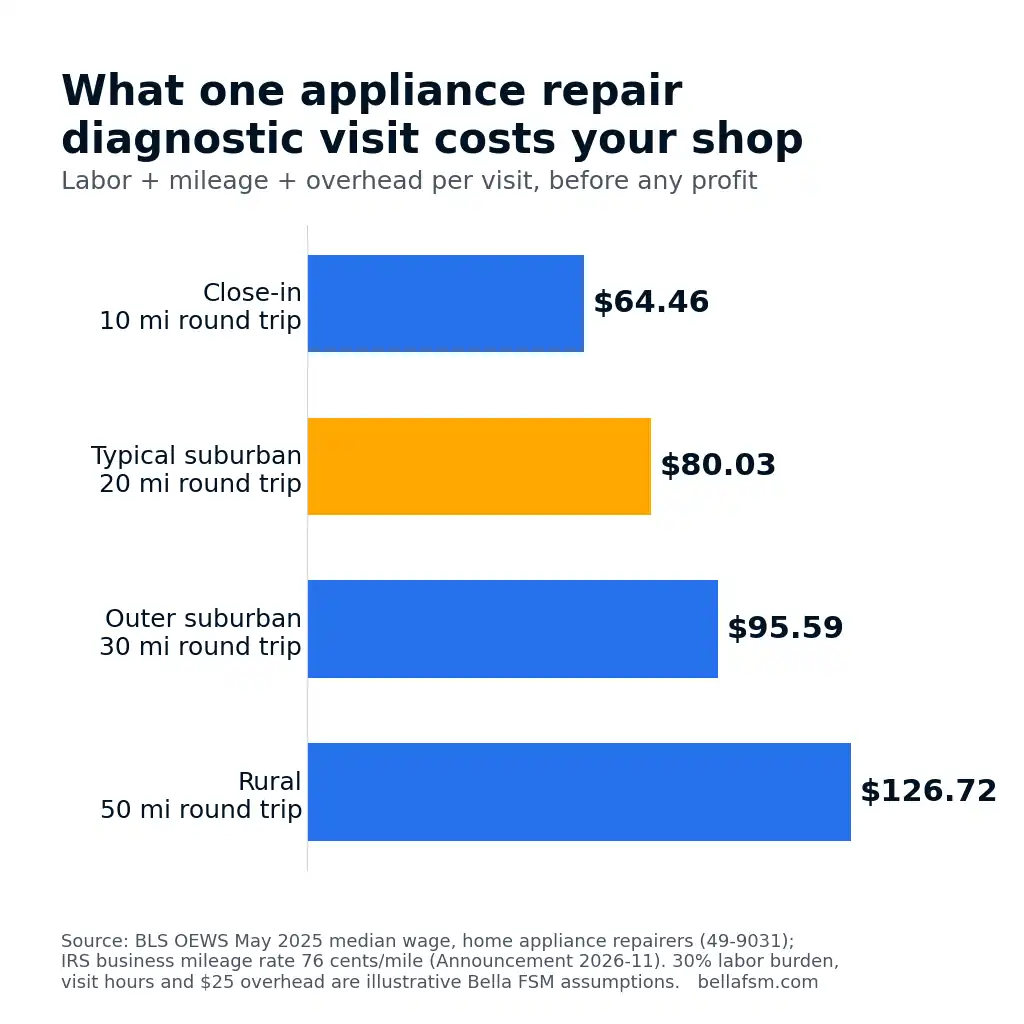
One diagnostic visit costs your shop the technician's loaded labor for the whole visit, plus vehicle cost for every mile driven, plus a share of overhead, and for a 20-mile round trip that adds up to about $80. The labor piece starts with wages. The Bureau of Labor Statistics reports a median wage of $24.51 an hour for home appliance repairers in May 2025, across 32,150 jobs, with the top 10% earning $38.78 or more (BLS Occupational Employment and Wage Statistics). Payroll taxes, workers' comp and benefits push the real hourly cost higher. The vehicle piece is easier to price: the IRS raised the business standard mileage rate to 76 cents per mile from July 1, 2026, under Announcement 2026-11, as the Journal of Accountancy reported. That rate is a fair proxy for fuel, wear, insurance and depreciation on a service van.
The worked calculation
The formula is simple: visit cost = (visit hours × burdened hourly wage) + (round-trip miles × $0.76) + overhead per visit. The table below applies it to four service-area shapes.
| Call type | Round-trip miles | Visit hours | Labor at $31.86/hr | Mileage at $0.76 | Overhead | Cost per visit |
|---|---|---|---|---|---|---|
| Close-in | 10 | 1.0 | $31.86 | $7.60 | $25.00 | $64.46 |
| Typical suburban | 20 | 1.25 | $39.83 | $15.20 | $25.00 | $80.03 |
| Outer suburban | 30 | 1.5 | $47.79 | $22.80 | $25.00 | $95.59 |
| Rural | 50 | 2.0 | $63.72 | $38.00 | $25.00 | $126.72 |
Source: BLS OEWS May 2025 median wage for home appliance repairers (49-9031); IRS business mileage rate from July 1, 2026 (Announcement 2026-11). The 30% labor burden, visit hours and $25 overhead are illustrative Bella FSM assumptions.
Ready to level up your business?
Try Bella FSM free and transform the way you work.
Why drive time hurts more than the wage
Swap in your own wage, burden and overhead, then look at the rural row. Mileage and the extra drive hour add more than $60 compared with a close-in call, and none of it is billable. Cutting the fee won't fix that. Routing will. Clustering calls by zip code in appliance repair scheduling software shortens the average round trip, and every mile cut drops straight to margin.
Second trips are the other leak. Each return visit to install a part repeats the mileage and the drive hour, which is why a stocked van matters as much as the fee. Our guide to appliance repair parts inventory covers which parts to carry for a higher first-time fix rate.
In short, price the fee at or above your typical-call cost and add a zone surcharge for anything past your core service area.
Chart: cost of one diagnostic visit by round-trip distance, from the worked table above. Chart may be embedded with attribution to Bella FSM and a link to this page.
Credit-back, flat fee or free: choosing a diagnostic fee policy
The dollar amount is half the decision. The other half is what happens to the fee once the customer hears the repair quote.
Fee credited toward the approved repair
A credit-back policy charges the appliance repair diagnostic fee on every visit and subtracts it from the bill when the customer approves the repair, so you are paid for the trip either way and the customer feels the fee was not wasted. It is popular because declines still cover the visit, and approvals close more easily when the fee disappears into the repair. The risk is underpricing the repair itself. If your flat repair prices were built assuming the diagnostic is paid separately, crediting it back quietly cuts your margin on every approved job. The fix is to build each flat repair price with the visit cost already inside it, then credit the fee against that total. As an illustration, a shop running 100 diagnostic calls a month at an $89 fee, with 25 declines, collects $2,225 from declined calls, which covers the roughly $2,000 those 25 typical visits cost at $80.03 each.
Those 25 declines are also your best follow-up list. Logging each one in appliance repair CRM software lets you call back when the old unit finally fails.
Flat diagnostic fee kept on every call
Some shops keep the fee no matter what and price repairs lower to compensate. This suits built-in and high-end work, where diagnosis takes longer. Connected units deserve a higher tier too. Our guide to smart appliance repair suggests pricing those diagnostics 25 to 50 percent above a standard fee.
Free diagnosis
Free diagnosis wins phone calls and loses money on every decline. Use it, if at all, as a short promotion for a new service area.
Credit-back is the safest default, as long as visit cost is built into your flat prices.
Ready to take your business further?
Start using Bella FSM free and work smarter.
How to present the service call fee so customers approve the repair
When customers complain about a fee, the cause is usually how it was disclosed rather than the amount.
- Quote the fee and the credit-back rule on the booking call, then repeat both in the confirmation text.
- Give a written flat price for the repair, with the credit shown, before any work begins.
- Take the fee on site when the diagnosis is done, whether or not the repair is approved.
Collecting at the door is easier when the technician can take a card on their phone. With field service payment processing built into the work order, a declined call is paid before the van leaves the driveway.
The invoice should tell the same story the phone call did. Good appliance repair invoicing software shows the fee as one line and the credit as a separate line, so the customer sees exactly what they paid for.
Disputes usually start when the fee is mentioned only after the diagnosis, named differently on the phone and the invoice, or credited on some jobs but not others. Pick one name and one rule and stick to them.
Use the same words for the fee at booking, on the quote and on the invoice.
What does California require before you charge a diagnostic fee?
California lets appliance service dealers charge a diagnostic fee, but only with written disclosure and a written estimate before any repair begins. Under Business and Professions Code section 9844, the dealer may charge "a reasonable fee" for determining the nature of the malfunction while preparing the written estimate, and must advise the customer of that fee in writing. The regulation that defines the fee goes further. California Code of Regulations Title 16, section 2722.5, says the diagnosis fee "shall include all transportation and travel costs" tied to the diagnosis, except for equipment that arrives by public carrier (16 CCR § 2722.5). In practice, that means a California shop cannot add a separate trip charge on top of its diagnostic fee for an in-home call. The travel cost has to sit inside the fee, which is one more reason to build it from a worked visit-cost calculation like the one above.
Other states vary, but the California model is a sound default anywhere: one fee that includes travel, disclosed in writing, with a written estimate before work starts.
Write your fee terms once and reuse that exact text everywhere.
Frequently Asked Questions
Set your appliance repair diagnostic fee from your own numbers
Your appliance repair diagnostic fee is the one price every customer pays, so it should never lose money. Work out your real cost per visit, choose a policy your flat repair prices can support, and disclose it the same way every time.
Bella FSM's appliance repair business software keeps the fee, the quote, the route and the payment on one work order. Start a free trial and price your next service call from real numbers.
Ready to grow your business?
Try Bella FSM free and simplify your work.