
Grow Your Business
Septic Service CRM Software
Septic service CRM software that helps septic companies build lasting customer relationships.
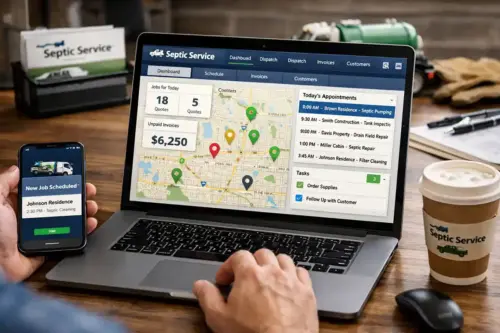
A tank pumped this spring will not need you again for three years, which is plenty of time for the homeowner to forget your name and for someone else's postcard to arrive first. Bella FSM keeps the property, the tank, and the date it comes due in one record, so the reminder goes out on your schedule.
Tank and property records
Automatic due-date reminders
Every visit logged per property
Property on file
1,250 gal concrete · lid behind garage
Comes due
Reminder sent 60 days out
In plain English
What is septic CRM software?
Septic CRM software is a customer record system built for companies that pump, inspect, and maintain septic systems. It holds contact details, property addresses, tank specifications, pumping histories, and every note a driver has left on a job, so the office and the truck work from the same file. Because the work repeats on a three to five year cycle rather than a weekly one, it also tracks when each property comes due and prompts the call before a competitor's reminder postcard lands in the mailbox.
Owner-operators
For a one-truck outfit, it means opening the property on the drive over and already knowing the tank size and where the lid is buried.
Multi-driver operations
With several trucks out, every driver reads the same property history, and the office can see which accounts are overdue without calling to ask.
Bella FSM is septic CRM software built for exactly that range. Free for 14 days, no credit card up front, and setup takes about 15 minutes.
80% of customers rate service quality as equally important to product quality, per Bella FSM's State of Field Service 2026.
Built on repeat relationships
Why septic customer records outgrow notebooks and spreadsheets
The reality
Septic accounts run on long cycles
- Most homeowners come due once every three to five years
- Every property has its own capacity, lid location, and access quirks
- Landlords and property managers hold a dozen addresses under one contact
- Real estate agents call for inspection quotes on a week's notice
- Counties want a receipt on file after the work is done
What goes wrong
Where septic customer files break down
- Due dates live in one person's memory and leave when they do
- The driver arrives without knowing where the lid is
- A three-year gap is long enough for a competitor to take the account
- Nobody can say which addresses belong to the same landlord
- Last visit's notes are on a paper ticket in a truck door
With Bella FSM
One septic customer record, office and truck
- Due dates calculated from capacity and household size
- Reminders go out automatically before the account goes cold
- Access notes, lid photos, and baffle condition on the property record
- Every address under a landlord grouped on one account
- Receipts and inspection reports attached where the county can find them
Why Bella FSM
Six reasons septic customer management software beats a spreadsheet
A spreadsheet can hold names and dates. It cannot tell you that the lid at 214 Ridge Road is twelve feet off the driveway, that the effluent filter was clogging last time, or that the same landlord owns four other addresses on your list.
Septic tank CRM records for every system
Capacity, material, compartment count, install year, baffle condition, and drain field status sit on the property, not in someone's head. Pull the whole profile up while the customer is still on the phone.
Every septic property in one customer record
A landlord with nine rentals is one contact with nine addresses, each on its own cycle. You stop treating them as nine unrelated customers who happen to share a phone number.
Reminders timed to each septic account
Bella FSM works out the next due date from tank capacity and household size, then sends the reminder on its own. A three-year gap stops being three years of silence.
Notes and photos from every septic visit
Root intrusion near the inlet baffle, a filter starting to clog, a gate code that changed. Whatever the driver types or photographs stays on the property for whoever shows up next.
Follow-ups that surface before the septic customer calls
Pending estimates, real estate inspection quotes, and overdue accounts all sit in one queue with a date attached. Nothing depends on someone remembering to check.
Reports on your most profitable septic routes
See revenue by work type, retention by account, and which parts of your territory actually pay. Useful when you are deciding where a second truck should go.
One System of Record
Start Free Trial
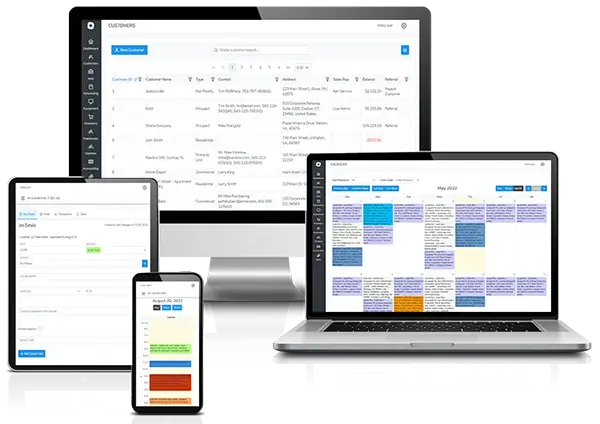
Every septic property, customer, and account in one record
A homeowner calls, says they have not pumped in three years, and cannot remember the tank size. You open the property and read back the 1,250-gallon concrete tank installed in 2009, the access point behind the garage, and the note about root intrusion near the inlet baffle from the last visit.
Septic property profiles with access notes and lid locations
- Contact details, billing address, and every property under that name
- Gate codes, dog warnings, and where the lid is actually buried
- Photos from previous visits attached to the address
The same septic record on the truck and at the desk
- Office edits show up on the driver's phone without a phone call
- Residential, commercial, and property-manager accounts all in one place

System Records
Start Free Trial
Septic equipment profiles down to baffle condition and lid access
A driver heading to a rural property can read the record on the way and know it is a 1,500-gallon two-compartment poly unit, that the lid sits twelve feet off the driveway on the east side, that the baffles were intact last time but the effluent filter was starting to clog, and that the county wants a pumping receipt on file.
Capacity, compartments, and install year on every septic account
- Tank material, capacity, and compartment count per system
- Install year and manufacturer where the homeowner knows them
- Several systems on one address for commercial and multi-unit sites
Repair notes and drain field status the septic driver can read on the way
- Baffle condition and drain field status logged visit by visit
- Repair history per system, so a recurring fault is obvious
Recurring Revenue
Explore route scheduling & dispatch
Contracts and maintenance plans linked to every septic account
A homeowner on a three-year cycle is easy to forget and easy for someone else to pick up when their reminder lands first. Plans and contracts attach to the customer profile with their own renewal dates, so the revenue you already earned does not quietly leave.
Renewal dates and plan revenue tracked per septic customer
- Contract terms and expiration dates on the customer profile
- Plan revenue and margin reported per account
- Satisfaction checks sent automatically after the work is signed off
The next septic visit set from capacity and household use
- Due dates calculated rather than guessed
- Repeat work generated automatically once the plan is set up

Leads & Follow-Ups
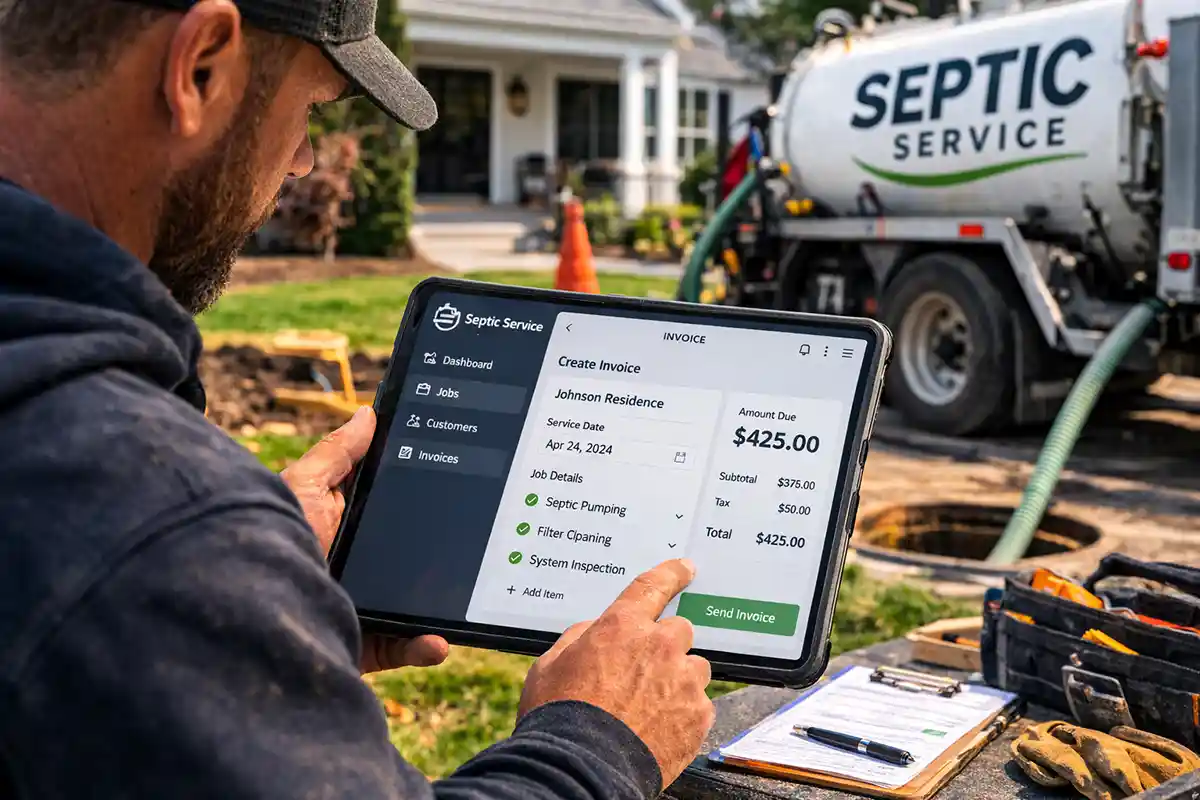
See how finished jobs become invoices
Lead and estimate follow-up for every septic inquiry
When the office can see every pending estimate, every account past its due date, and every real estate agent who asked for an inspection quote last month, outreach becomes targeted instead of random. You call the people who are actually due, not the ones you happen to remember.
Track where each septic lead came from
- Phone calls, website forms, and realtor referrals logged the same way
- Reporting on which sources turn into the accounts worth keeping
- Full communication history attached to the contact
Outreach aimed at the septic accounts actually due
- Reminders on pending estimates so quotes do not go stale
- Finished work carries gallons, disposal site, and repair notes straight through
Retention
Start Free Trial
Retention reporting that shows which septic accounts are overdue
Losing a customer here is rarely dramatic. They just do not call, and you do not notice for a year. Reporting sorts your book by who is past due, who renewed, and which parts of your territory are worth a truck, and it sits inside the full septic platform rather than off to one side.
Overdue septic accounts surface first
- Every account ranked by how far past its due date it has drifted
- Real estate transaction inspections and county paperwork tracked per address
- Retention reported by account type, not just headline revenue
Route clusters that make a septic day pay
- Group nearby properties so a due-date sweep fills a day efficiently
- Reports on revenue by work type and by part of your territory
20units · one manager
Retention Reality · Portfolio Accounts
Staggered pumping schedules, tracked for every property manager
One property manager with 20 rental units, all on different cycles, is the account a notebook cannot hold. The companies that keep that revenue are the ones whose system raises each upcoming visit before the manager has to think about it.
Start Free Trial
Frequently Asked
Frequently Asked Questions About Septic Service CRM Software
What is septic service CRM software?
Septic service CRM software is a customer relationship management platform designed for companies that pump, inspect, and maintain septic systems. It stores customer contact information, property details, system specifications, pumping histories, and communication records in one centralized database, giving your office and field teams instant access to everything they need.
How does a CRM improve septic customer relationships?
By keeping detailed records of every pump-out, inspection, and system observation, a CRM means your drivers arrive at each property already informed. Customers notice when your team knows the tank location, the access problems, and the work history without being told again. That preparation builds trust and produces word-of-mouth referrals.
Can I store septic equipment details and specifications in the CRM?
Yes. Bella FSM lets you create detailed equipment profiles for every system at each property, including tank type, capacity, number of compartments, installation year, baffle condition, and drain field status. When a customer calls with a problem, you can pull up their complete profile and work history in seconds.
Does the CRM automate pumping reminders and follow-ups?
Bella FSM automates follow-up messages, satisfaction surveys, and pumping due-date reminders based on configurable triggers. After a pump-out is completed, the system can send a thank-you email immediately and set the next reminder from tank size and household occupancy, all without manual effort from your office staff.
Can I run business performance reports from the CRM?
Yes. Bella FSM reports on customer retention, revenue by work type, driver efficiency, lead conversion rates, and seasonal trends. The numbers show which work and which parts of your territory are most profitable, so decisions about route planning, equipment purchases, and territory expansion rest on something other than instinct.
Is there a CRM for septic companies?
Yes. Bella FSM is built for this trade rather than adapted from a sales tool, so the record holds tank capacity, lid location, baffle condition, and the date each property comes due, instead of deal stages nobody in this work uses. Office staff and drivers read the same file, and reminders send themselves.
Lock in the repeat work
Why septic companies need more than a spreadsheet
Free 14-day trial. No credit card required. Cancel anytime. Real human support that understands how this trade actually runs, from one truck to a full yard.
What you get on day one
- Property records with capacity, lid location, and access notes
- Due dates calculated from capacity and household size
- Automatic reminders and post-visit follow-ups
- Contracts and maintenance plans with renewal tracking
- Mobile app so drivers read the file on the way
- U.S.-based support that knows field work