
Grow Your Business
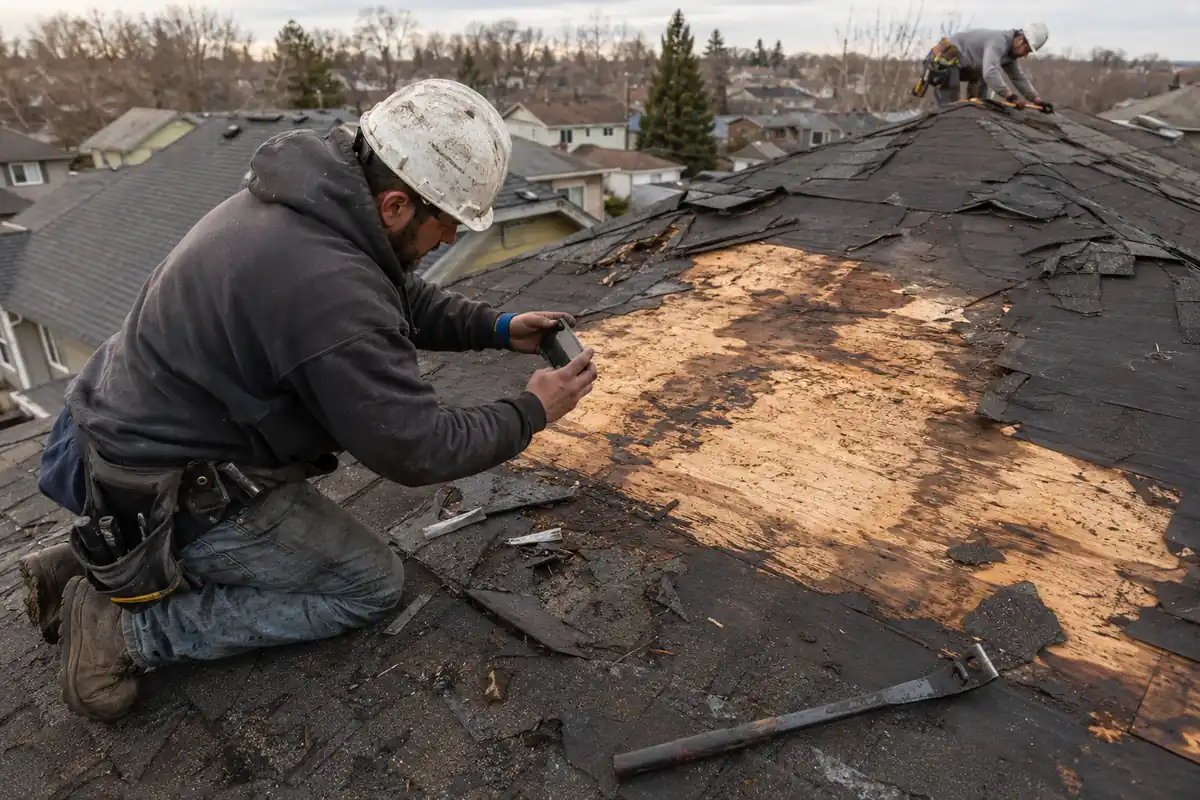
Your crew tears off a 28 square roof on Tuesday morning and finds nine sheets of rotted decking under the felt. By noon the new deck is down, the synthetic is on, and the evidence is gone forever. Three weeks later the carrier denies the extra scope because nobody can prove the rot existed. That is not a claims problem. It is a roofing supplement documentation problem, and it quietly costs storm restoration contractors thousands of dollars per job. Roofers who win supplements consistently are not better negotiators. They run the same capture sequence on every tear-off, usually from inside their roofing software, so the proof exists before new shingles cover it.
Why Roofing Supplement Documentation Decides Your Margin
An adjuster's first estimate is written from the ground, from a drone pass, or from a report generated before anyone opened the roof. It is an educated guess about what sits underneath. When your crew gets up there, the real scope appears: rotted sheathing, missing drip edge, a second layer nobody counted, code-required ice and water shield.
Industry estimates put the money left behind at roughly 20 to 40 percent of the claim when a carrier's first estimate goes uncontested. Format matters as much as content. Supplements filed in the carrier's own estimating format with linked photo evidence commonly recover $7,000 to $8,000 above the original, while identical scope sent as a loose PDF lands near $3,000 to $4,000 because reviewers downgrade what they cannot verify.
The cash flow picture is worse than the revenue picture. You bought material on day one and paid the crew that Friday, but supplement dollars arrive weeks after the job closes. Every day of documentation delay is a day your working capital funds the carrier's review, which shows up plainly for contractors tracking receivables in field service invoicing software.
Takeaway: treat supplement evidence as a revenue task with a labor cost, not as paperwork for later.
What Adjusters Actually Need to See
Adjusters are not hostile. They are volume-constrained. A desk reviewer with forty open files approves the scope they can verify in ninety seconds and kicks back the scope they cannot. Six things separate an approved photo set from a disputed one:
- Scale in the frame. A hail bruise shot alone communicates nothing. A quarter, a tape, or a chalk circle tells the reviewer the size without a phone call.
- Address in one frame per category. A house number or street sign ties the set to the loss location.
- Test squares from multiple slopes. Chalk-marked impacts inside a ten by ten square, shot on each elevation, support the damage count instead of asserting it.
- Quantities that match the claim. If you are asking for nine sheets of decking, show nine sheets, numbered and shot individually.
- Date and time stamps. Sequence proves the condition preexisted your crew.
- One photo tied to each line item. Drip edge, pipe boots, step flashing, ridge vent, and ice and water shield each need their own frame.
Keeping that history against the property record rather than a laptop folder pays again later. When the same neighborhood takes hail in three years, a roofing crm makes the prior claim file retrievable by address instead of by memory.
Takeaway: shoot for the reviewer. If a stranger cannot read the photo in five seconds, reshoot it.
The Tear-Off Documentation Sequence That Holds Up
Most crews document opportunistically. Someone remembers, pulls out a phone, and grabs a few frames between bundles. That produces sets heavy on the dramatic and light on the specific. Budget 40 to 60 frames across three phases instead:
- Phase 1, before anything moves (about 10 frames). Four elevations from the ground, the address, existing ridge and valleys, gutter and fascia condition, and any interior staining.
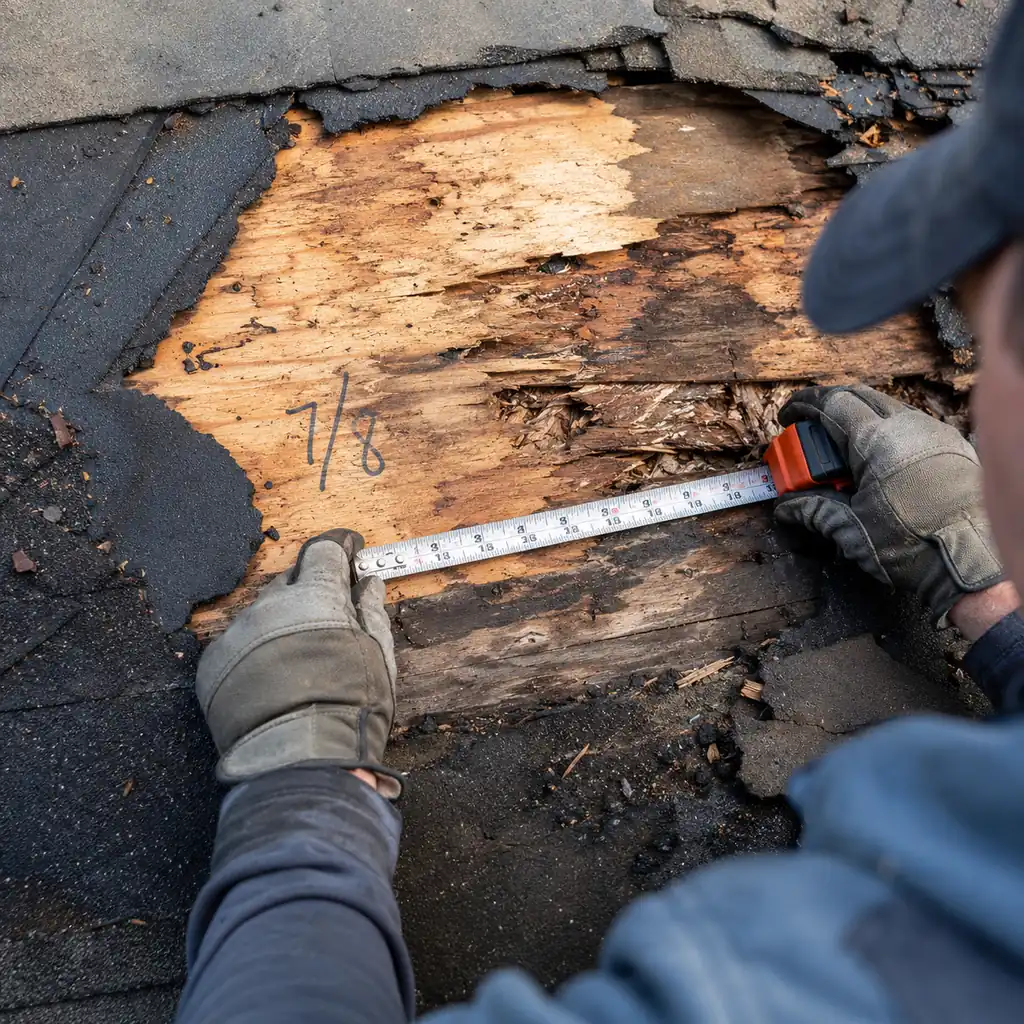
- Phase 2, during tear-off and dry-in (about 20 frames). This is the phase that pays. Layer count at a cut edge, every rotted deck sheet individually, valley metal, all penetrations, step and counter flashing, and the bare deck before new material covers it.
- Phase 3, at completion (about 20 frames). Finished slopes, ridge, flashing details, cleanup, and the dumpster load. These close out workmanship disputes later.
The practical unlock is naming one documenter per crew and putting those fifteen to twenty minutes on the schedule as real labor. When it is nobody's job it becomes everybody's afterthought. Assigning the role in service scheduling software makes it visible to the foreman the same way a material delivery window is.
Here is the sequence on a real job. A crew arrives at 7:00 a.m. on a 30 square hip roof in a hail zone. The documenter shoots the ten-frame perimeter set before the first bundle is loaded, costing five minutes. At 9:40 the tear-off exposes seven soft sheets around the north valley. He numbers each with a lumber crayon, shoots them with a tape across the delamination, and captures valley flashing that was never scoped. Twelve frames, eight minutes. By 10:00 the office can start writing while the crew is still on dry-in.
Slotting that documentation window against the rest of the production day follows the same logic as building a roofing production schedule.
Takeaway: a fixed sequence with a named owner turns a variable outcome into a repeatable one.
Ready to level up your business?
Try Bella FSM free and transform the way you work.
Getting the Photos Off the Phone and Into the Claim File
The most common failure is not capture. It is retrieval. A foreman's phone holds 1,400 photos from six jobs, none labeled. The office asks for the decking shots from Wednesday's job on Maple, and forty minutes disappear into a camera roll. Sometimes the phone was replaced and the evidence went with it. Fix it at the point of capture:
- Photos attach to the job record on the roof, not to a personal camera roll uploaded later.
- Every frame carries the job number, so the address is never in question.
- The office sees the set arrive and starts the supplement while the crew is still on site.
- Nothing depends on one person's device or one person's memory.
This is the everyday case for a mobile field service app. The crew shoots into the job, the office pulls from the job, and the chain of custody stays intact without anyone emailing a zip file.
The claim file is only half of it. When the supplement, the original estimate, the change order, and the homeowner conversation all sit against one property in a roofing contractor crm, a disputed line six weeks later takes minutes to answer instead of an afternoon.
Takeaway: evidence you cannot find in two minutes is the same as evidence never captured.
Five Mistakes That Get Roofing Supplements Denied
Denials cluster into a short list, and almost none of them concern whether the damage was real.
- Quantity mismatch. The submission asks for more units than the photos support. Reviewers count. If you find eleven sheets, photograph eleven sheets.
- No scale reference. Damage that cannot be measured from the frame gets treated as cosmetic.
- Photos with no tie to the loss. No address, no date, no slope orientation, so the reviewer cannot confirm the frames belong to the file.
- Late submission. Once the roof is finished and the dumpster is gone, you are asking a carrier to accept a condition nobody can reinspect.
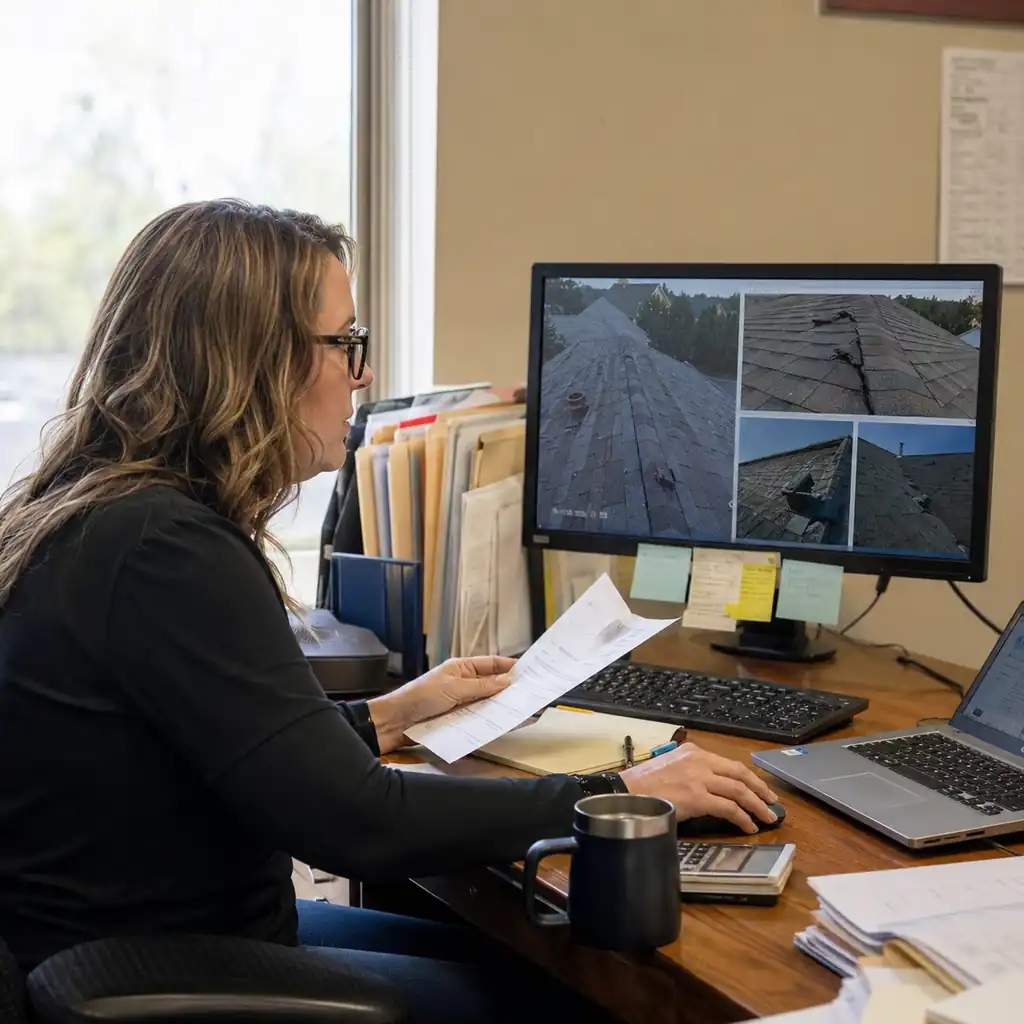
- Wrong format. A narrative email with attachments asks the reviewer to build your estimate for them. A line-item submission in the carrier's estimating format, each item backed by a linked photo, is the version approved on the first pass.
There is a real choice about who writes the submission. Third-party supplement firms bring platform fluency and carrier familiarity for a percentage of what they recover, which suits high storm volume with a thin office. Handling it in-house keeps the full recovery, but demands someone who knows the estimating platform and has time to chase adjusters. Either model fails on bad photos.
Standardized job records in roofing contractor software let you switch between the two models without rebuilding documentation habits.
Approvals also rarely arrive on the first ask. The persistence that closes them is the same discipline covered in our guide to roofing estimate follow up.
Takeaway: fix format and quantity discipline first. Those two account for most first-pass denials.
Ready to take your business further?
Start using Bella FSM free and work smarter.
The Numbers That Tell You the System Is Working
Roofers measure closing rate and job cost, then leave supplement performance untracked. Six numbers, reviewed monthly, expose whether the field system is real or aspirational.
| Metric | What it tells you | Healthy direction |
|---|---|---|
| Supplement capture rate | Share of insurance jobs with a supplement filed | Rising toward your true rate of hidden scope |
| Average supplement dollars per job | Whether crews find scope or just file paperwork | Stable or rising |
| First-pass approval rate | Documentation and format quality | Tracked by writer, trending up |
| Days from tear-off to submission | Field to office handoff speed | Under three days |
| Days from submission to approval | Carrier responsiveness and submission quality | Typically 10 to 20 days |
| Photo completeness rate | Share of jobs hitting the three-phase frame budget | Approaching every job |
Days to submission and first-pass approval move fastest, because both respond to process rather than luck. Once the supplement sits as a tracked receivable in your field service billing software, the aging report does your follow-up prompting.
Crew-level completeness is easier to read when documentation is assigned like any other task in your technician scheduling software, because you can see which foreman actually runs the sequence.
Takeaway: track supplement dollars per job by crew. It surfaces the foreman leaving money on every roof.
Frequently Asked Questions
Build the System Before the Next Storm
Storm season leaves no room to invent a process. Contractors who recover full claim value have already decided who shoots the photos, how many frames each phase needs, where the images land, and who writes the submission. Everyone else improvises on the roof and negotiates from weakness six weeks later. Strong roofing supplement documentation is the cheapest margin improvement available to a roofing company, because it costs twenty minutes of labor and recovers scope you already performed. If your job records, crew schedules, photos, and invoices live in four different places, start there. Bella FSM keeps them in one.
Ready to grow your business?
Try Bella FSM free and simplify your work.