
Grow Your Business

The first painter to deliver a clean, signable quote almost always wins the job. In residential painting, the homeowner who calls you on Monday is calling two other shops by Tuesday, and the company that gets a real number in front of them first sets the anchor every other bid is measured against. Same-day painting estimates are no longer a luxury reserved for big franchises with full-time estimators they are a workflow any two-person crew can run if the tools and steps are tight. This guide lays out a practical same-day estimate process for small and medium painting contractors: what to standardize, what to automate, the production numbers to lean on, and the metrics that will tell you whether the system is actually moving close rates.
Why Same-Day Painting Estimates Win More Residential Jobs
Speed-to-quote is the single most reliable predictor of close rate in residential trades. Industry surveys of small painting shops consistently show that contractors who deliver a written estimate within 24 hours close 35 to 50 percent of qualified leads, while shops that take three or more days fall under 20 percent. The math is simple: a homeowner who has a number in hand stops calling. A homeowner who is still waiting on you keeps shopping.
Same-day painting estimates do three things at once. They reduce the homeowner's anxiety about an unknown price, they signal that your shop is organized and easy to work with, and they make it harder for the next painter to undercut you because the homeowner has already started forming an opinion. Most owners over-index on the price piece. The trust piece matters more. When a homeowner signs the same day, they are paying for confidence, not just a number.
There is a hidden financial benefit too. Estimates that sit longer than 48 hours go cold. Every dead estimate represents real cost windshield time, the estimator's hourly rate, fuel, and the opportunity cost of skipping a different lead. A faster cycle keeps your closing rate up and your customer acquisition cost down at the same time.
The 5-Step Same-Day Painting Estimate Workflow
Every painting shop running same-day estimates uses some version of these five steps. Differences are mostly in tooling. The discipline is the same.
Step 1: Pre-qualify on the call
The single biggest reason same-day estimates fail is that the estimator shows up to a job they should never have driven to. Train whoever answers the phone even if that is you to capture five data points before scheduling the walk: scope (interior, exterior, cabinets, deck), approximate square footage or number of rooms, timing, decision-maker availability for the walk, and budget posture. A two-minute qualifying script saves four hours of windshield time per week.
Step 2: Arrive with a pricing book, not a calculator
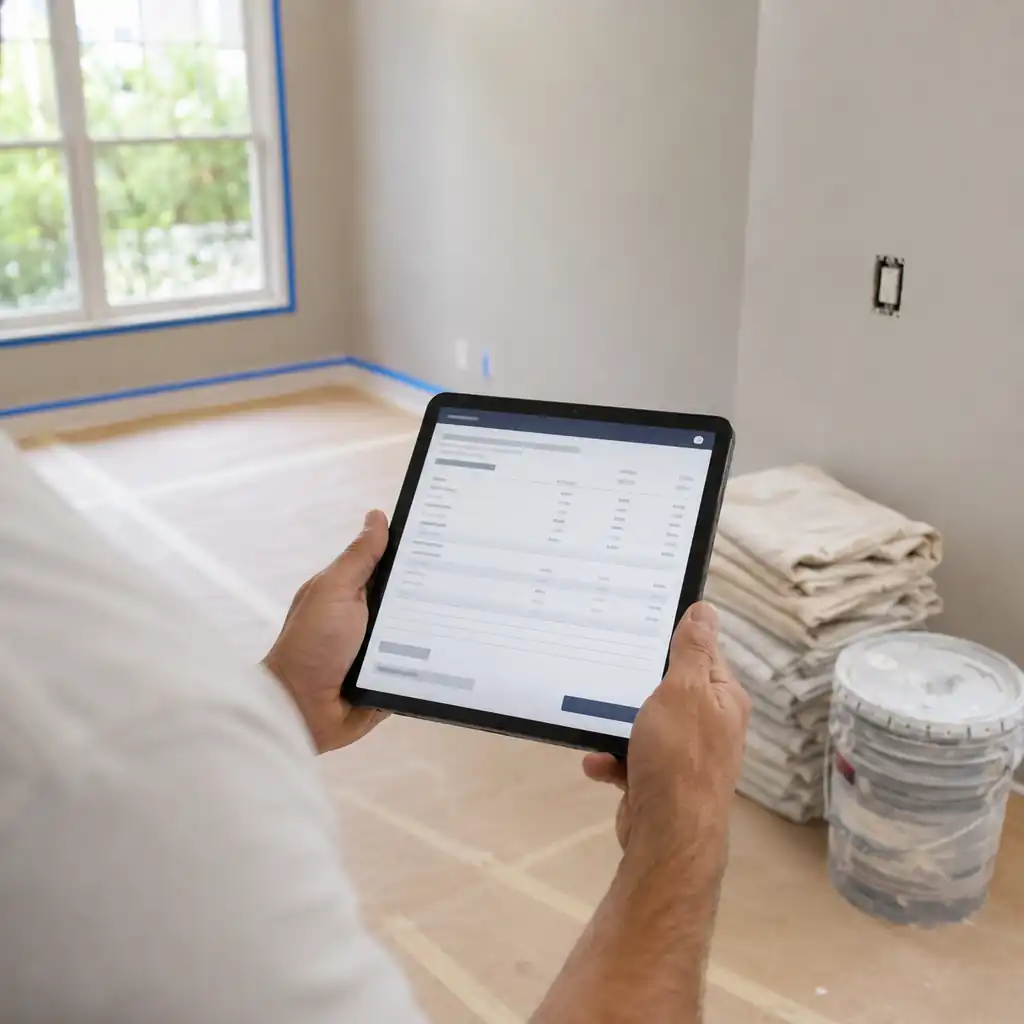
Your estimator should walk in with standardized production rates and a tablet running painting contractor business software that already knows your costs. Production rates square feet per hour for cut-in, rolling, brushing, and prep are the only way to quote in real time. If you are doing trim math in a notebook, you cannot deliver a same-day quote. A simple internal pricing book that says "150 sq ft of standard wall surface per hour, $X per hour fully burdened" eliminates 80 percent of the calculation work on-site.
Step 3: Capture conditions, not just measurements
Walk the job with a tablet or phone. Photograph problem areas peeling paint, water stains, mold, cracked caulk and tie each photo to a line item. Pictures protect you when the homeowner forgets the scope you agreed to. They also let you bracket the prep work, which is where most painting jobs lose money.
Step 4: Build the quote on-site or in the truck
By the time you walk back to the truck, the estimate should be 80 percent done in your head. Use a mobile estimating template that lets you select rooms, surfaces, product tiers, and prep level from a pre-priced list. The goal is to deliver a written number emailed or texted, with a clickable link before you drive to the next appointment.
Step 5: Send a real proposal, not a price
A real proposal includes scope, exclusions, product details, payment terms, and a one-click signature link. A bare price loses to a bare price every time. A proposal that explains your prep standard and warranty terms holds its margin even against cheaper competitors.
Tools You Need to Make Same-Day Painting Estimates Work
You do not need every tool on day one. You need three things that talk to each other.
The first is a mobile-friendly CRM or job tracker that holds the lead, the photos, the proposal, and the follow-up cadence in one place. A scheduling and dispatch system designed for trade businesses — like Bella FSM’s service scheduling software and dispatch software — lets the office see which estimates are open, which need follow-up, and which crew is closest to a callback. A general CRM bolted on top of a paper schedule does not do that.
The second is a way to build and send the proposal from the field. Most painting shops eventually graduate to a dedicated estimating tool, but you can run a clean same-day workflow with a tablet, a templated painting estimate template, and an e-signature service. The non-negotiable is that the quote leaves with the estimator, not back at the office.
The third is automated follow-up. The single highest-ROI automation in painting is a sequence that pings the homeowner at the 24-hour, 48-hour, and 7-day mark on any unsigned estimate. Most shops never build this and quietly lose 15 to 20 percent of their pipeline to silence. A modern field service CRM with built-in automation handles this without anyone touching it.
Pair these three with a mobile app that gives the estimator everything offline in the driveway and you have a workflow that can run two to three same-day estimates per estimator per day with consistent quality.
Ready to level up your business?
Try Bella FSM free and transform the way you work.

Common Mistakes That Sink Same-Day Painting Estimates
Speed alone is not enough. The shops that try to go faster without fixing the underlying process actually close fewer jobs. Watch for these traps.
The first is quoting without a real production rate. A guess produces a guess. If you do not know your hours-per-room, you will either overprice and lose the job or underprice and lose the margin.
The second is sending a flat price with no scope. A number with no story is the easiest thing in the world for a competitor to beat. Always send scope, exclusions, and product detail with the price.
The third is skipping the follow-up. A same-day estimate without a follow-up sequence is still a slow estimate. The homeowner gets the number, sits on it, forgets, and signs with someone who called back.
The fourth is letting one estimator hoard tribal knowledge. If only your senior person can quote in the field, you have a bottleneck, not a workflow. Document production rates and pricing rules so any trained estimator can run them.
The fifth is not standardizing prep tiers. Painting jobs win or lose on prep. Define two or three prep tiers — basic, standard, restoration — with a published price per square foot for each. This turns prep from a negotiation into a menu.
Ready to take your business further?
Start using Bella FSM free and work smarter.
Metrics to Track After You Launch
You cannot improve what you do not measure. Once your same-day painting estimate workflow is running, watch these numbers weekly.
Lead-to-quote time is the simplest one, average minutes from initial call to signed-quote delivery. If your goal is true same-day, the median should be under eight working hours.
Close rate by estimator is the next layer. Same-day delivery should pull your overall close rate up by 10 to 20 percentage points within 90 days. If it is not moving, your proposal content is the problem, not your speed.
Average revenue per estimate is the early warning system. Same-day quoting can train estimators to undersell on prep just to close fast. If average revenue per quote drops, retrain on prep tiers.
Follow-up touch count tells you whether the automation is firing. The target is at least three touches per unsigned quote inside seven days. Below that, your CRM is half-installed.
Finally, watch revenue per estimator-hour. Same-day quoting only pays if your estimator is closing enough jobs to justify the windshield time. If revenue per hour drops, tighten the pre-qualifying script.
Most painting shops that adopt these metrics see meaningful movement within a single quarter. The improvement is rarely about working harder, it is about the friction that comes out of the process. For shops that also want help filling the lead funnel at the front, our guide on how to get painting contracts and the playbook on marketing for painting contractors pair well with this workflow.
Frequently Asked Questions
Start Closing More Painting Jobs This Week
Same-day painting estimates are not a technology project — they are a discipline supported by the right tools. Standardize your production rates, build a templated proposal, run automated follow-up, and measure the five numbers above. The shops that do this consistently outgrow their market every year.
If your current scheduler, CRM, or paper-and-spreadsheet system cannot keep up with same-day delivery, that is the first thing to fix. Bella FSM’s painting contractor software is built for small and medium trade businesses that want one place to schedule, dispatch, quote, invoice, and follow up — without stitching five tools together. Start with a 30-day free trial and run your next ten leads through the workflow above. The close rate will move.
Ready to grow your business?
Try Bella FSM free and simplify your work.