
Grow Your Business

A nail pop in the guest bedroom. A missing cabinet pull. Paint touch-up behind the range. Individually these are ten-minute fixes. Collectively they are the reason your last three projects sat six weeks past substantial completion while the client sat on your final draw. Contractor punch list management is the least glamorous part of running a construction business, and it is the part that most directly decides when you get paid. Most small general contractors treat the punch list as a cleanup task that starts after the work is done. The GCs who close out in two weeks treat it as a tracked workflow that starts on day one, usually inside the same general contractor software that already holds their schedule and job costs.
What a Stalled Punch List Actually Costs You
Run the arithmetic on one job and the problem stops looking cosmetic. On a $180,000 remodel with a 10% retainage holdback, $18,000 of your money sits in the client's account. If your punch list takes 45 days to clear instead of 15, that is 30 extra days of float you financed for free. Do that four times a year and you have handed customers an interest-free credit line while paying interest on your own. This is the quiet mechanism behind most contractor cash flow crunches.
The second cost is remobilization. A drywall patch caught during the framing-to-rough-in window costs you a sub who is already on site. The same patch eight weeks later costs a truck roll, a half-day minimum, and a schedule slot you could have sold. Rework addressed after the fact routinely runs two to five times the in-sequence cost. The item did not get more expensive. The logistics did. Tracking that gap per project inside your contractor business software turns a vague sense that closeout hurts into a number you can act on.
The third cost never gets booked. Closeout is the last thing your client experiences. A crisp two-week closeout produces a referral. A three-month trickle of unanswered texts produces a review that costs you leads for years.
Takeaway: price the delay, not the item. Clearing your list 30 days faster releases $18,000 sooner and saves two remobilizations.
Build a Rolling Punch List Instead of an End-of-Job Scramble
The highest-leverage change available to a small GC is to stop generating the punch list at the end. A rolling punch list opens the day the job starts and closes continuously. Every trade gets inspected the moment its scope is complete, so defects get corrected before the next phase buries them.
At each phase handoff, the superintendent walks the work with a phone and logs anything failing the standard. Because the sub is still mobilized or has just left, the correction window is days rather than weeks. Contractors who already sequence trades and buffer days inside general contractor scheduling software can attach the inspection to the phase itself, so no handoff happens without one.
A typical residential sequence:
- Post-framing: square and plumb, blocking for grab bars and cabinets, headers verified against plan.
- Post-rough-in: stub locations, box heights, duct runs clear of joists, nail plates installed.
- Post-drywall: corner beads, seam finish under raking light, no fasteners proud.
- Post-trim: reveal consistency, tight miters, door swing and hardware clearance.
- Post-paint: coverage at transitions, caulk lines, overspray on hardware.
Five short inspections replace one long argument. A GC who catches missing blocking at framing spends $40. The same GC who finds it when the tile setter tries to hang a grab bar spends a day of demolition and an uncomfortable phone call. This is the discipline separating shops that streamline construction operations from the ones firefighting every Friday.
Takeaway: tie an inspection to every phase completion. If a phase cannot be marked done without one, the rolling punch list maintains itself.
Run Your Own Pre-Punch Walkthrough Before the Owner Does
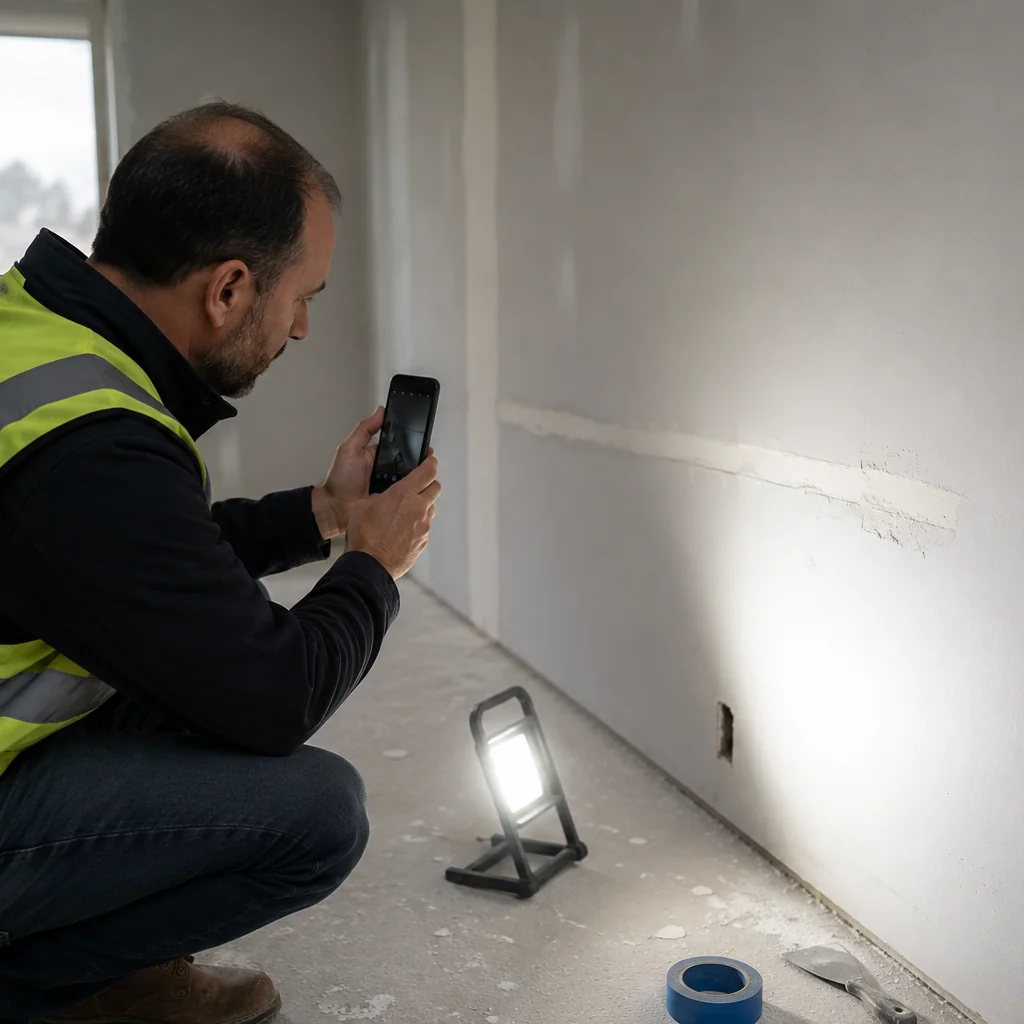
Two to three weeks before the formal owner walkthrough, walk the job yourself and write the list your client would have written. Then fix it. The goal is not to hide anything. It is to hand over a project where the obvious defects are already gone, so the formal list stays short.
Punch lists are psychological as much as technical. A client who finds fourteen items on the first walk starts hunting. A client who finds three assumes the job was built well and stops looking.
Bring raking light. A handheld LED held flat against a wall reveals drywall and paint defects that overhead lighting hides completely, and it catches the item your client would find on a sunny Saturday. Photograph every correction. When a homeowner asks in month four whether the ceiling crack was there at closeout, photo history stored against the project record in a general contractor crm software settles it in thirty seconds instead of becoming a dispute.
Takeaway: budget one superintendent day and two weeks of lead time for the pre-punch. It is the cheapest insurance against a long formal list.
Ready to level up your business?
Try Bella FSM free and transform the way you work.
Write Punch Items Your Subs Can Fix Without Calling You
Most punch lists fail on writing quality, not tracking. "Fix paint in kitchen" guarantees a phone call, a second trip, or both. Every item needs five components before it leaves your hand.
| Component | Weak version | Actionable version |
|---|---|---|
| Location | Kitchen | Kitchen, north wall, left of range hood |
| Defect | Paint bad | Roller lap marks under raking light, 18 in. run |
| Standard | Make it right | Uniform sheen, no visible lap at 24 in. |
| Owner | Painter | Delgado Painting, assigned 8/14 |
| Evidence | None | Photo with tape measure in frame |
The second trip is where punch list profit disappears. A sub who arrives without knowing the defect brings the wrong sheen, the wrong caulk, or no ladder. Treat each item as a discrete assignment with a scope and a deadline, the way you would treat any other work order software record.
Deadlines matter as much as descriptions. Assign a date to every item the moment you create it. Fourteen days works as a default for cosmetic items and thirty days for anything with material lead time. Push those assignments through the same contractor scheduling app your crews already check each morning, so punch work competes for calendar space alongside new production instead of living on a clipboard nobody opens.
Takeaway: if an item does not name a location, a defect, a standard, an owner, and a date, it is not an assignment. It is a reminder to argue later.

Contractor Punch List Management Is a Billing Event
Closeout is not the end of the work. It triggers the largest remaining transaction on the job, and it should be scheduled like one. Substantial completion starts the clock on retainage release, final invoicing, lien waivers, and warranty commencement. Miss the sequence and the money sits.
Build a closeout packet once and reuse it:
- Signed punch list with every item marked complete and dated
- Final lien waivers from every sub and material supplier
- Warranty documents and manufacturer registrations for installed equipment
- As-built notes and approved change order documentation
- Final invoice with a separate retainage release line
Most GCs discover a missing lien waiver on the day they want to invoice, which adds a week. Generating the retainage release invoice directly from the completed milestone in your general contractor invoicing software removes that step, because the milestone and the invoice are one record.
One billing distinction is worth defending hard. A punch item is contract work that was not finished correctly, so you pay for it. A change order is new scope the client requested, so they pay for it. Clients under closeout pressure routinely attach new scope to the punch list, and that undocumented creep is a top cause of margin erosion. Rigorous change order management for contractors keeps a "while you're here, can you also..." request from becoming free labor.
Takeaway: treat substantial completion as a scheduled billing milestone with a document checklist, not a phase that ends whenever the last item closes.
Ready to take your business further?
Start using Bella FSM free and work smarter.
Five Mistakes That Turn a Two-Week Punch List Into a Two-Month One
- No single list. The client texts items, the architect emails items, the super writes on a legal pad. Three lists means no list. Everything belongs in one record on the project.
- No owner per item. A list assigned to "the subs" is assigned to nobody. Every line needs a company name.
- Accepting an open-ended list. If the client keeps adding indefinitely, the job never closes. The formal walkthrough produces the list. Anything found afterward is a warranty item on a separate track.
- Losing the client history. When that homeowner calls fourteen months later about a sticking door, a crew that can pull punch photos and warranty dates from a contractor crm answers in minutes. The crew searching old texts spends an afternoon and still guesses.
- Waiting to invoice. Holding the final invoice until the last item closes hands the client a reason to delay. Invoice at substantial completion with retainage held separately, so contractor billing software keeps the amounts distinct and the larger payment moves on schedule.
Takeaway: most closeout delay is a documentation failure, not a labor failure. Fix the record-keeping and the schedule follows.
Frequently Asked Questions
Close Out Faster, Get Paid Sooner
Contractor punch list management is not a paperwork chore. It is the operational discipline that determines whether your retainage releases in two weeks or two months, whether your subs make one trip or three, and whether your last impression earns a referral or a one-star review. The system is not complicated: inspect at every phase handoff, pre-punch before the owner walks, write items nobody has to call you about, and treat substantial completion as a scheduled billing event with a document checklist attached.
What makes it stick is keeping the list, the schedule, the subcontractor records, and the invoice in one place instead of four. Bella FSM is built for small and mid-size general contractors who need construction-specific tools without enterprise complexity or pricing. Start a free 14-day trial and set up your first project in under an hour.
Ready to grow your business?
Try Bella FSM free and simplify your work.