
Grow Your Business
Lawn Care Drought Services: How to Replace Lost Mowing Revenue When Watering Restrictions Hit

Your Tuesday route has eleven properties on it. On Monday the city moved to two-day-a-week outdoor watering, and by month end six of those lawns will be dormant enough that mowing them is hard to justify. The customer still expects a truck. You still owe the crew eight hours. That squeeze is what lawn care drought services exist to solve, and it appears in more markets every season. Restrictions across Colorado, Texas, California and Arizona have shifted from emergency measures to standing policy. The route your lawn care software built in March no longer matches what the ordinance allows in July, and that gap is your margin.
What a Two-Day Watering Restriction Actually Does to Your Route
Turf on a restricted watering budget grows slower. That is the whole mechanism, and everything follows from it. Cool-season lawns needing a seven-day cut in May stretch to ten or fourteen days by mid-July. Warm-season turf goes semi-dormant and stops asking for the mower.
Run the arithmetic on your own book. Take 220 residential accounts at $52 per visit across a 28-week season. Weekly service produces 28 visits per property. Stretch the interval to ten days and you land near 20. That is eight lost visits per property, roughly $91,500 never invoiced, on a route that costs almost exactly the same to operate.
Almost the same is the part that hurts. Drive time does not shrink when mowing time does, and fuel, insurance, equipment payments and guaranteed crew hours stay fixed against a revenue line that just fell by a third. Most shops find the hole late, because their service scheduling software keeps generating visits on the original cadence and the calendar looks full right up until the skips start.
Takeaway: Compare visit counts per property against the same eight weeks last year. A delta over two visits means repricing mowing alone will not fix it.
Why Cutting Mowing Frequency First Is the Wrong Move
Operators reach for one of three responses, and two are traps.
- Cut frequency and absorb it. Honest, and it hands your fixed costs a bill you cannot pay. Works only if another service line fills the day.
- Hold frequency and mow anyway. Protects the invoice for six weeks, then generates callbacks. Cutting drought-stressed turf at normal height scalps it and invites weed pressure you will fix for free.
- Restructure the offer. Harder conversation up front, and the only one that survives a second dry season.
One technical fix applies regardless of path: raise the deck half an inch to a full inch. Taller blades shade the crown, hold moisture, and cut callbacks on stressed lawns. Tell the customer why, because otherwise a longer lawn reads as a skipped service.
The restructure conversation goes better when you know who to call first. Prioritize properties with in-ground irrigation and prior add-on purchases, since those homeowners already spend beyond the mow and own equipment worth auditing. That segmentation is what a field service crm for small business should produce in a couple of clicks, not a night with a spreadsheet.
Takeaway: Raise mow height today, then list irrigated properties with prior add-on spend.

Five Lawn Care Drought Services That Refill the Route
Restrictions do not remove demand from a property. They move it from the turf to the water system. Every service below bills against work the homeowner now needs.
| Service | Typical price | Crew time | Why it sells |
|---|---|---|---|
| Zone-by-zone irrigation audit | $125 to $350 | 60 to 90 min | Finds heads and zones wasting a limited allowance |
| Smart controller install | $180 to $600 labor | 1 to 2 hours | Rebates often reach $200 residential, $1,000 commercial |
| Drip retrofit for beds | $1,800 to $4,500 | 1 to 2 days | Drip is often exempt from day-of-week spray rules |
| Turf conversion and xeriscape | $4,500 to $15,000 | 3 to 10 days | Permanent fix for lawns that brown out yearly |
| Soil health program | $95 to $250 per visit | 30 to 45 min | Aeration and wetting agents stretch every gallon |
Sequence matters more than menu breadth. The audit is the wedge: short, cheap enough to say yes to over the phone, and it produces a findings list that justifies everything else. A crew documenting four broken heads and two overspray zones has written its own controller and drip proposal, and the customer reads it as diagnosis rather than upsell.
Watch the billing mechanics on rebate work. Most utility programs reimburse equipment on the receipt and exclude labor and tax, so a customer expecting the rebate to cover the job will be unpleasantly surprised. Quote equipment and labor as separate lines, and make sure your field service invoicing software prints that split cleanly enough to hand straight to the utility.
Takeaway: Lead with the audit, price it as an easy yes, and separate equipment from labor on every rebate-eligible invoice.
Ready to level up your business?
Try Bella FSM free and transform the way you work.
Repricing the Agreement Without Triggering Churn
The contract you signed in February decides what a July restriction costs you.
Per-visit agreements track the calendar honestly. Visits drop, revenue drops, and you absorb the entire hit. Flat monthly agreements do the reverse. Revenue holds while service visibly thins, and around the third stretched interval the customer starts counting trucks and calling the office.
The structure that survives both is a season-total agreement with a defined visit band. Commit to a range, say 24 to 30 visits, at a fixed seasonal price, with a water-conditions clause stating that visit timing follows turf growth and municipal restrictions rather than a fixed weekday. Add a line converting visits not needed for mowing into turf health checks or irrigation inspections at no extra charge. The customer keeps a predictable bill, and the crew keeps a reason to be on site.
Send the amendment before the restriction tightens, not after the first skipped mow. Customers accept a change framed as preparation far more readily than one framed as a reaction. Your job scheduling software should flip affected accounts to the new band in bulk, because doing 220 by hand is how a good plan dies in the office.
Takeaway: Move seasonal customers to a visit-band agreement with a water-conditions clause, and send it while the lawns are still green.
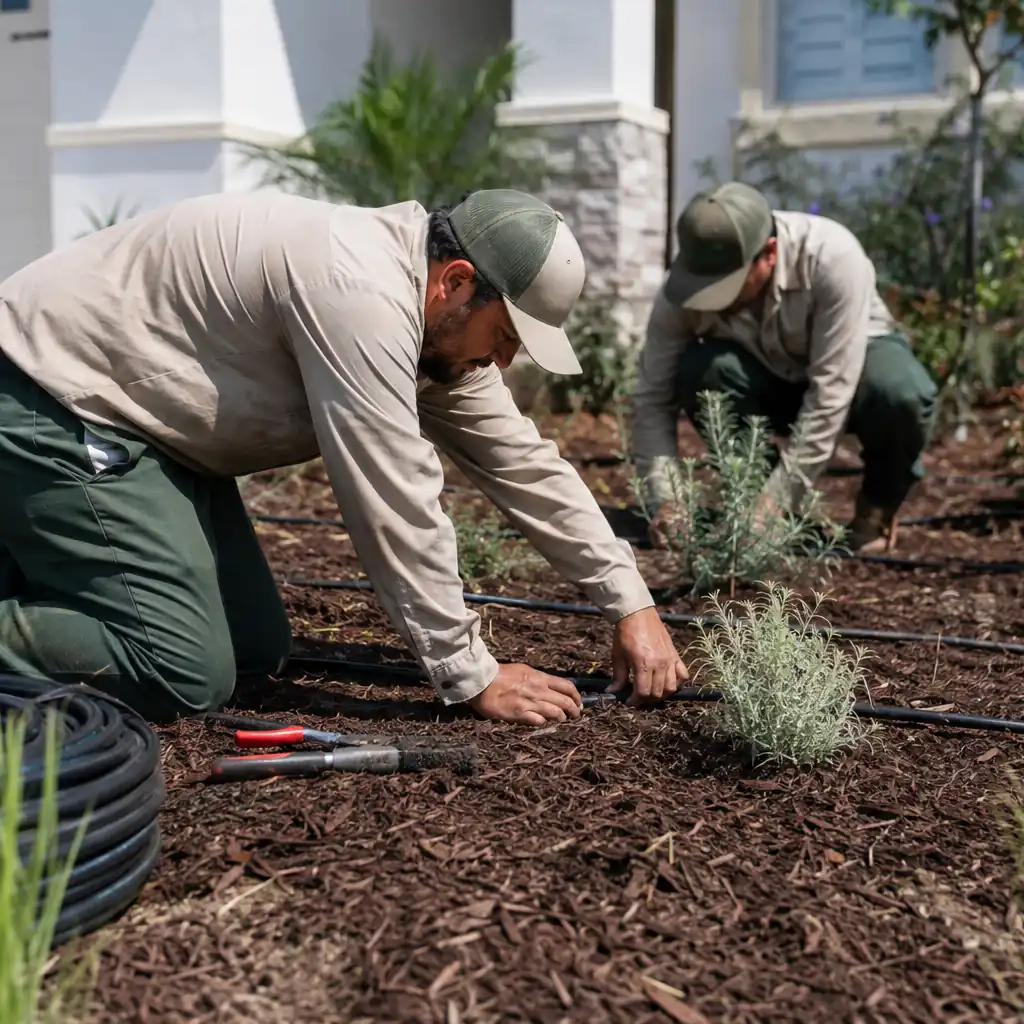
Documenting Compliance So Your Customer Never Gets the Fine
Almost nobody writes about this part, and it is the one that turns into a dispute. When a technician opens a valve to test a zone on a restricted day, the citation goes to the property owner, not to you. First-offense penalties run from a written warning to a few hundred dollars, and repeat violations escalate fast.
Three habits keep that off your desk. Store each municipality's permitted watering days on the customer record, so crews are not guessing which suburb allows what. Require a timestamped photo of the controller screen before and after any zone test. Log manual runs with duration and zone number, so the record shows a brief diagnostic rather than a full cycle.
All three depend on the technician capturing it on site, not reconstructing it that evening. A mobile field service app that attaches photos and notes directly to the job is the difference between a defensible record and a memory.
Restriction days also reshape the route, because irrigation work must land on permitted days while mowing does not care. That breaks routes built purely on geography, so revisit sequencing alongside the principles in our guide to lawn care route optimization.
Takeaway: Store watering days on the customer record, photograph controller interactions, and log manual zone runs.
Ready to take your business further?
Start using Bella FSM free and work smarter.
The Numbers to Watch and the Mistakes That Cost the Most
Four metrics tell you whether the pivot is working. Revenue per stop should hold or climb even as visit counts fall, because the mix is shifting toward higher-ticket work. Billable hours per route-day should stay near spring levels. Add-on attach rate is the leading indicator. Gross margin by service line will surprise you, since turf conversion carries real material cost while audits are nearly pure labor.
The expensive mistakes repeat across shops. Quoting a turf conversion from the driveway without measuring square footage. Promising a rebate amount before confirming the utility still has funds. Selling a controller install without verifying the existing valves work, which turns a two-hour job into a two-day repair. Failing to re-sequence after skips, so crews burn forty minutes of unpaid drive time.
Track it against last season rather than against budget. A dry year is not a bad year if revenue per stop is up and attach rate is climbing, and comparing against a plan written before the restriction existed only proves the plan was wrong. Solid lawn care business software should surface those numbers without exporting anything.
Weather-driven disruption has a familiar shape whichever direction it comes from, and much of this applies when storms rather than restrictions move your calendar. Our breakdown of lawn care rain delay scheduling covers the recovery side of the same problem.
Takeaway: Review revenue per stop, billable hours per route-day, attach rate and margin by service line weekly, against last year.
Frequently Asked Questions
Building a Drought-Resistant Book of Business
Watering restrictions are not a weather event to wait out anymore. They are a permanent feature of operating in a growing share of the country, and the shops treating them as a service design problem instead of a revenue accident are adding accounts while competitors trim crews. A well-built lawn care drought services program keeps trucks productive on days the mower stays on the trailer, moves revenue from a commodity line to a diagnostic one, and gives customers a reason to stay under contract through the driest months.
Start with the two moves that cost nothing: raise your mow height and pull a list of irrigated properties with prior add-on spend. Price an audit, put it in front of that list, and let the findings sell the rest. Bella FSM helps lawn care operators schedule that work, capture proof on site, and invoice it cleanly, so a restricted watering calendar does not have to mean a restricted season.
Ready to grow your business?
Try Bella FSM free and simplify your work.