
Grow Your Business
OSHA Window Cleaning Requirements: 2026 Rules, Penalties, and State Breakdown
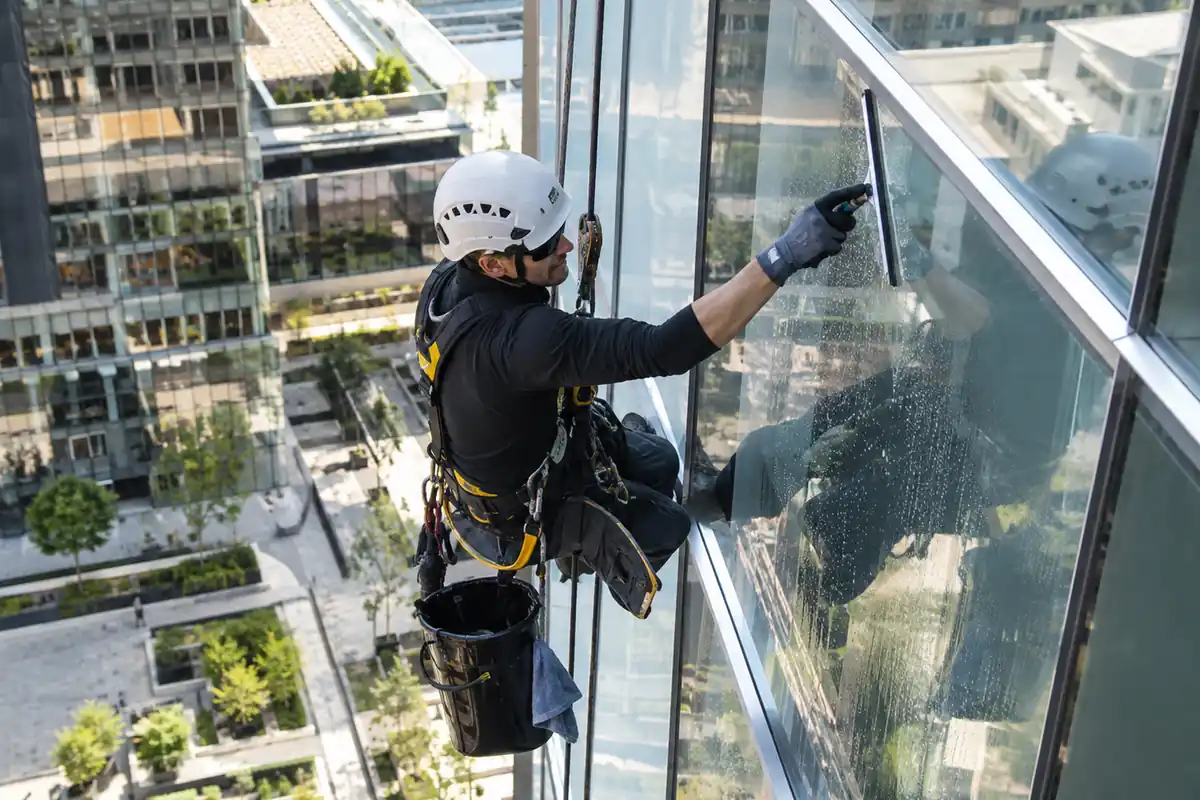
A property manager calls on Monday and wants a crew on a twelve-story glass face by Thursday. Before you quote it, one question decides whether the job is legal to take: has the building owner certified the roof anchors in writing? OSHA window cleaning requirements put that single document on the critical path. The cost of guessing is steep. The federal maximum penalty for a willful or repeated violation is $165,514, and OSHA's own penalties page shows the amounts set in January 2025 carrying into 2026 with no inflation adjustment. Most crews that lose a high-rise account do not lose it on price. They lose it because the paper trail behind the work is thin, and keeping that trail is what window cleaning software exists to do.
What do OSHA window cleaning requirements actually cover?
Federal window cleaning rules live in 29 CFR 1910 Subpart D, and the section governing high work is 1910.27, "Scaffolds and rope descent systems." It places one duty on the building owner and a list of them on the employer. The owner has to identify, test, certify and maintain every anchorage to hold at least 5,000 pounds in any direction for each attached worker, then tell the employer so in writing before any rope descent system is used. The employer has to keep that written information for the duration of the job, train every operator under 29 CFR 1910.30, inspect the system at the start of each workshift, put each worker on a separate independent personal fall arrest system, and secure every squeegee and bucket with a tool lanyard. None of it is optional on commercial work.
| Requirement | What 1910.27(b) says |
|---|---|
| Anchorage strength | At least 5,000 pounds in any direction, for each employee attached |
| Certification cycle | Annual inspection by a qualified person; certification at least every 10 years |
| Written information | Owner informs the employer in writing before use; employer keeps it for the job's duration |
| Compliance date | Anchorage and written-information duties took effect November 20, 2017 |
| Maximum height | No rope descent above 300 feet above grade unless no other means is feasible |
| Stabilization | Required at the work location for descents greater than 130 feet |
| Fall arrest | Each worker on a separate, independent personal fall arrest system |
| Equipment checks | System inspected at the start of each workshift; damaged gear removed immediately |
| Dropped objects | Tools, squeegees and buckets secured by tool lanyard |
Source: 29 CFR 1910.27(b), Occupational Safety and Health Administration, text current as of the September 2026 eCFR edition.
Two of these catch small crews more than the rest. The 130-foot stabilization line catches anyone moving from four-story storefront work up to mid-rise, because gear that was fine at 90 feet is not sufficient at 140. Your gear list drives that, so revisit which tools belong on the truck before you bid the taller building.
Turn 1910.27(b) into a ten-line checklist your lead tech signs at the start of every suspended job.
Who certifies the anchors, the building owner or the contractor?
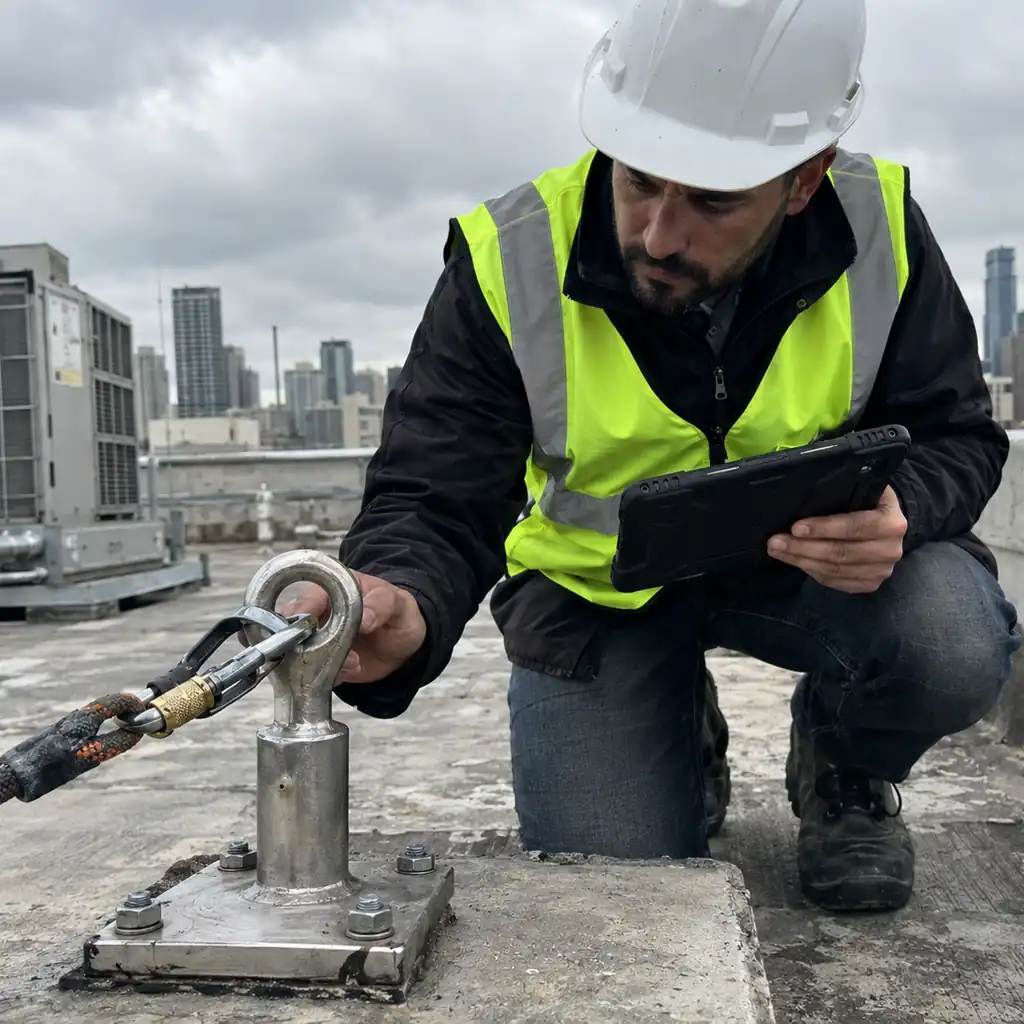
The building owner certifies; the contractor verifies and refuses. That split is the most misunderstood part of the standard, and it puts small window cleaning companies in an awkward commercial position. Under 1910.27(b)(1)(i) the duty to identify, test, certify and maintain anchorages sits with the building owner, based on an annual inspection by a qualified person and certification at least every ten years. But 1910.27(b)(1)(ii) puts the enforcement burden on you: the employer must ensure no employee uses any anchorage before the employer has obtained that written information. If the owner never produced it, OSHA cites the contractor whose worker was on the rope. A property manager saying "they were fine last year" is not written information, and a maintenance log is not a certification. You need a document naming the anchorages, stating the 5,000 pound capacity, and identifying the qualified person behind it.
What the written assurance has to contain
At minimum it identifies each anchorage, confirms testing and maintenance, states capacity of at least 5,000 pounds in any direction per attached worker, and rests on an annual inspection by a qualified person. Anything vaguer is a gap you will be asked about later.
That paperwork belongs with the account, not in a job folder that disappears when the crew changes. Certification dates, qualified-person contacts and expiry are facts about a building, so they belong beside the site contact and the gate code. Companies keeping them in window cleaning crm software answer an inspector in a minute instead of calling the property manager back.
What to do when the owner has nothing on file
Three honest options, and none of them is "go anyway." Bid the building with an alternative access method such as a boom lift or water-fed pole where the height allows. Quote it contingent on the owner commissioning an anchor certification, which takes weeks. Or decline in writing. Contractors who put the third option on the table usually get one of the first two back.
Make "anchorage certification on file, dated within ten years" a bid qualifier on suspended-access proposals.
Ready to level up your business?
Try Bella FSM free and transform the way you work.
What a violation costs in 2026
OSHA's published maximum penalties did not move this year. The agency's penalties page lists amounts assessable after January 15, 2025, and those figures apply through 2026 because the October 2025 Consumer Price Index data needed for the annual adjustment was never published. That makes 2026 the first year since OSHA began annual adjustments in 2016 without an increase.
| Violation type | Maximum penalty (2026) |
|---|---|
| Serious | $16,550 per violation |
| Other-than-serious | $16,550 per violation |
| Posting requirement | $16,550 per violation |
| Failure to abate | $16,550 per day beyond the abatement date |
| Willful or repeated | $165,514 per violation |
Source: OSHA, "OSHA Penalties", amounts effective after January 15, 2025 and unchanged for 2026; osha.gov/penalties, accessed September 2026.
The fine is the smaller half of it. A fall protection citation follows you into every commercial prequalification questionnaire for years, and property managers screen for it. That matters most on the recurring accounts that carry a route, which is why the contract structure behind a year-round maintenance program deserves the same care as the safety file.
For scale: the Bureau of Labor Statistics recorded 356 fatal work injuries among building and grounds cleaning and maintenance workers in 2024, up from 337 in 2023, inside a national total of 5,070 that fell 4.0 percent year over year. The occupational group containing window cleaners moved the wrong way in a year the country moved the right way.
How many anchorage certifications expire on your route each year?
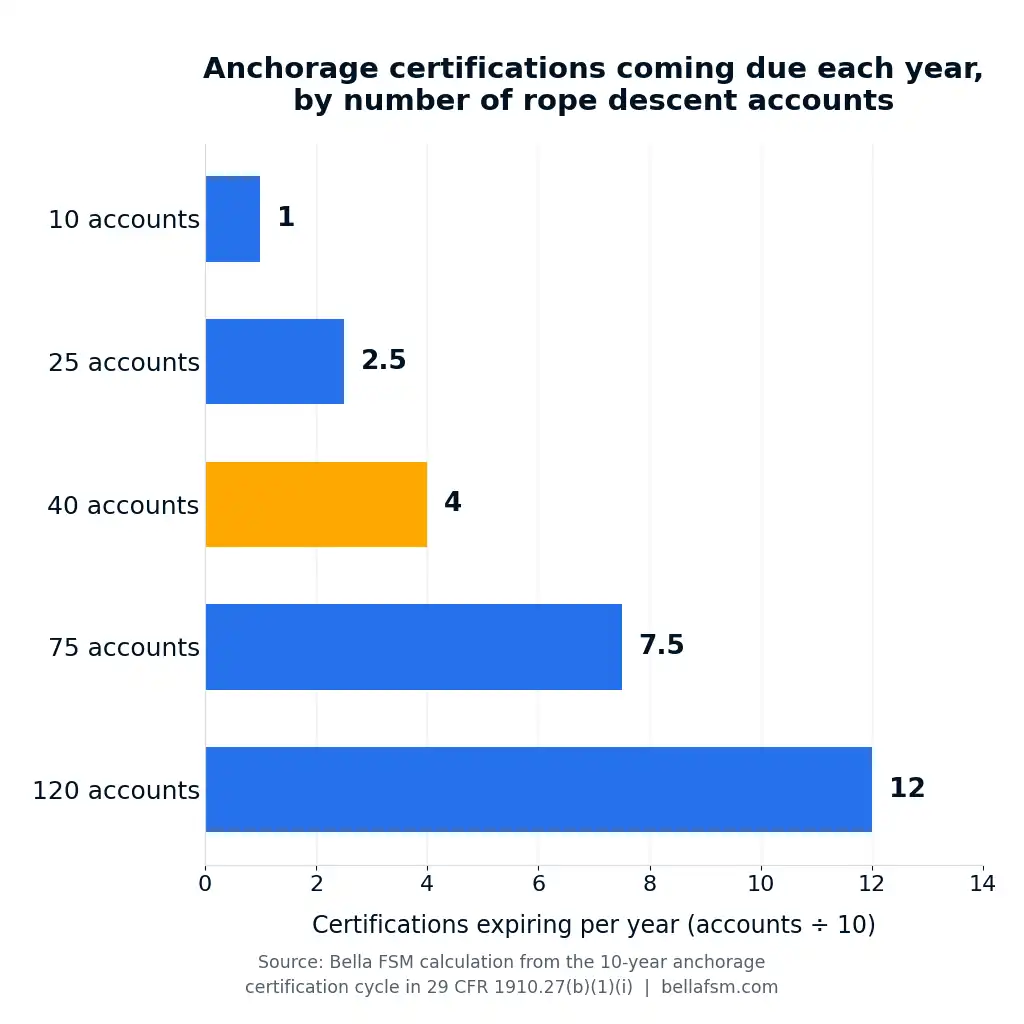
This is worth doing on paper once, because the answer determines whether compliance is a calendar item or an emergency. The ten-year certification cycle in 1910.27(b)(1)(i) means that across a stable book of suspended-access accounts, roughly one tenth of your buildings hit a certification expiry every year. The annual inspection obligation is heavier: every account, every year, without exception. A route of forty rope descent buildings therefore produces about four certification renewals and forty inspection confirmations annually, plus forty written assurances to collect and file. Spread across twelve months that is a small recurring task. Discovered all at once in March, when three property managers want spring service in the same week, it becomes the reason crews sit idle in the yard waiting on a document nobody owns.
The formula is simple: certifications expiring per year = rope descent accounts ÷ 10, and annual inspections to confirm = rope descent accounts.
| Rope descent accounts | Certifications expiring per year | Annual inspections to confirm | Written assurances to collect |
|---|---|---|---|
| 10 | 1 | 10 | 10 |
| 25 | 2.5 | 25 | 25 |
| 40 | 4 | 40 | 40 |
| 75 | 7.5 | 75 | 75 |
| 120 | 12 | 120 | 120 |
Source: Bella FSM calculation applying the 10-year certification and annual inspection cycle in 29 CFR 1910.27(b)(1)(i). Arithmetic projections for a stable account list, not survey data.
Count your rope descent accounts, divide by ten, and calendar that many certification reviews for next year now.
Chart: anchorage certifications coming due each year, by route size. This chart may be embedded with attribution to Bella FSM and a link to this page.
How state rules change the picture
Federal 1910.27 sets a minimum that several states build on. OSHA's State Plans directory lists 22 State Plans covering private sector workers and seven covering only state and local government employees. In the 22, state standards must be at least as effective as federal OSHA, and a few go considerably further for window cleaning specifically.
| Jurisdiction type | Count | What applies to a private window cleaning contractor |
|---|---|---|
| State Plans covering private sector workers | 22 | State standards, at least as effective as federal OSHA; may add window-cleaning-specific rules |
| State Plans covering only state and local government | 7 | Private contractors remain under federal OSHA |
| Federal OSHA jurisdiction | All remaining states and territories | 29 CFR 1910 Subpart D applies directly |
Source: OSHA State Plans directory, osha.gov/stateplans, accessed September 2026.
California: written assurance plus an OPOS
California has a dedicated window cleaning article in Title 8, and §3282 goes past the federal rule in three ways. Building owners must give the employer written assurance covering anchors, fittings, load capacities and stabilization before use. That equipment must be inspected at least every 12 months rather than certified every ten years. Owners of buildings 36 feet or taller must also produce an Operating Procedures Outline Sheet when the building lacks established procedures or has architecture requiring complex rigging.
Washington: a whole chapter of its own
Washington maintains WAC 296-878, "Safety Standards for Window Cleaning," a standalone chapter last amended effective October 1, 2020, with sections on training, pre-job area inspection, carabiner and rope selection, boatswains' chairs, power line clearances, and rope descent systems. The requirement out-of-state crews miss most often is the site-specific service and emergency recovery plan: a written per-building document, not a company policy.
Multi-state crews feel this in dispatch before the office feels it. A tech qualified under one state's plan is not automatically the right tech for a building across the border, so jurisdiction has to be visible when the day is built. Window cleaning scheduling software that carries crew qualifications alongside the route stops the wrong assignment before it happens.
Keep one compliance sheet per state you work in, and review it whenever you add a state.
Ready to take your business further?
Start using Bella FSM free and work smarter.
Building the compliance record into the job, not the file cabinet
Every OSHA duty on this page produces a document, and each one already has a natural home in a record you create anyway. The written assurance belongs to the building, the workshift inspection to the visit, the training record to the technician. Companies that treat safety paperwork as a separate binder end up maintaining two systems and trusting neither of them.
The cleanest version is a pre-job checklist attached to the job itself. The lead tech confirms the written assurance is on file and dated, confirms the anchorage inspection is within twelve months, records the workshift equipment inspection, and notes weather, since 1910.27(b)(2)(xi) prohibits rope descent work in gusty or excessive wind. Run inside work order management software, that record is timestamped and attached without anyone filing anything.
What the documentation is worth commercially
Commercial buyers now ask for the safety file during procurement, not after an incident. A contractor who can produce dated anchorage assurances, current training records and per-visit inspection logs competes on something price-shoppers cannot match. It also shortens payment cycles. Window cleaning invoicing software that attaches job documentation to the invoice removes the follow-up entirely.
Administrative load is the quiet cost. A forty-account route generates roughly 120 compliance artifacts a year once you count assurances, inspections and training refreshers. Handled by hand that is a part-time job. Handled as a byproduct of work the office is already recording, it costs almost nothing.
If a safety document lives only in a binder, assume it will be missing on the day you need it.
Methodology and sources
Every federal requirement here was read from the regulation text rather than a secondary summary. Rope descent provisions come from 29 CFR 1910.27(b) as published in the eCFR, current as of the September 2026 edition, and training duties from 29 CFR 1910.30. Penalty amounts come from OSHA's penalties page, which lists maximums assessable after January 15, 2025; those carried unchanged into 2026 because the October 2025 Consumer Price Index figure required for the statutory adjustment was not published. Jurisdiction counts come from OSHA's State Plans directory. California provisions come from California Code of Regulations, Title 8, §3282, and Washington provisions from WAC 296-878 as amended effective October 1, 2020. Fatality figures come from the BLS Census of Fatal Occupational Injuries for 2024, using the building and grounds cleaning and maintenance group, the closest published group containing window cleaners; BLS publishes no separate window cleaning series. The certification-volume table is arithmetic derived from the regulation's own cycle and labeled as such. This page is reviewed each September.
Media & citation: data on this page may be cited with attribution to Bella FSM and a link to this page.
Window cleaning OSHA questions we get asked most
Frequently Asked Questions
Turning the rules into a working system
OSHA window cleaning requirements are not complicated, but they are unforgiving about evidence. The rules want a written assurance before the rope goes over the parapet, a trained operator, an inspection at the start of the shift, and proof that all three happened. Generate those records while you dispatch and bill the job and the evidence is already sitting there when an inspector or a property manager asks. That is the case for purpose-built window cleaning business software instead of a spreadsheet and a filing cabinet. Bella FSM was built for this kind of documented, recurring field work.
Ready to grow your business?
Try Bella FSM free and simplify your work.