
Grow Your Business
Two carpet cleaners can work the same street on the same day and take home very different money. One charges $99 for three rooms because a franchise down the road ran a coupon. The other quotes $189 for the same work, books it, and still gets the referral. The difference is rarely talent with a wand. Knowing how to price carpet cleaning jobs means anchoring every quote to your real costs, the method you will run, and a minimum that keeps small jobs worth the drive. This guide covers current 2026 rate data, the per room versus per square foot decision, and the add-ons that quietly carry your margin. Operators who get this right treat pricing as a system they run inside their carpet cleaning software, not a number they guess at the front door.
Where carpet cleaning pricing goes wrong
Most pricing problems trace back to a handful of habits. The most common one is matching coupon prices from national franchises. A $99 three-room special is a loss leader built to put a technician in the house, where the real ticket gets built from protectant, deodorizer, and upholstery. If you match the coupon without the upsell engine behind it, you inherit the loss and skip the recovery.
The second habit is quoting whole homes over the phone with no square footage. Callers describe a "small living room" that turns out to be 400 square feet with a hallway and two walk-in closets attached. The third is treating every method as if it costs you the same to deliver. Hot water extraction burns more fuel, more water, and more time per room than low-moisture work, and a price list that ignores that difference subsidizes your hardest jobs with your easiest ones.
The takeaway: never publish a price you have not tested against your own cost per job hour. Everything below builds on that number.
How much should you charge for carpet cleaning in 2026?
Most professional carpet cleaning jobs in 2026 land between $123 and $242, with a national average of $183, according to Angi's carpet cleaning cost guide, updated in August 2026. The same guide puts per room rates at $40 to $125 and square foot rates at $0.20 to $0.90, depending on method, carpet material, and local labor costs. Treat those numbers as the market band your customers see when they compare quotes, not as a target. A solo operator carrying roughly $60 an hour in true costs for fuel, solution, insurance, and equipment payments needs to sit near the top of that band to clear a real profit. Start from the market range, then adjust for your metro, your soil conditions, and how many of your jobs arrive with pets, stairs, or heavy furniture attached.
The floor matters more than the ceiling. Angi reports industry minimum service fees of $75 to $125, and established operators in busy metros often set theirs higher. A minimum only protects you when the stop fits your day, so route small jobs in carpet cleaning scheduling software that stacks them in the same zip code instead of scattering them across town.
If a job cannot clear your minimum after drive time, it is marketing, not revenue. Price it like you do not need it.
Should you price per room or per square foot?
Price residential work per room and commercial work per square foot. That is where most profitable operators land, and the market data backs the split. HomeGuide's 2026 cost data puts the average professional rate at $0.25 to $0.50 per square foot, and notes that most companies define a room as 200 to 250 square feet. Per room pricing wins on the phone because a homeowner can count rooms and you can quote in thirty seconds, while square footage protects you on commercial work where one "room" might be 3,000 square feet of open office. The hybrid rule that keeps both models honest is a room-size cap: any room over 250 square feet gets billed as two. Publish the cap up front. It converts your biggest quoting risk into a line item the customer can verify with a tape measure.
When per room pricing wins
Per room is faster to quote, easier to advertise, and simpler for a crew to apply without calling the office. Volume discounts keep it competitive: HomeGuide's per room tiers run from $100 to $150 for a single room down to $40 to $50 per room at five rooms, which rewards the whole-house booking your route economics prefer.
When square footage wins
Square footage earns its keep on empty rentals, offices, and any job booked by a property manager who already knows the floor area. Measure once with a laser, and the number stops being an argument. Store room counts, measurements, and fiber notes in carpet cleaning CRM software so a repeat clean or a move-out quote takes one phone call instead of a second site visit.
Ready to level up your business?
Try Bella FSM free and transform the way you work.
Price the method, not just the space
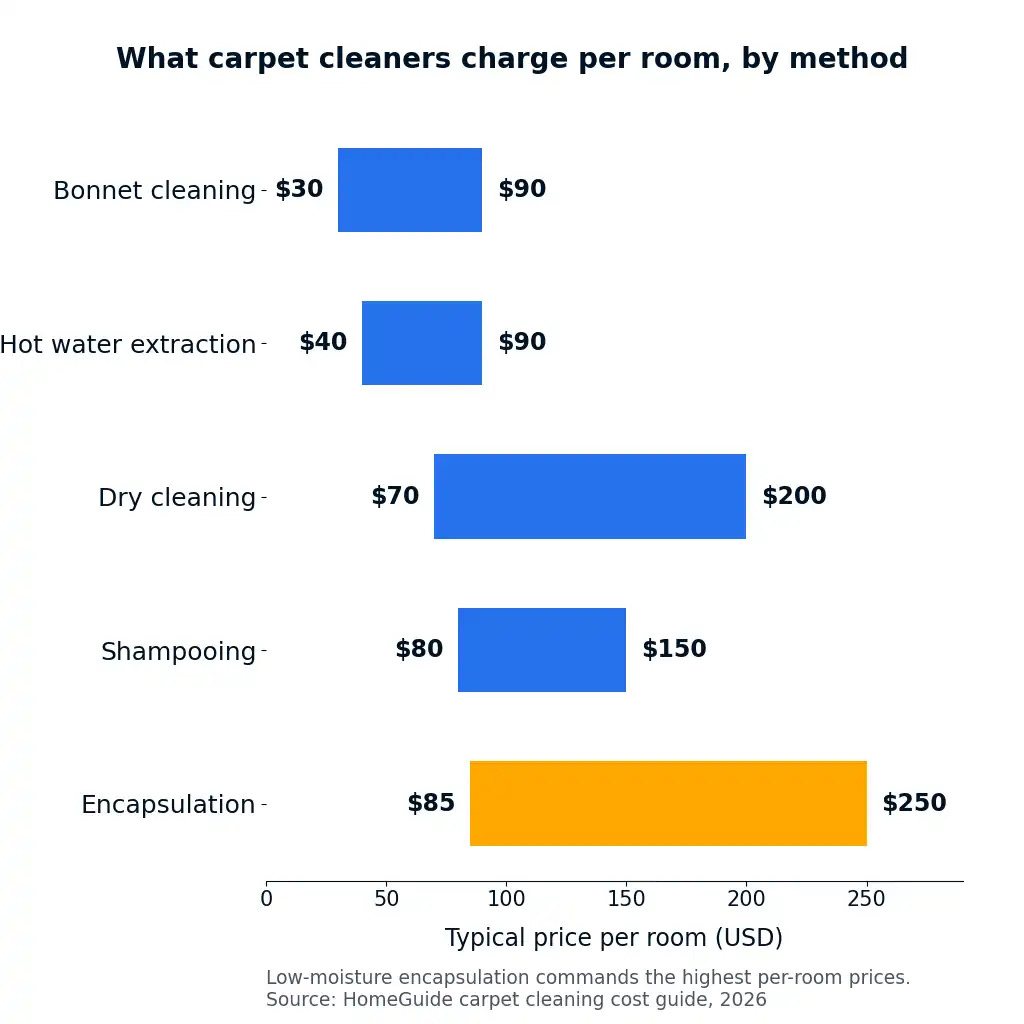
Methods carry different costs, different dry times, and different perceived value, and your rates should say so. HomeGuide's cost data shows how wide the per room spread runs by method:
| Cleaning method | Typical price per room | Operator notes |
|---|---|---|
| Bonnet cleaning | $30 to $90 | Surface clean, fast dry, commercial maintenance |
| Hot water extraction | $40 to $90 | The anchor residential service, longest dry time |
| Shampooing | $80 to $150 | Heavy soil, older equipment still common |
| Dry cleaning | $70 to $200 | Fast dry, good for delicate fibers |
| Encapsulation | $85 to $250 | Low moisture, strong commercial margin |
Two patterns matter in that table. Hot water extraction, the method most residential customers ask for by name, sits at the low end of the spread even though it costs the most to deliver per hour. Encapsulation and dry methods command higher per room prices while using less water and less truck time, which is why low-moisture work has become the margin play on commercial accounts. Natural fibers move the whole table: wool and cotton typically run about 30% more per HomeGuide, and they deserve a listed surcharge rather than a wince at the door.
Your own numbers beat the national spread. Operators who run every job through carpet cleaning business software can compare quoted price against actual time on site for each method, then reprice the ones that consistently run long. Do that once a quarter and the price list starts reflecting your trucks, not a national average.
Minimum charges, stairs, and the add-ons that protect margin
Set your minimum charge at $100 to $150 and stop apologizing for it. HomeGuide's data shows carpet cleaners typically carry a $100 to $150 minimum job fee, and the logic is fixed cost, not greed. Every stop pays for the same truck roll: drive time, setup, hose runs, teardown, and the insurance meter that runs whether you clean one room or six. A $75 single-room job that consumes 90 minutes door to door pays worse than staying home once fuel and solution come out. The minimum converts your smallest jobs from quiet losses into acceptable fill work between larger stops. Post it on your website, state it on the phone before you quote anything else, and give the caller a reason to add a second room or a hallway to get past it. Most will.
Add-on pricing that holds up
Add-ons are where thin base rates go to get rescued. Angi's guide prices odor treatment at $20 to $40 per room, protectant at $10 to $40 per room, and stain removal at $40 to $300 depending on severity, while stairs run $2 to $5 per step. HomeGuide adds furniture moving at $25 to $75 per room when the customer has not cleared the space. None of those numbers work as mumbled extras. Itemize each one in carpet cleaning invoicing software so the customer sees protectant and pet treatment as priced line items, and the technician collects on site instead of mailing a surprise.
Which extras deserve a slot on your menu is its own decision. Our guide to carpet cleaning add-on services breaks down the ones that sell best when a cleaning crew is already in the house.
Ready to take your business further?
Start using Bella FSM free and work smarter.
How to price carpet cleaning jobs consistently: build one rate card
Picture a two-truck operation that quotes from memory. The owner prices a wool-heavy colonial at his usual rate, a tech quotes a repeat customer the 2023 price out of habit, and the office splits the difference on a commercial bid. Three prices, one company, and the spread costs more than any coupon ever did. The fix is one rate card: a base per room rate with the 250 square foot cap, a commercial square foot rate, the minimum, the per-step stair rate, and a short add-on menu with firm numbers.
Then make the card impossible to avoid. Attach it to every ticket in your work order management software so the technician quoting an upsell in the living room uses the same numbers as the office. Review the card twice a year against your actual job times and your costs, and version it like the business document it is.
If margins still look thin after a reprice, read our breakdown of whether carpet cleaning is a profitable business. It walks through where the money usually leaks, and pricing is only one of the holes.
Frequently Asked Questions
Stop quoting from memory
Learning how to price carpet cleaning jobs is not a one-time exercise. The market band gives you a starting point, your own job costs tell you where in the band you belong, and a single rate card keeps every truck quoting the same numbers. Build the card, put the minimum in writing, price the method instead of the myth, and let add-ons carry the margin they were designed to carry. Bella FSM gives carpet cleaning operators one place to run the schedule, the customer records, the work orders, and the invoices those prices live on, and it takes minutes to try.
Ready to grow your business?
Try Bella FSM free and simplify your work.