
Grow Your Business
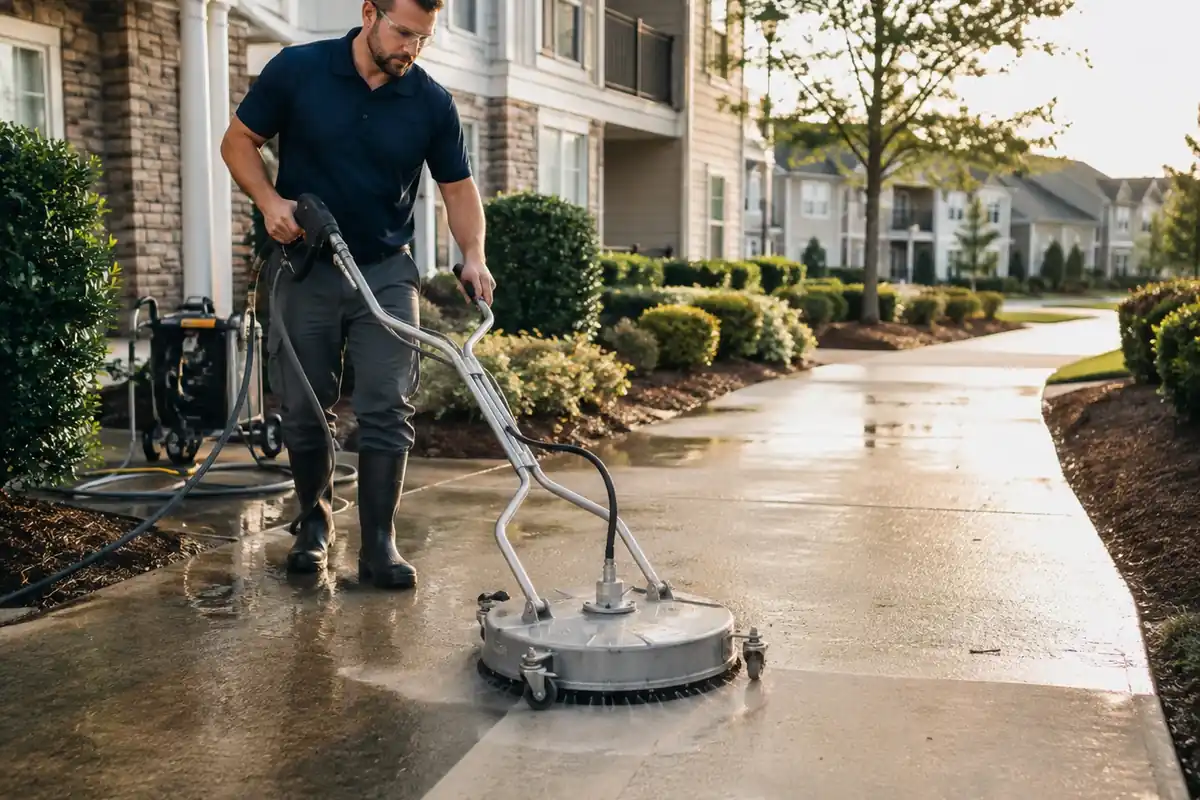
A property manager emails on a Tuesday asking for a bid on eleven buildings, two pool decks, and roughly 14,000 square feet of common sidewalk. She needs the number by Friday. You have never walked the property and nobody has said who pays for the water. Most owners fire back a fast guess and regret it for the next two years. HOA pressure washing contracts are the steadiest recurring revenue in exterior cleaning, but only for operators who treat the bid as an operations problem rather than a pricing exercise. The crews that win run the scope, the calendar, and the paperwork out of one place, and pressure washing software is what turns an eleven-building scope into a route a two-person crew can finish.
What HOA pressure washing contracts change about your business
Residential work is transactional. Someone sees algae on their siding, calls three companies, picks one. Association work is procurement. A board compares written scopes, checks insurance, and signs an agreement that outlives the person who signed it.
The revenue profile changes too. Annual association scopes commonly land between $3,500 and $12,000 per community, and operators built around commercial and HOA accounts often run past 70 percent recurring revenue. That matters more every year, with customer acquisition costs climbing 8 to 15 percent annually.
Then there is who you are selling to. One community can involve four people who each believe they are the decision maker: the board president, the maintenance committee chair, the on-site manager, and the accounts payable clerk at the management company. Keeping all four on one property record, with notes on who approves what, is the job pressure washing crm software exists to do. Decide which business you want before you quote your first association.
Bid during budget season or wait a year
Associations do not buy when you are ready to sell. They buy on a fiscal calendar, and most companies learn that the expensive way.
For calendar-year associations, budget season runs September through November. Boards start 90 to 120 days before year end and approve at least 30 days before the new fiscal year begins. Many put existing contracts out to bid three to six months ahead of that, even for vendors they intend to keep. A proposal arriving in February arrives after the money is allocated. Boards that deferred a decision often revisit vendors between January and March, a smaller and less crowded window.
Build a list of every association in your area with its fiscal year end, current vendor, and renewal date. Those dates are the cheapest sales tool in the business, and they belong on the customer record rather than in somebody's phone.
Then plan for what winning looks like. Once four communities all want their spring wash inside the same six-week window, your constraint stops being sales and becomes capacity. That is a scheduling problem, and pressure washing scheduling software is what keeps a good spring from becoming six weeks of overtime.
Write a scope that protects your margin
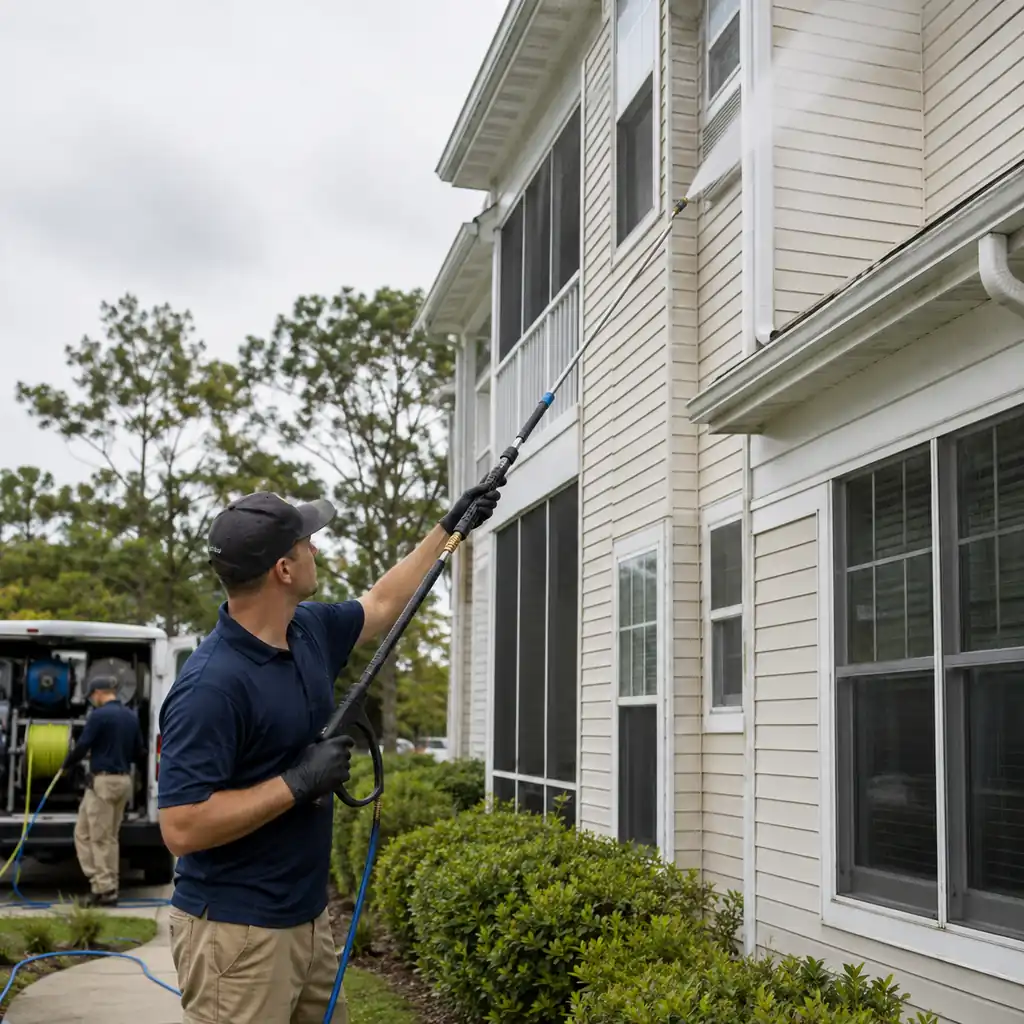
A vague scope is how a profitable contract becomes a two-year argument. Every bid should list each surface by location, approximate square footage, cleaning method, and frequency, and specify pressure and chemistry on anything delicate. Vinyl siding, painted wood, and stucco all take damage from direct high-pressure spraying.
| Common area surface | Typical method | Typical frequency | Scope note that saves you later |
|---|---|---|---|
| Sidewalks and entry hardscape | Surface cleaner, high pressure | Quarterly to semiannual | State whether gum and oil removal is included |
| Building facades and soffits | Soft wash | Annual | List the PSI ceiling for painted surfaces |
| Pool deck and clubhouse exterior | Mixed | Semiannual | Note existing spalling and cracked coping |
| Mailbox kiosks, signage, fences | Low pressure | Annual | Count units, never "as needed" |
| Roofs and overhangs | Soft wash only | Every 2 to 3 years | Price separately from the base program |
Write the exclusions as plainly as the inclusions. Rust removal, efflorescence, paint overspray, and heavy oil staining are separate line items in every profitable shop. So is water: confirm in writing whether the association supplies water and power.
Scope creep is the largest single margin leak on association work, and it never arrives as a big request. It arrives as a board member asking whether you can just hit the extra fence by the tennis court. Handle it as a change order with its own line, so pressure washing invoicing software can bill it against the same account without reopening the annual agreement.
Photograph and measure everything during the walkthrough. Two years on, when a new board member asks why the pool deck looks patchy, your pressure washing crm is the only place anyone still remembers the concrete was already spalled the day you first walked it. If a line in your scope could be read two ways by someone who was not there, rewrite it.
Ready to level up your business?
Try Bella FSM free and transform the way you work.
Price the annual program, not the visit
Boards generally see two models: per-visit pricing, and an annual program at a locked rate. Per-visit looks cheaper on the page and is worse for both parties. Your revenue goes lumpy, their budgeting becomes guesswork, and every quarter invites a fresh price comparison.
Ground the annual number in real rates. Flatwork generally runs $0.15 to $0.75 per square foot, with most work between $0.20 and $0.50. Soft washing prices 10 to 20 percent above straight concrete cleaning because of chemical cost. Run those against the 180-unit community above:
- 14,000 square feet of sidewalk at $0.18 per square foot, cleaned quarterly, is roughly $10,000 a year
- Two pool decks of about 2,200 square feet each, twice a year at $0.22, adds roughly $1,900
- Eight facades soft washed annually at $0.35 per square foot, priced off elevation area rather than footprint
That is how a $12,000 scope gets built, and how you learn early that a community wants $18,000 of work on a $9,000 budget. For the underlying rate logic and how to adjust for soil load and surface age, our guide on how to price pressure washing jobs goes deeper than a contract article should.
Two clauses belong in every annual agreement: an escalator tied to a published index or set at a flat 3 to 5 percent, so a three-year contract does not quietly become a pay cut when sodium hypochlorite prices move, and monthly billing rather than payment on completion.
Then price your own execution honestly. A community you can clean in one mobilization is worth more than the same square footage split across three visits because of parking rules. Pressure washing dispatch software that shows crew hours against contract value is how you tell a good account from a merely busy one.

Clear the vendor compliance hurdles before you unload
Property managers eliminate uninsured vendors during selection, not after. Send your certificate of insurance with the bid.
Most associations expect $1 million to $2 million per occurrence and $2 million to $3 million aggregate in general liability, plus workers compensation and commercial auto. The coverage is not the obstacle people expect: pressure washing companies pay roughly $75 a month, about $895 a year, with most policies between $500 and $1,500 annually. The endorsement is the step people miss. Add each association and its management company as an additional insured before the crew arrives, then email the updated COI to the property contact.
Wastewater separates serious bidders from the rest, especially on pool decks and any sloped hardscape draining to a storm inlet. If you are not already handling reclamation, read up on pressure washing wastewater compliance before you sign something naming you responsible for runoff.
Then comes the unglamorous list that decides whether the crew has a good day: gate codes, amenity keys, parking restrictions, irrigation schedules, resident notification. Most associations want residents told 48 to 72 hours ahead so cars and patio furniture get moved. Name who sends that notice in the contract.
Solve the payment friction too. Management companies pay on their own cycle, and a missing W-9 or the wrong AP email turns 30 days into 75. Storing remittance details per property in your pressure washing billing software removes most of that delay.
Ready to take your business further?
Start using Bella FSM free and work smarter.
Run the contract so the board renews without a re-bid
The board member who championed you will probably be gone within two years. Associations hold elections and managers change companies. Your relationship is not with a person, so it has to live in a file.
Close every visit with proof: date, crew, times, before and after photos, and any exception noted on the spot. Work order management software that captures that from a phone in the field means you are not reconstructing a year from memory when a new treasurer asks what the association got for $11,000.
Send a one-page annual recap 30 days before budget season: visits completed, square footage cleaned, and any condition the board should plan for. Pulling that from pressure washing business software takes minutes; rebuilding it from a year of text messages takes an afternoon.
Density is the last piece. Two associations six minutes apart are worth more than two thirty minutes apart, and the second community in a corridor carries far less drive time than the first. The thinking behind pressure washing route optimization applies just as well to which contracts you chase.
Frequently Asked Questions
Turning one contract into a book of them
The first association is the hardest. You are learning the procurement rhythm, writing a scope tight enough to defend, and finding out what your crew can finish in a day on unfamiliar ground. By the fourth you have a template, a route, and a reference the next board will call.
HOA pressure washing contracts are won on a written scope and kept on documentation, and both depend on whether your scopes, photos, and invoices sit in one place instead of five. Bella FSM is pressure washing service software built for companies making exactly that transition. See how it fits your operation before the next budget season starts.
Ready to grow your business?
Try Bella FSM free and simplify your work.